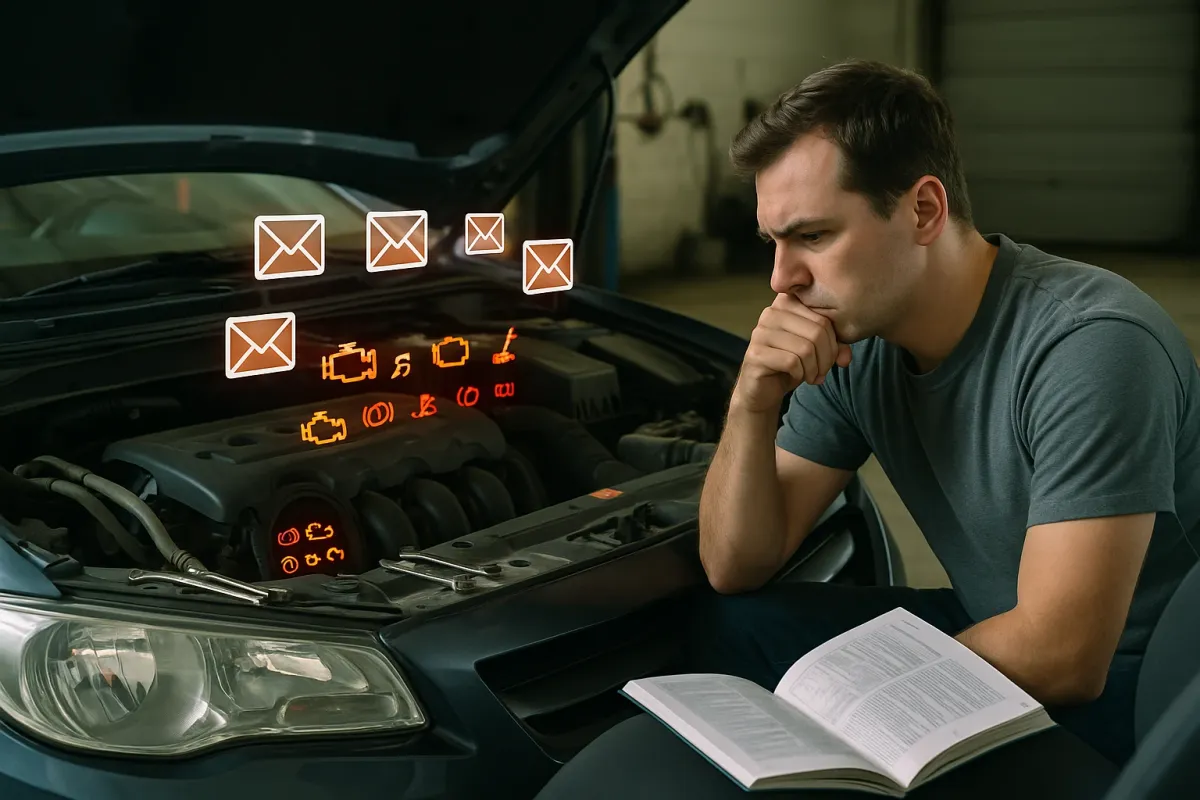
Your car works exactly the same way.
Every squeak, warning light, odd vibration, or overdue reminder is basically your vehicle sending you an email. Ignore enough of them, and you don’t just get an annoying situation—you get a breakdown, a tow truck, and a repair bill that could’ve been avoided with simple, cheap maintenance.
Below are five “messages” your car sends you all the time—and how to respond before they turn into automotive disaster.
1. The “Unread Email” You Ignore: Your Oil Life and Service Light
Most modern cars track oil life or show a maintenance reminder based on mileage or driving conditions. When that light pops up, it’s not a suggestion; it’s a deadline reminder. Automakers like Honda, Toyota, and Ford have built-in maintenance minder systems that factor in engine temperature, trip length, and even driving style. But many drivers treat that reminder the way they treat a long, stressful work email—they mentally mark it “later” and then forget.
Actionable tips:
- Know your interval, not just the sticker. If your manual says 7,500–10,000 miles for synthetic but you only drive short trips or sit in heavy traffic, consider changing closer to 5,000–7,500 miles. Short trips are “severe service.”
- Use the dipstick, not just the dash. Check your oil level and color monthly. Low or very dark, sludgy oil means you’re way past “reply now” territory.
- Don’t reset the light without the service. Some people reset their service light after topping off oil or changing it late, just to get rid of the notification. That’s like deleting your boss’s email without actually doing the work.
- Pay attention to new noises after an oil change. Ticking, knocking, or leaks in the driveway after service are your car saying, “Something went wrong—double‑check the work.”
- Stick to a consistent oil type. Jumping between random brands and viscosities because one was on sale is like constantly changing project tools mid‑deadline. Pick an approved synthetic that meets your manufacturer’s spec and stay with it.
2. The “CC’d to Everyone” Alert: Tire Wear, Noise, and Pressure
Tires are the dull, functional “operations email” of your car—nobody gets excited about them until there’s a blowout on the highway. But right now, rising replacement costs and pothole damage in many US cities are making neglected tires one of the most expensive mistakes drivers make.
Actionable tips:
- Check pressure monthly, not just when the TPMS light comes on. Tire Pressure Monitoring Systems (TPMS) are often calibrated to ping you when pressure is dangerously low, not just slightly off. Use a $10 gauge and set pressures to the door-jamb sticker.
- Look for uneven wear like you’d scan a messy inbox. More wear on the inside or outside edge means alignment or suspension issues. Cupping (scalloped patches) usually points to bad shocks/struts.
- Rotate roughly every 5,000–7,500 miles. If you already change your oil on that schedule, ask for a rotation at the same time. It’s the “reply all” that benefits every tire.
- Pay attention to new loud humming that changes with speed. It might be a wheel bearing, but often it’s just badly cupped tires that should’ve been rotated earlier.
- Check the date code, not just tread depth. On the tire sidewall, the four‑digit DOT code (e.g., 2419) means week 24 of 2019. Once your tires are 6–8 years old, replace them even if they “look fine”—rubber ages and hardens.
3. The “Passive-Aggressive Memo”: Brakes That Squeal, Pulse, or Fade
In those viral worst‑email threads, there’s always one message that reads “As per my last email…”—a nice way of saying “You ignored this, and now it’s urgent.” Your brakes do the same thing: they start with whispers and end with shouting.
Actionable tips:
- Listen to the first squeal. Many pads have wear indicators—small metal tabs designed to make a high‑pitched squeak when the pad is near the end of its life. That’s the “as previously stated” of the brake world.
- Feel for a vibration in the steering wheel or pedal under braking. That often points to warped rotors or uneven pad deposits. It’s usually fixable with a resurfacing or rotor replacement before it damages more components.
- Check fluid—it’s not just about pads. Brake fluid absorbs moisture over time, which can cause internal corrosion and a spongy pedal. Many manufacturers recommend flushing every 2–3 years, even if your mileage is low.
- Don’t ignore one side pulling. If the car veers when braking, you may have a sticking caliper or uneven pad wear. That’s like one team member doing all the work while the other slacks off—it won’t end well.
- Ask for measurements, not just “you need brakes.” A good shop will tell you pad thickness (in mm) and rotor condition. That’s your version of a detailed project brief instead of a vague complaint.
4. The “Email That Crashes Your System”: Cooling System and Overheating
In the workplace, an overloaded email server can bring everything to a halt. Under your hood, that “server” is your cooling system—and if it fails even briefly, you can turn a healthy engine into an expensive boat anchor.
With heat waves and stop‑and‑go traffic in many cities, overheating incidents spike this time of year. A small coolant leak that you “monitor for later” can quickly escalate.
Actionable tips:
- Make coolant checks part of your monthly routine. Look at the overflow tank when the engine is cold. The level should be between “MIN” and “MAX,” and the fluid should be relatively clear, not rusty or sludgy.
- Never ignore a sweet smell or white residue. A sweet, syrupy odor in the cabin or under the hood, or dried white/pink crust around hoses and connections, often means a slow coolant leak.
- Watch the temperature gauge, not just the warning light. Many cars still have a traditional gauge. If it starts creeping above its normal mid‑range point, pull over and investigate—don’t wait for the red light.
- Replace hoses and belts proactively on older cars. Rubber ages, even with low miles. On vehicles 8–10 years old, a cooling system inspection (hoses, clamps, radiator, water pump) is cheap insurance.
- Don’t “just top up” mysterious coolant loss. If you’re adding coolant regularly, you have a problem—possibly a head gasket issue on some engines. Get it pressure‑tested before it escalates.
5. The “Ignored IT Ticket”: Battery, Electronics, and Warning Lights
In that trending thread about bad work emails, a common theme is people ignoring IT’s early warnings until an entire system fails. Your car’s electrical system behaves the same way: small glitches and occasional warnings are often the first signs your battery, alternator, or sensors are about to check out.
With more vehicles loaded with screens, ADAS features, and always‑on connectivity, electrical health is more critical than ever.
Actionable tips:
- Test your battery before winter or extreme heat. Both kill weak batteries fast. Most parts stores will load‑test for free. If it’s nearing the end of its life (often 4–6 years), budget for a replacement before it strands you.
- Don’t ignore slow cranking. If the engine turns over sluggishly in the morning but eventually starts, that’s your “IT ticket” being escalated. Check the battery and charging system ASAP.
- Deal with the check‑engine light properly. A steady light usually signals something emissions‑related but not immediately catastrophic; a flashing light often indicates active misfire that can damage the catalytic converter. Either way, scan it—many parts stores offer free code reads.
- Watch for weird electrical behavior. Random warning lights, flickering screens, or intermittent issues can point to poor grounds, a failing alternator, or low system voltage—not just “weird software.”
- Document recurring issues. If the same warning comes back after being “cleared,” note the mileage, conditions, and symptoms. That log is like a paper trail in a messy email chain—it helps a good technician find the root cause quickly.
Conclusion
Those viral “worst work emails” are funny because everyone recognizes the pattern: an early warning is ignored, a reminder gets brushed off, and eventually something breaks that never had to. Your car plays out the same story—just with more expensive consequences.
The fix isn’t complicated: treat your vehicle’s small signals the way you wish your team treated important emails—read them early, respond promptly, and follow up before the situation escalates.
If you make oil life, tire health, brake behavior, cooling checks, and electrical warnings part of your regular “inbox review,” your car will quietly do its job in the background—no drama, no meltdown, and far fewer surprise repair bills worth ranting about online.