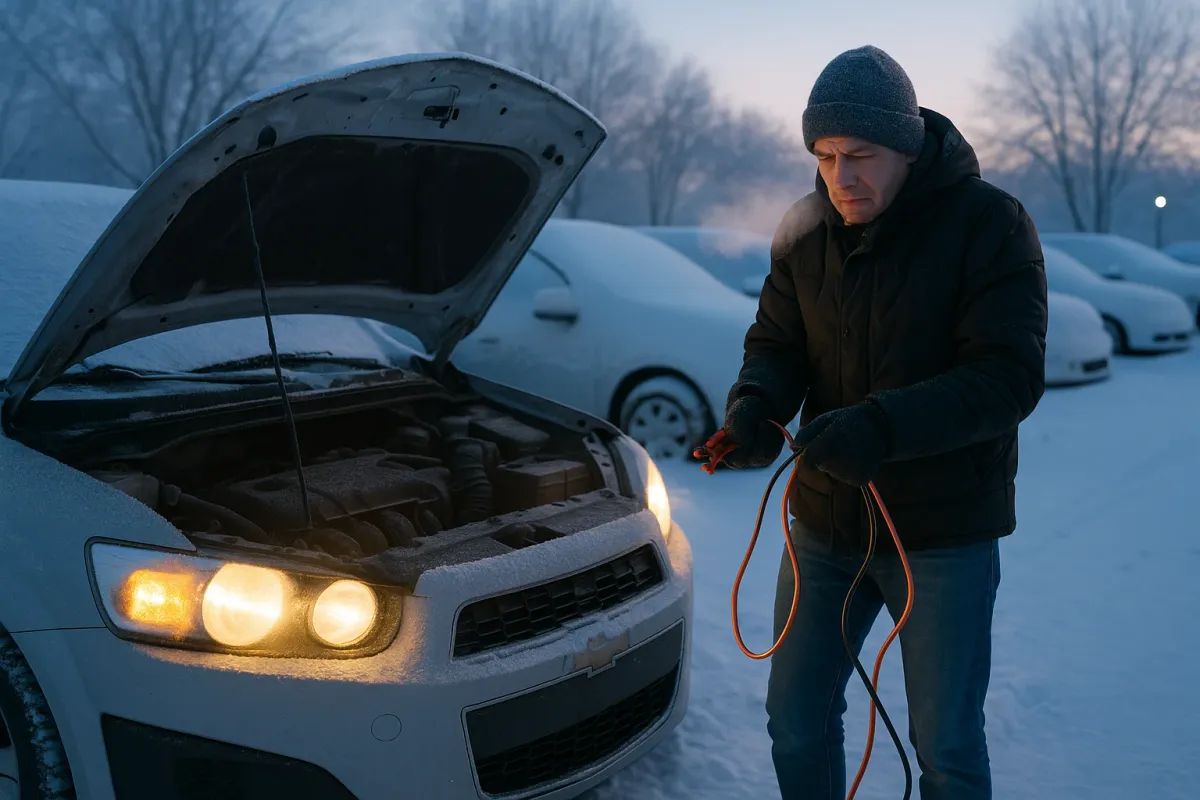
That mix — colder-than-usual mornings, more electronics, and drivers hanging onto cars longer — is the perfect recipe for winter battery failures. The good news: a lot of these “surprise” no‑starts are completely preventable with a bit of maintenance and planning. Here’s how to keep your car ready to go when the next cold front hits.
Understand Why Cold Weather Kills Weak Batteries
Low temperatures don’t just make engines harder to crank; they also cut a battery’s available power. At around 0°F (-18°C), a typical lead-acid car battery can deliver only about half of its rated capacity, while your engine needs more power than usual because the oil is thicker and everything turns more slowly. That’s why national roadside services always see a jump in calls during the season’s first hard freeze — batteries that were “fine” at 50°F suddenly can’t spin the starter fast enough at 10°F.
Modern cars with stop-start systems, power-hungry infotainment units, heated seats, and always-on telematics demand more from the 12‑volt system than older vehicles ever did. If your battery is more than 3–5 years old, or your vehicle sees mostly short trips, that strain adds up. Knowing that this year’s early cold snaps are already exposing weak batteries means now is the time to assume yours might be next — and to check it before it strands you.
Action: If your battery is over 3 years old, treat it as “suspect” going into winter and plan to get it tested, even if it seems fine.
Get a Proper Battery Test (Not Just a Quick Voltage Check)
Many drivers rely on the dashboard battery icon or a simple voltage reading and assume their battery is healthy. But as dealerships and independent shops are seeing this season, a battery can show OK voltage and still fail under load. That’s why professional testers use a conductance or load test to measure cold-cranking performance, not just resting voltage.
Most parts stores (AutoZone, O’Reilly, Advance, etc.) and many tire shops will test your battery and charging system for free — and this winter they’re busy doing exactly that as more cars show up with slow cranks and dim lights. A proper test will check:
- Battery health (state of charge and overall capacity)
- Cold cranking amps (CCA) versus what your car requires
- Charging system output from your alternator
- Parasitic draw that could be draining the battery when parked
If your battery tests marginal heading into freezing weather, consider replacement preventative maintenance, not a “nice to have.” The cost of a new battery is usually less than one out-of-town tow bill or missed workday because the car won’t start at 6 a.m.
Action: Schedule a real battery and charging-system test before the coldest weeks hit, and replace anything that tests “weak” instead of trying to squeeze out one more season.
Match the Right Battery to Your Car (Not Just the Cheapest One)
As automakers like BMW, Mercedes, and many newer mainstream brands move to AGM (Absorbent Glass Mat) batteries and integrate stop-start systems, using “whatever fits” is a fast way to create reliability problems. Battery suppliers are noting more warranty claims caused by under-spec or wrong-type replacements installed to save money up front.
When it’s time to replace:
- Use the correct type: If your car came with an AGM battery, stick with AGM. They handle deep cycles and electrical loads better than standard flooded lead-acid batteries.
- Meet or exceed the OEM CCA rating: Winter demands high cold cranking amps. Avoid downgrading to a lower CCA just to save a few dollars.
- Check physical size and terminal layout: Modern engine bays are tight. A battery that “almost fits” can stress cables or rub on components.
- For newer cars, ask about battery registration: Many European and some newer domestic vehicles require electronic “registration” or coding of the new battery so the charging system knows its capacity and type. Skipping this step can shorten battery life.
The trend in 2024 and beyond is clear: cars are becoming rolling computers, and the 12‑volt battery is their foundation. Treating it as a critical component instead of a generic commodity will pay off in fewer surprise no‑starts.
Action: Use your owner’s manual or manufacturer’s online parts catalog to confirm the exact battery spec (type, CCA, group size), and insist on meeting or exceeding it when replacing.
Change How You Use the Car in Cold Weather
A lot of this winter’s battery trouble isn’t just about age — it’s about how cars are used. Short, stop-and-go trips with everything electrical turned on don’t give the alternator enough time to recharge what the starter pulled out, especially in cities seeing more remote-working drivers who no longer do longer daily commutes.
You can tilt the odds in your favor with a few habit tweaks:
- Limit short, back-to-back runs: Combine errands so the engine runs longer between starts.
- Avoid long “accessory mode” sessions: Streaming music, running the fan, and using heated seats with the engine off is brutal on the battery in cold weather.
- Let the car run a bit after starting on very cold mornings: Giving it a few more minutes of run time helps the alternator recover the starting draw.
- If you own a second car that sits: Drive it at least 20–30 minutes every week in winter or use a maintainer; sitting is hard on batteries.
- Remote start wisely: Those extra start cycles add up. If your remote start is firing the car multiple times a morning “just in case,” you may be draining more than you realize.
Roadside providers continually report that many winter no-starts come from vehicles that are rarely driven or only used for ultra-short trips. Driving patterns matter as much as battery age.
Action: Look at your weekly driving pattern and build in at least one 20–30 minute continuous drive in winter to keep the battery properly charged.
Prep Now for the “It Still Died” Scenario
Even with perfect maintenance, there’s always the chance your battery decides to quit at the worst possible moment. With early storms already snarling traffic and slowing down tow response times in many regions, having a basic backup plan is no longer optional.
To stay ready:
- Carry a quality set of jumper cables or a lithium jump pack: Modern compact jump starters are small, powerful, and ideal if you park where help might not be close.
- Store them where you can reach them with the car locked: Trunk-only access can be a pain if you have an electronic trunk release and no manual key cylinder.
- Know safe jump-start procedure: Incorrect connections can damage electronics. Review your owner’s manual now, not in the dark on the side of the road.
- Save your roadside assistance number in your phone: Whether it’s AAA, your insurance, or the automaker’s program, don’t hunt for it in an emergency.
- If parking outside overnight in extreme cold: Park facing outward for easier access to the battery or jump points, and avoid deep snow or standing water that complicates service access.
This season’s spike in dead-battery calls is a reminder: preparation is part of maintenance. A simple jump pack in the glovebox can turn a major crisis into a five-minute delay.
Action: Add “winter battery kit” to your checklist: jumper cables or a jump pack, gloves, a small flashlight, and your roadside assistance info, all stored where you can reach them quickly.
Conclusion
With temperatures dropping and electrical loads climbing, it’s no coincidence that auto clubs and shops are seeing a flood of winter battery failures right now. But most of these “sudden” no-starts actually build up over months of marginal performance, short trips, and overlooked testing.
By understanding how cold weather stresses your battery, getting it properly tested, matching the right replacement to your vehicle, adjusting your winter driving habits, and preparing for the rare failure anyway, you stack the odds in your favor. Do those things now — before the next cold snap — and your car is far more likely to be truly “auto ready” every time you hit the start button this winter.