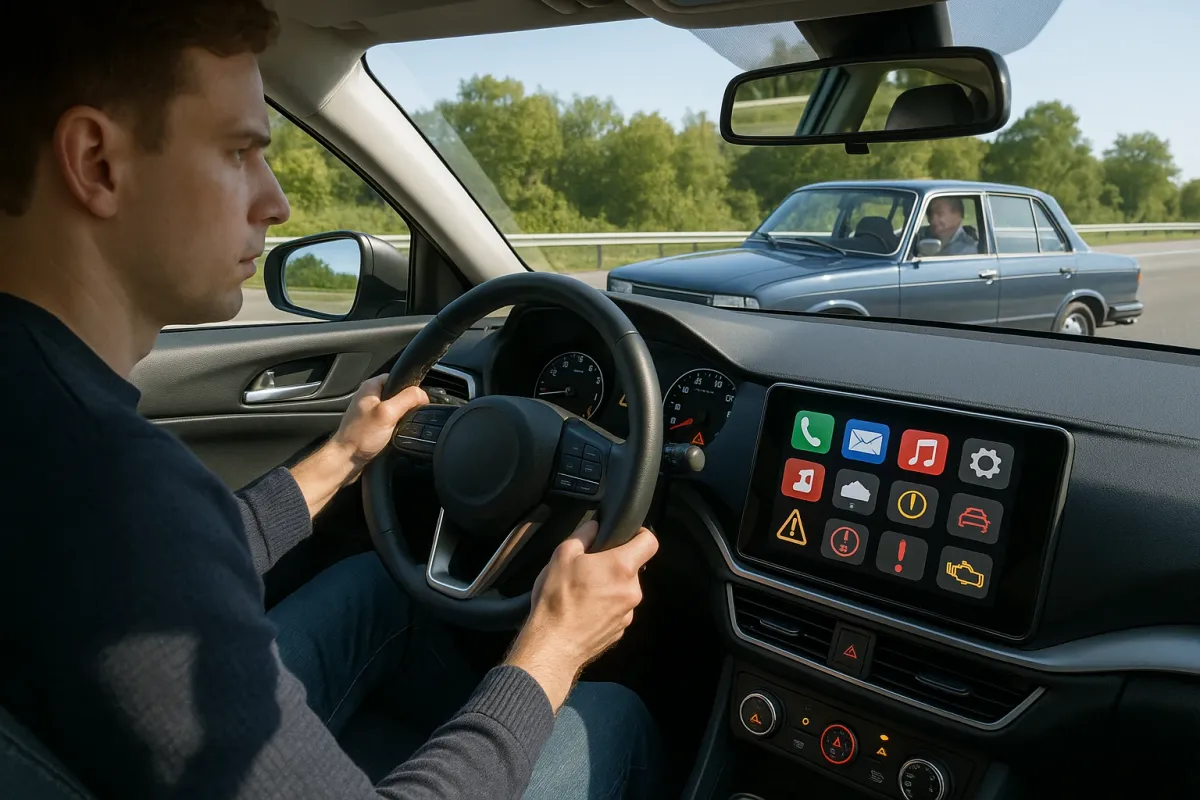
If you’re shopping for a car right now, this matters. The same way a film buff can’t unsee a bad CGI scene once someone points it out, you can’t unsee poor in-car tech once you live with it. Below are five practical checks to run on any new or used car you’re considering today—so you don’t end up with a vehicle that drives great but ages like a forgotten streaming series.
Treat the Infotainment Like a Phone You’re Stuck With for 10 Years
Carmakers are rushing huge touchscreens into dashboards, but the software often lags behind your smartphone by years. Owners of otherwise solid cars—from mainstream brands like Ford and Volkswagen to premium names like Mercedes-Benz and BMW—are posting clips of freezing maps, randomly rebooting systems, and voice controls that misunderstand basic commands.
When you test-drive:
- Boot it up cold. Start the car from “off” and time how long the screen takes to be usable. If it’s slow now, it won’t magically get faster in five years.
- Stress-test the system. Run navigation, stream music via Bluetooth, and plug in Apple CarPlay or Android Auto all at once. Switch apps quickly. Look for lag, stutters, or audio dropouts.
- Check update options. Ask if the system gets over-the-air (OTA) updates without dealer visits, and how long the brand typically supports software. Tesla, Hyundai/Kia, Ford, and Volvo are leaning harder into OTA; some others quietly don’t.
- Verify offline usability. If your phone isn’t connected, can you still enter an address, adjust climate, and browse radio easily? Don’t assume “connected” means “better” when the basics are buried.
- Look for physical backups. Memes about “three taps to change the AC” exist for a reason. Physical knobs, scroll wheels, and shortcut buttons are your best friend when the touchscreen misbehaves.
If the infotainment feels clunky or half-baked in 2025, expect it to feel ancient by 2028.
Ignore the Screen Size—Judge the Controls Like a Cockpit
Viral posts and comment sections love to dunk on “iPad glued to the dash” interiors. Beyond the humor, there’s a real issue: a lot of 2024–2025 cars make you poke through menus for things you’ll use daily, from seat heaters to drive modes.
During your inspection:
- Do a “no-manual” test. Give yourself five minutes to adjust climate, radio, navigation destination, and driver-assistance settings without touching the owner’s manual. If it’s confusing now, it’ll be worse at 6 a.m. in the rain.
- Check reach and visibility. Can you comfortably reach the screen and key buttons without leaning forward? Is the display readable in bright sunlight, or does it wash out?
- Try driving with gloves. If you live in a cold climate, see if rotary dials and volume knobs can be used with gloves. A pure glass interface often fails this.
- Evaluate voice control honestly. Car brands love to demo “Hey Mercedes” or “Hey BMW”–style systems. Try real phrases like “I’m cold” or “Find coffee nearby.” If you’re repeating yourself, that’s your answer.
- Score it like a tool, not a toy. Ask: “If this were a work device I used all day, would I tolerate this interface?” If the answer is no, move on.
The best cabins in today’s market—often from brands like Mazda, Hyundai, and some German models—strike a balance: tech when you want it, simple controls when you don’t.
Read the Fine Print on Subscriptions Before You Buy
There’s growing backlash online around “features as a service”—from BMW’s once-experimental heated-seat subscriptions to connected service fees that kick in after a free trial. The memes about “paying monthly to use your own car” are brutal, but there’s truth there.
Before you sign anything:
- List every feature that depends on a subscription. This can include navigation traffic data, remote start via app, vehicle location, emergency call services, Wi‑Fi hotspot, and some advanced driver aids.
- Ask for the post-trial prices. Don’t just accept “this is free for three years.” Get the monthly or yearly costs in writing so you can add them to your true cost of ownership.
- Clarify what breaks without a subscription. In many models, navigation still works offline but loses live traffic; in others, certain connected safety or convenience features disappear altogether.
- Beware “trial-addicted” impressions. A car may feel smarter during the first months when everything is turned on. Imagine it with only what you’re willing to pay for long-term.
- Compare brands on openness. Some brands quietly lock more behind subscriptions; others offer more for free. When two cars are tied on performance and price, ongoing tech costs can be the tiebreaker.
A great car that turns into a nickel‑and‑diming app bundle after 12 months will not age well—no matter how good the launch review scores were.
Test Safety Tech in the Real World, Not Just on the Window Sticker
Advanced driver-assistance systems (ADAS)—lane-keep assist, adaptive cruise control, blind-spot monitoring—are everywhere in current spec sheets. But owners are filling forums and social feeds with clips of ping-ponging lane-keep, overly aggressive emergency braking, and steering nudges that feel more annoying than helpful.
On your test-drive:
- Use adaptive cruise on a highway, if possible. See how smoothly it accelerates and brakes with traffic. Jerkiness equals fatigue on long trips.
- Try lane centering on gentle curves. Some systems track confidently; others drift or “bounce” between lane lines. Turn it on and off to feel the difference.
- Check the alert style. Are lane warnings a gentle vibration, a beep, or a full-on alarm? If it feels naggy in a short drive, you’ll probably disable it later—and lose a helpful safety net.
- Look for easy customization. Good systems let you adjust following distance, lane-keep strength, and warning timing with a few taps.
- Confirm camera clarity at night. If you can, check the backup camera and 360° view at dusk or in a dim garage. Grainy, low-res cameras are still surprisingly common.
Well-tuned safety tech should fade into the background. If you’re fighting it—or laughing at how badly it behaves—take those online complaints seriously.
Judge How the Car Drives, Not Just What the Internet Says
In a culture that loves movie memes and savage one-liners, it’s easy for certain cars to become the butt of every joke: “boring,” “appliance,” “overhyped,” “overpriced.” Some deserve it; some don’t. But you’re the one who has to drive the thing every day.
Balance the noise with your own experience:
- Focus on the basics first. Ride comfort, steering feel, brake modulation, and visibility matter more day‑to‑day than 0–60 bragging rights.
- Match the powertrain to your reality. Turbos, hybrids, and EVs all deliver power differently. Drive them back-to-back in stop‑and‑go traffic and on the highway to see what actually feels best to you.
- Pay attention to noise levels. Road and wind noise are hard to evaluate from spec sheets, but they’re a top complaint in long‑term owner reviews.
- Check real‑world consumption. Look at owner-reported fuel economy or EV range (forums, user reviews, apps) alongside official numbers. If a model consistently misses the mark, treat that as a warning.
- Do a “bad road” test if you can. Find a rough surface, speed bump, or patchy pavement. How the suspension handles that will tell you a lot more than a polished dealer loop.
Use social media and review sites to narrow your list—but let your own test-drives make the final call.
Conclusion
Today’s cars are more like rolling smartphones than ever—and that’s exactly why they can feel outdated so fast. Viral complaints about glitchy screens, confusing controls, and sneaky subscriptions aren’t just noise; they’re early warnings about how well (or badly) a car will age in your driveway.
If you’re shopping right now, treat the infotainment, controls, safety tech, and subscription structure as seriously as the engine, price, and styling. Put every system to the test during your drive, ask pointed questions about updates and fees, and imagine living with this exact setup five or ten years from now. Do that, and you’ll end up with a car that still feels ready for the road long after the memes move on to the next target.