Below are five practical, enthusiast-friendly habits you can plug into your calendar and actually stick with.
Habit 1: Use Seasonal “Check Zones” Instead of Random Inspections
Most people either over-maintain (wasting time and money) or ignore maintenance until something breaks. A smarter approach is to use a repeatable “check zone” routine at key times: early spring, mid-summer, early fall, and just before winter really hits.
In each of these periods, walk around your car and run a targeted mini-inspection:
- Fluids: Motor oil level and condition, coolant (check reservoir level and look for discoloration), brake fluid level, and windshield washer fluid.
- Tires: Tread depth, visible damage, and sidewall cracking. Use a coin or tread gauge and adjust pressures based on the owner’s manual—not the sidewall.
- Visibility: Wiper blade condition, headlight and taillight function, fog lights, and backup lights.
- Leaks and Smells: Look under the car for fresh drips, and notice any new fuel, coolant, or burnt oil smell in the driveway or garage.
By tying this routine to seasonal changes instead of mileage alone, you’ll catch issues earlier—like slow leaks, uneven tire wear, or a weakening cooling system—before they turn into breakdowns.
Habit 2: Match Your Tires and Pressures to Real-World Weather
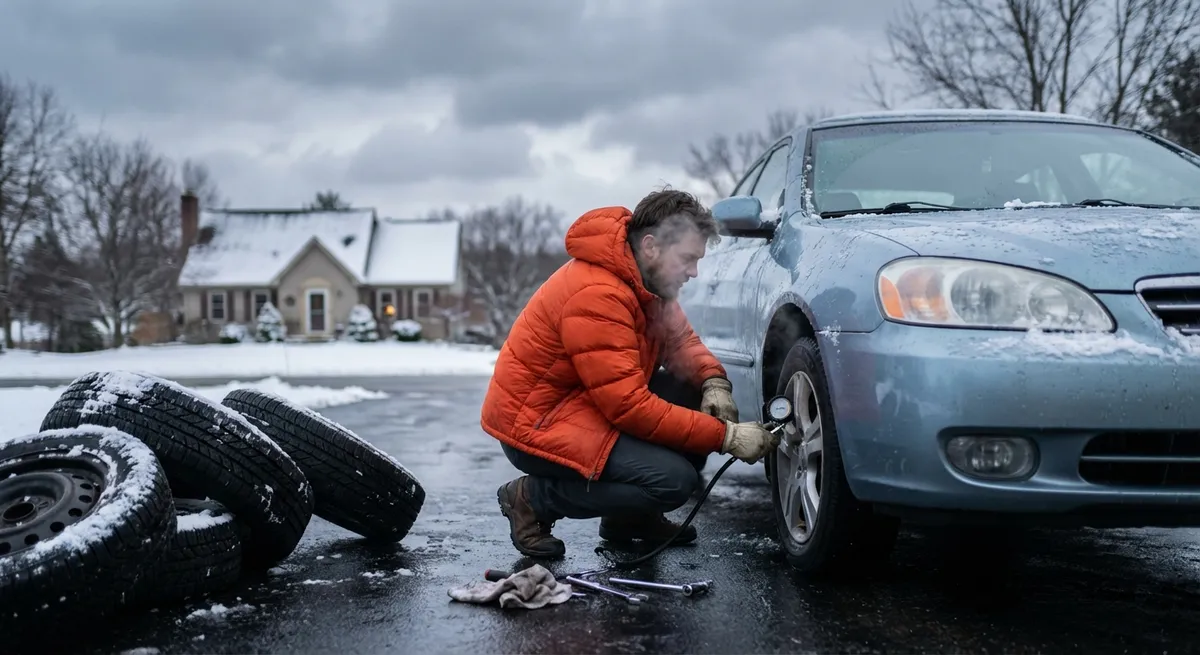
Tires are your only contact with the road, yet they’re often treated as an afterthought. Seasonal thinking here pays off fast in both safety and performance.
In hot months, asphalt temperatures can exceed the air temperature by a lot, causing tire pressures to spike. In colder months, tire pressure drops (roughly 1 psi for every 10°F decrease). Instead of setting and forgetting, build this rhythm:
- Check pressures at least once a month and at each major temperature shift (first real cold week, first heat wave).
- Use the placard in the door jamb or the owner’s manual for recommended pressures—not the number on the tire sidewall, which is a maximum rating.
- If you live where winter conditions are real (snow/ice), consider a dedicated set of winter tires rather than all-seasons. The rubber compound and tread pattern are designed to stay flexible and grip in low temperatures.
- In milder climates, focus on high-quality all-season tires and verify tread depth before the rainy season hits; deeper tread evacuates water better and reduces hydroplaning risk.
Treat tires like a performance part, not a consumable. Properly chosen and maintained, they sharpen braking, steering feel, and confidence in bad weather.
Habit 3: Build a Cooling System Routine Before Heat or Hills Expose Weakness
Overheating usually feels “sudden,” but it’s often the final stage of a long-developing issue. The cooling system is especially sensitive to seasonal stress—summer traffic, long grades, and heavy loads can quickly expose a weak radiator, worn hoses, or old coolant.
Twice a year (ideally spring and late summer), add the cooling system to your checklist:
- Coolant condition: With the engine cold, look in the overflow reservoir. The fluid should generally be clear and brightly colored (varies by formula), not rusty, milky, or full of particles.
- Hoses and clamps: Gently squeeze accessible hoses. They should feel firm but not rock-hard or mushy. Check for swelling near the clamps and any visible cracking.
- Radiator and fans: Look for bent fins, debris, or leaks around seams. Confirm that electric cooling fans engage when the engine warms up or when the A/C is on.
- Service interval: Coolant has a service life—typically every 5 years or a certain mileage, depending on type. Long-life coolants still degrade over time, and neglected coolant can corrode internal passages and water pumps.
Doing this before a summer road trip or mountain drive is especially important. A healthy cooling system not only prevents breakdowns but helps the engine maintain proper operating temperature, which impacts power, fuel economy, and oil life.
Habit 4: Protect Your Battery and Electrical System From Temperature Swings
Both extreme heat and deep cold are rough on batteries. Hot weather accelerates internal degradation; cold weather makes it harder for a weak battery to crank the engine. Many “sudden” winter no-starts are actually the result of a battery slowly weakened during summer.
Use the transitional seasons—spring and fall—to give your electrical system a focused once-over:
- Battery health check: Many auto parts stores will test your battery’s state of charge and cranking ability for free. Do this before winter and again before peak summer.
- Visual inspection: Look for corrosion on terminals (white or bluish buildup), loose clamps, or damaged cables. Clean and tighten as needed using appropriate tools and a battery-safe cleaner.
- Parasitic drains: If the car sits for long periods, consider a quality battery maintainer instead of relying on random drives to keep it charged. Modern cars with many modules can slowly drain a battery over time.
- Alternator and grounding: Pay attention to dimming lights, slow cranking, or electrical oddities. These may indicate alternator or grounding issues, not just a weak battery.
A stable electrical system also supports modern driver-assistance systems, infotainment, and sensors that enthusiasts increasingly rely on—everything from adaptive cruise to logging and tuning tools.
Habit 5: Guard Against Seasonal Rust, Corrosion, and Interior Wear
Weather doesn’t just affect moving parts; it attacks the body, chassis, and interior over time. Salt, humidity, UV exposure, and temperature swings all accelerate wear—but targeted habits can dramatically slow this down.
Integrate these into your seasonal routine:
- Before winter or rainy season:
- Thoroughly wash the underbody, especially in rust-prone regions.
- Inspect wheel wells, brake lines, and pinch welds for early signs of corrosion.
- Consider a professional underbody treatment or rust inhibitor if you drive on salted roads.
- During winter and after storms:
- Rinse off road salt as soon as temperatures allow.
- Don’t let salty slush dry and bake onto the underside for weeks.
- Before peak summer sun:
- Apply a UV protectant to dashboards and interior plastics.
- Use a windshield sunshade if parking outside regularly.
- Treat leather with an appropriate conditioner to prevent cracking.
- All year, but especially after extreme weather:
- Check door seals, trunk seals, and sunroof drains. Clogged drains or torn seals invite water intrusion, leading to mold, electrical issues, and hidden rust.
These habits don’t just keep the car looking good; they preserve structural integrity, resale value, and the “solid” feel that enthusiasts appreciate.
Conclusion
Good maintenance isn’t about guessing when something might break—it’s about building predictable habits that line up with how weather really affects your car. By:
- Running seasonal “check zones,”
- Matching tires and pressures to conditions,
- Staying ahead of cooling system stress,
- Protecting your battery and electrical health, and
- Guarding against rust, corrosion, and interior damage,
you turn maintenance from an occasional headache into a simple, repeatable system. Your car stays sharper, safer, and more enjoyable to drive—no matter what the forecast says.
Sources
- [National Highway Traffic Safety Administration – Tire Safety](https://www.nhtsa.gov/equipment/tires) - Covers tire maintenance, pressure, tread, and safety recommendations
- [U.S. Department of Energy – Maintaining Your Vehicle](https://www.energy.gov/energysaver/maintaining-your-vehicle) - Explains how proper maintenance affects efficiency and performance
- [AAA – How to Prevent Car Overheating](https://newsroom.aaa.com/2019/07/how-to-prevent-your-vehicle-from-overheating/) - Practical guidance on cooling systems and preventing breakdowns in hot weather
- [Consumer Reports – Car Battery Buying Guide](https://www.consumerreports.org/cars/car-batteries/buying-guide/) - Independent information on battery life, testing, and replacement timing
- [Car Talk – How to Prevent Rust on Your Car](https://www.cartalk.com/content/how-prevent-rust-your-car) - Detailed look at rust causes, prevention strategies, and treatment options