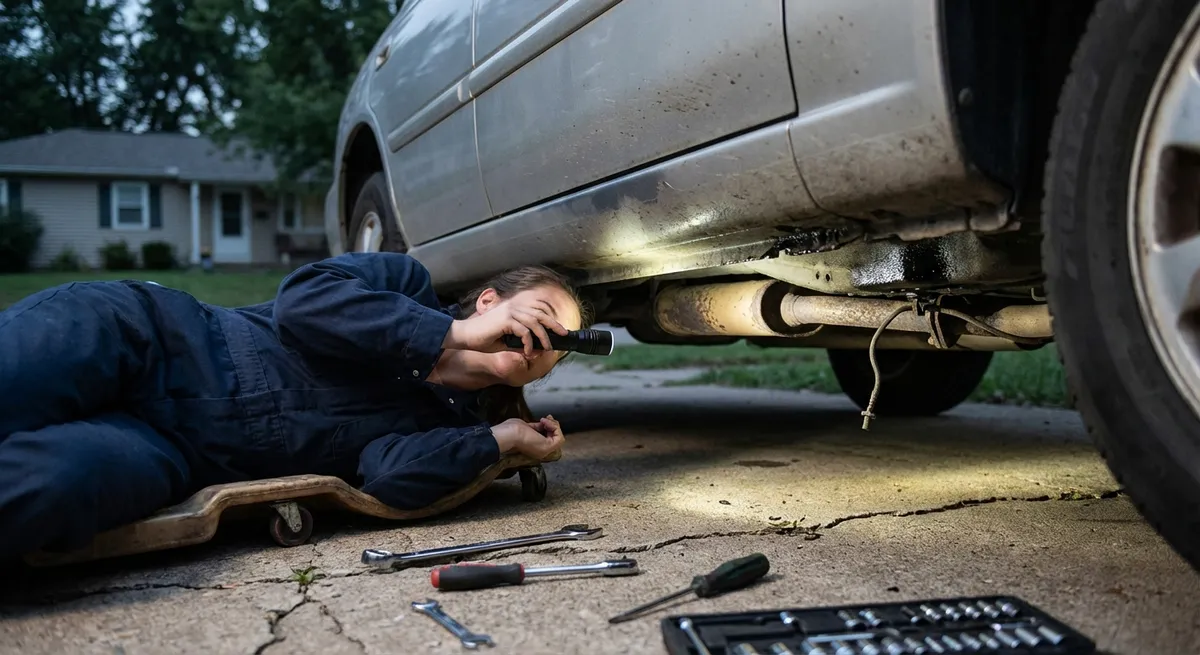
Below are five practical, enthusiast-level checks that can fit into your monthly or quarterly routine and meaningfully reduce surprise repairs.
Visual Leak Scan: Reading the “Story” on Your Driveway
Before you even get under the car, start with the ground. Fresh spots on the driveway or garage floor are often the first clue something is off.
Look for stains after the car has been parked for several hours or overnight. Dark brown or black, thick spots often suggest engine oil. Reddish or amber, slippery fluid may indicate transmission or power-steering fluid, depending on your car. Bright green, orange, pink, or yellow watery spots may be coolant. Clear water near the front passenger side is usually just condensation from the A/C system and is normal.
Once you spot a stain, grab a flashlight and look underneath in the same area, tracing up from the drip to its possible source—oil pan, drain plug, transmission case, hoses, or radiator. Even if you’re not doing the repair yourself, taking photos of leaks and noting when they appear gives your mechanic a head start and can prevent a minor seep from turning into a low-fluid, component-damaging failure.
Exhaust System Check: Catching Rust, Leaks, and Performance Loss
Your exhaust system lives in a harsh environment—heat, moisture, road salt, and debris all work against it. Ignoring it until it gets loud can mean missing earlier warning signs that impact fuel economy, emissions, and even safety.
With the car parked on level ground and completely cooled down, slide a mat or cardboard under the side of the vehicle and visually inspect the exhaust from the engine area (downpipe) back to the muffler and tailpipe. You’re looking for flaky rust, holes, broken hangers, and loose or missing heat shields. Surface rust isn’t unusual in many climates, but areas where you can flake off metal, see gaps at joints, or find black soot around connections can signal leaks.
On startup, listen for new sounds—ticking near the engine (possible manifold leak), raspy mid-car buzz (resonator or mid-pipe issues), or deep, boomy noise at the rear (muffler problems). Exhaust leaks can allow fumes to enter the cabin and may cause the engine’s oxygen sensors to react incorrectly, affecting performance and triggering warning lights. Early detection gives you the option of a targeted repair instead of a full system replacement.
Suspension and Steering Glance: Spotting Wear Before It Feels Dangerous
Suspension and steering components wear gradually, which means drivers often adapt to worsening behavior without realizing how far performance has fallen. A quick look under the car can reveal issues that haven’t yet become obvious from behind the wheel.
With the front wheels turned slightly to one side and the car parked, use a flashlight to inspect major components: control arms, tie rods, sway bar links, and bushings. You’re checking for cracked rubber, torn boots, shiny metal where parts are rubbing, or fresh grease escaping from joints. On vehicles with struts or shocks visible from underneath, look for oil on the body of the shock—this can indicate a failing seal.
You can complement this visual check with a simple wheel test. If you have a safe way to slightly lift a corner of the car using the factory jack and proper jack points, gently try to move the wheel at 12 and 6 o’clock (for vertical play) and 3 and 9 o’clock (for steering play). Any noticeable clunk or movement may signal worn bearings, ball joints, or tie rods. Identifying these early can improve both safety and tire life, and it allows you to plan repairs before something fails on the road.
Undercarriage Rust Patrol: Protecting the Hidden Structure
Even if your car looks clean from the outside, the underbody can be quietly accumulating rust—especially in regions with road salt or near the coast. Left unchecked, rust can compromise brake lines, fuel lines, structural rails, and mounting points.
Use a bright light and inspect key areas: frame rails or unibody rails running along the sides, jack points, rear subframe or axle mounts, and any exposed brake and fuel lines. Light, even surface rust is common on metal components, but deep flaking, bubbling around seams, or missing paint and undercoating deserve attention. Pay particular attention to metal lines running under the car—if they look heavily corroded or pitted, they may be approaching the point where a hard stop or bump could cause a leak.
If you catch rust early, you may be able to clean it up and apply a rust converter and protective coating, or have a shop do a more thorough treatment. This is much more cost-effective than replacing structural sections or dealing with unexpected brake line failures—both of which can be expensive and dangerous.
Under-Car Fluid & Line Check: Safeguarding Brakes, Fuel, and Cooling
Beyond leaks, there’s a lot of critical plumbing under your car—hoses and lines that move fuel, brake fluid, and coolant. A few minutes of inspection can prevent breakdowns and, in extreme cases, fire or loss of braking.
Scan the radiator area and lower hoses for bulges, cracks, or evidence of dried coolant (often a chalky residue). Follow any visible coolant lines as far as you can, looking for chafed spots where hoses touch other components or brackets. On fuel lines, look for damp spots, strong fuel odor, or areas where plastic clips are missing and lines are rubbing metal—friction points can eventually wear through.
For brake lines, look for rust, dampness, or swelling of any flexible rubber hoses near the wheels. Under the transmission and engine oil pan, check that drain plugs and filters appear dry and tight, without fresh wetness around them. If you do your own oil or fluid changes, this is the time to double-check your own work; if a shop services your car, periodic visual inspections give you a way to verify nothing is loosening or seeping between visits.
Conclusion
Getting under your car doesn’t require a full mechanic’s setup—just some care, a consistent routine, and a willingness to look closely. By scanning for leaks, inspecting the exhaust, checking suspension and steering pieces, monitoring rust, and keeping an eye on under-car lines and hoses, you turn “surprise repairs” into planned maintenance. For enthusiasts, it’s also a way to stay connected to how the car is aging underneath the paint. A few minutes on the ground a few times a year can easily pay for themselves in avoided breakdowns and extended vehicle life.
Sources
- National Highway Traffic Safety Administration (NHTSA) – Vehicle Maintenance - Federal safety guidance on basic vehicle checks and why they matter
- AAA – Car Care: Preventive Maintenance Tips - Practical checklists and explanations of common wear items
- Car Care Council – Free Car Care Guide - Consumer-focused maintenance guidance, including undercar and fluid checks
- U.S. Environmental Protection Agency (EPA) – Vehicle Exhaust Emissions - Background on why exhaust system integrity affects emissions and health
- Penn State College of Earth and Mineral Sciences – Corrosion of Metals - Educational overview of how and why rust forms on metal components