This guide breaks down practical auto tech upgrades and habits that real owners can use right now. No dealership visit required, no full system rewires—just targeted changes that make your existing car easier, safer, and more enjoyable to live with.
Transform Your Phone Into the Car’s Command Center
If your vehicle doesn’t have built-in smartphone integration (or has an early, clunky version), your phone can still become the hub of your car’s tech without a costly head-unit swap.
Start with a high-quality mount placed in your natural line of sight, just below eye level and off to the side. This reduces how far your eyes travel from the road while still giving you visibility for navigation and alerts. Pair the mount with a sturdy, fast-charging cable or a MagSafe/Qi wireless charging pad to keep your battery from draining under heavy GPS use.
Next, set up a driving-optimized home screen before you start the engine. Put your navigation app, music/podcast app, and a voice assistant shortcut in the dock. Turn on Do Not Disturb While Driving so calls and notifications don’t constantly pull your eyes from the road—emergency callers can still break through depending on your settings.
If your car has Bluetooth, dive into the settings and prioritize it over other paired devices so it connects reliably the moment you start the car. No Bluetooth? A simple Bluetooth-to-AUX or USB adapter can bridge the gap and give you hands-free calling and audio streaming without replacing the stereo. The goal is simple: one tap (or voice command) to start navigation, adjust audio, and respond to crucial messages while your hands stay on the wheel.
Use Budget-Friendly Driver Aids to Add Safety Features Your Car Lacks
Modern cars come with advanced driver-assistance systems (ADAS) like forward collision warning, lane departure alerts, and blind-spot monitoring. If your vehicle predates these features, you can add some of the most useful ones with add-on tech—without paying for a new car.
Blind-spot mirrors are the simplest place to start. Stick-on convex mirrors on your side mirrors give you a better view of lanes beside and behind you, especially in dense traffic. From there, consider aftermarket blind-spot monitoring or rear cross-traffic alert systems that use sensors mounted in your rear bumper or license plate frame to warn you of vehicles you can’t see.
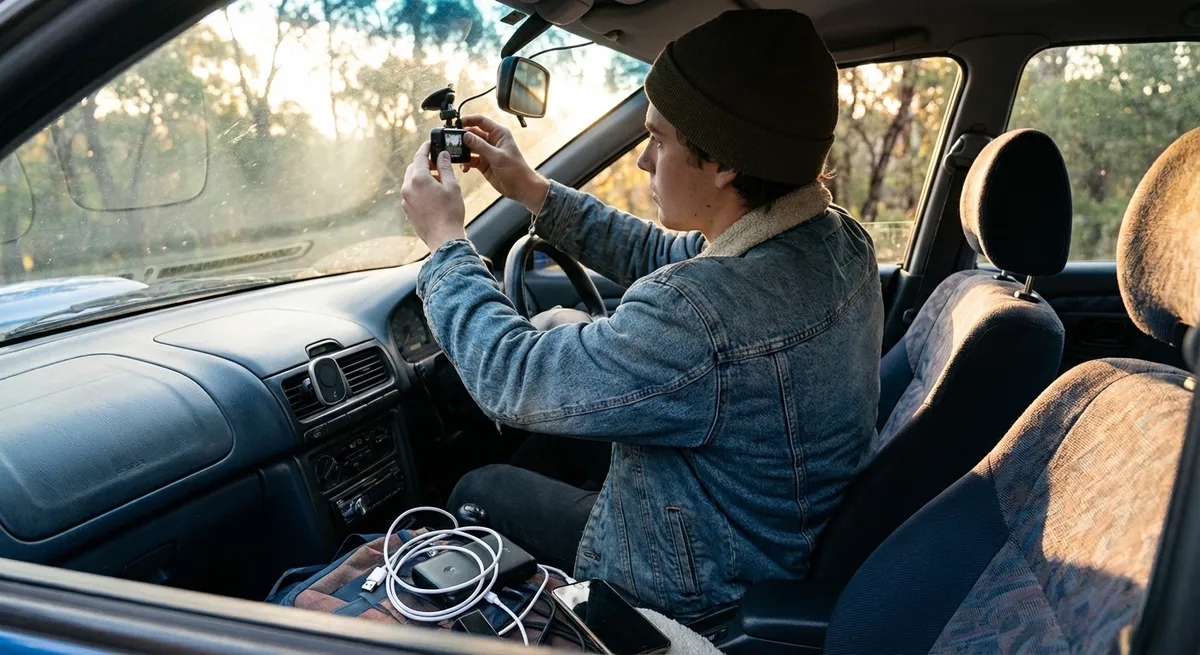
Dash cameras are another high-value upgrade. A forward-facing dash cam with loop recording and G-sensor collision detection can protect you after an incident by providing objective video evidence. Some models offer parking mode to capture low-speed bumps or vandalism while you’re away. For ride-share or delivery drivers, dual-channel cameras (front and interior) can be worth the extra cost.
If your night driving feels stressful, look for upgraded halogen bulbs or LED retrofit kits that meet legal requirements in your region and are compatible with your vehicle’s housings. Properly aimed, brighter lights improve reaction time without blinding oncoming traffic. Always adjust and test beam alignment after bulb or housing changes, and stick to reputable brands that publish beam pattern and compliance information.
Make Smarter Use of Real-Time Data: OBD-II Adapters and Apps
Most cars built since the mid-1990s have an OBD-II (On-Board Diagnostics) port, typically under the dash. A simple plug-in adapter, paired with a smartphone app, can turn that hidden port into a powerful tool for understanding your car’s health and behavior.
When a check engine light turns on, an OBD-II scanner lets you retrieve the diagnostic trouble code (DTC) and see a plain-language description, so you can gauge how urgent the problem is. Sometimes it’s something minor like a loose gas cap; other times it indicates an emission or engine issue that needs prompt attention. Knowing the difference helps you avoid both panic and neglect.
Many adapters also provide live data: coolant temperature, intake air temperature, fuel trims, oxygen sensor readings, and more (depending on your car). Even if you’re not a DIY mechanic, trends in this data can alert you to issues early—like a running temperature creeping up over time or unusual fuel trim values that hint at air leaks or sensor problems.
For fuel-conscious drivers, some apps calculate real-time and historical fuel economy based on OBD data and GPS. This helps you see how changes in speed, route choice, or tire pressure affect your consumption, making your driving style more deliberate rather than guesswork. When combined with maintenance logs in the app, you get a clear picture of how your driving and upkeep habits impact reliability and running costs.
Upgrade Comfort and Convenience With Small Tech Changes
Not every tech improvement has to be about safety or performance; comfort and convenience can change how you feel about your car every single day. Start with power management: if you regularly charge multiple devices, consider adding a quality multi-port USB-C/USB-A adapter that supports fast charging. Avoid the ultra-cheap options and choose one from a reputable electronics brand with built-in overcurrent and overheat protection.
Interior lighting upgrades can make night use more pleasant. Replacing dim, yellowish interior bulbs with quality LED modules (designed for automotive use) gives you brighter, whiter light for finding dropped items or reading a map. Choose a color temperature around 4,000–5,000K for a neutral look that isn’t harsh on your eyes.
For organization, tech-focused organizers can keep cables, sunglasses, and gadgets from sliding around. A non-slip dash mat can securely hold your phone or toll transponder, and an under-seat or console organizer can keep charging cables, tire gauges, and adapters accessible but out of sight. This cuts down on distractions and clutter, especially if you share the car with family members.
Finally, consider simple climate-control helpers. A remote starter (where legal and compatible) can pre-condition your cabin on extremely hot or cold days, reducing strain on your engine and HVAC when you start driving. Sunshades and ceramic window tint (installed professionally and within local regulations) help keep interior temperatures down, which in turn reduces your reliance on maximum A/C settings and can slightly improve fuel efficiency.
Treat Software and Firmware Like Part of Your Maintenance
Cars are increasingly software-defined, but many owners never think about updating the digital side of their vehicle. Whether your car has built-in navigation, a factory infotainment system, or a plug-in device like a dash cam or aftermarket stereo, keeping software and firmware updated can improve performance, fix bugs, and in some cases, enhance safety.
For factory systems, check your owner’s manual or the manufacturer’s website for how updates are delivered. Some newer cars receive over-the-air (OTA) updates when connected to Wi-Fi or cellular networks. Others require updates via USB drive or a dealer visit. If your navigation maps are several years old, you may be missing new roads, speed limit changes, and updated points of interest.
Aftermarket devices—dash cams, backup cameras, OBD-II adapters, and head units—often release firmware updates to improve compatibility with phones, fix bugs, or add features like better parking modes or new recording options. Make a habit of checking the manufacturer’s support page every few months and updating devices during downtime, like when parked at home.
Before any major trip, combine digital checks with your usual mechanical prep. Verify that your navigation apps are updated, offline maps are downloaded for areas with poor coverage, and your emergency contacts are stored in your phone and in any connected-car apps. Think of it as a “software service interval” that runs alongside oil changes and tire rotations, keeping both the mechanical and digital sides of your car working together smoothly.
Conclusion
You don’t need a brand-new, fully loaded car to enjoy modern auto tech. With a thoughtful mix of simple hardware add-ons, smart use of your smartphone, and attention to the data your car is already generating, you can dramatically upgrade your day-to-day driving experience.
Focus on changes that directly solve your real-world problems—whether that’s clearer visibility at night, better organization, early warning of mechanical issues, or just making sure your phone and car play nicely together. Over time, these targeted upgrades turn your existing vehicle into a smarter, more comfortable, and more confidence-inspiring daily driver.
Sources
- [National Highway Traffic Safety Administration (NHTSA) – Advanced Driver Assistance Systems](https://www.nhtsa.gov/equipment/driver-assistance-technologies) - Overview of modern driver-assistance tech and how it improves safety
- [U.S. Department of Energy – Fuel Economy: Driving More Efficiently](https://www.fueleconomy.gov/feg/driveHabits.jsp) - Explains how driving style and vehicle condition affect fuel use
- [Edmunds – What Is an OBD-II Scanner?](https://www.edmunds.com/car-maintenance/what-is-an-obd-ii-scanner.html) - Practical guide to using OBD-II tools for understanding car issues
- [AAA – Headlight Technology and Safety](https://newsroom.aaa.com/2018/10/headlights-fail-safely-light-road/) - Discusses headlight performance, visibility, and safety implications
- [Consumer Reports – Dash Cams Can Be a Silent Witness in Car Crashes](https://www.consumerreports.org/car-safety/dash-cams-can-be-a-silent-witness-in-car-crashes-a4977687453/) - Reviews benefits and considerations of using dash cameras