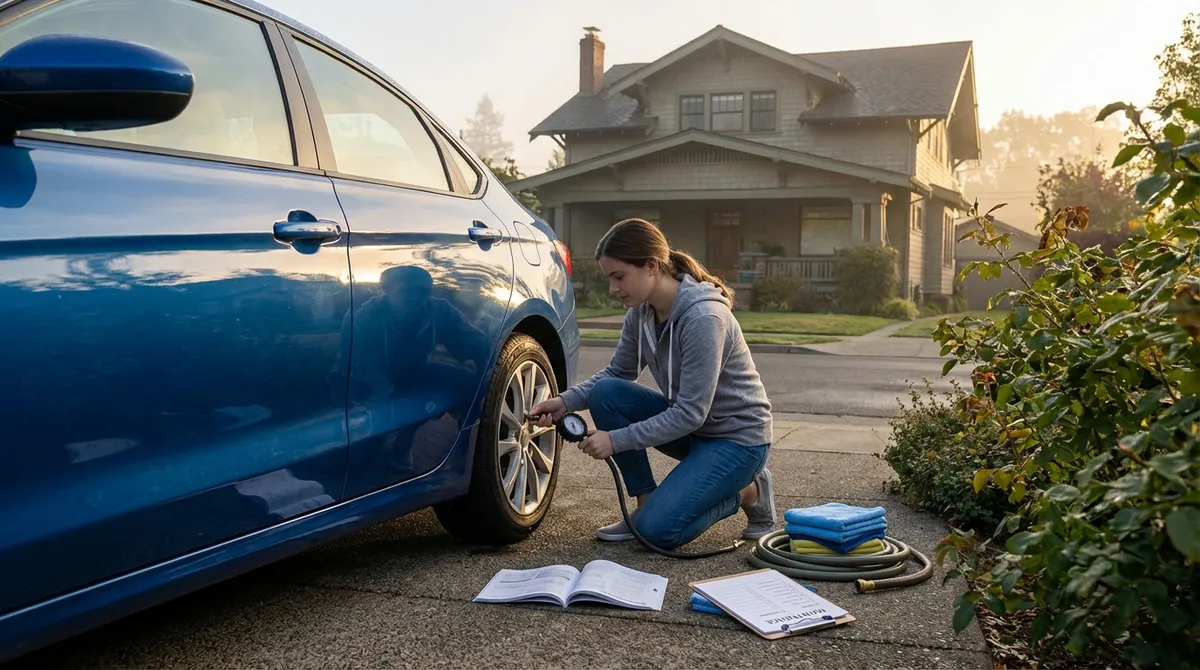
This guide focuses on five practical, high-impact maintenance moves. They don’t require a full toolbox or race-shop-level knowledge—just a bit of consistency and a willingness to look closely at how your car is aging.
1. Treat Fluids Like Wear Items, Not Background Details
Every major system in your car depends on fluid health, not just fluid level. That difference explains why a car can feel “fine” one month and suddenly develop overheating, slipping, or steering issues the next.
Here’s how to treat fluids as wear items:
- Engine oil: Go by time and use, not just mileage. Short trips, frequent idling, and extreme temperatures all justify changing oil earlier than the maximum interval in the owner’s manual. If you mostly drive short in-town distances and the oil looks dark and smells like fuel, change it even if mileage seems low.
- Coolant: Don’t just top it up. Old coolant loses corrosion inhibitors and can quietly damage your radiator, water pump, and heater core. Inspect coolant at least twice a year: look for rust color, sludge, or oil-like film. If you see any of those—or if it’s past the time interval in the manual—flush it, don’t just add more.
- Brake fluid: It absorbs moisture over time, which raises the risk of corrosion and soft pedal feel. If your car is more than a few years old and still on original brake fluid, get a flush even if the pedal “feels okay.” Brake fluid should look clear to light amber, not dark brown.
- Transmission fluid (automatic or DCT): Many “lifetime” fluids are defined by the manufacturer’s warranty period, not the car’s real service life. If you tow, drive aggressively, or live in a hot climate, plan on periodic fluid changes. Check color and smell: burnt-smelling, very dark fluid is a bad sign.
- Power steering and differential fluids (if applicable): These are often ignored but easy to service on many vehicles. If the steering feels heavier or noisier than it used to, or you hear whine from the rear at steady speeds, fluid age might be part of the story.
By thinking of fluids as items that age instead of items that are just “full” or “low,” you’ll catch small problems while they’re cheap and keep the car feeling consistent year after year.
2. Use Your Tires as a Health Report, Not Just Rubber That Rolls
Tires tell you what’s going on with the suspension, alignment, and your driving habits. The tread pattern is basically a report card of how the car is being used and how well the chassis is working.
When you inspect your tires, don’t just look at tread depth; look at patterns:
- Center wear higher than edges: You’re likely overinflating. High pressure reduces contact patch and can hurt braking and wet grip.
- Edge wear (both sides) with good center: Often underinflation, or consistently hard cornering on soft sidewalls.
- One-side wear (inside or outside): Classic sign of alignment issues (excess camber or toe). If the inside is worn and the outside looks fine, you can’t just look from the outside of the car—you have to get down and inspect.
- Cupping or scalloping: Uneven, wavy wear that can mean worn shocks, struts, or bushings. It often shows up as a humming or droning noise that changes with speed.
- Feathering (sharp edge on one side of tread blocks): Often caused by toe misalignment. You’ll feel it if you slide your hand across the tread in one direction and it feels “rough,” then “smooth” in the other.
Actionable habits that pay off:
- Check tire pressure monthly, and always when there’s a big temperature change. Use the pressure on the door jamb, not the maximum printed on the tire sidewall.
- Rotate tires on a set schedule, usually every 5,000–7,500 miles, or at every oil change if you want to keep it easy to remember.
- Request an alignment anytime you see abnormal wear, replace suspension components, or feel the car pulling or the steering wheel off-center.
This approach means your tires act as an early warning system, catching alignment and suspension issues before they become expensive or affect safety.
3. Build a “Baseline” for How Your Car Sounds, Smells, and Feels
Enthusiasts often talk about “knowing” their car. You don’t need racing experience to build that familiarity—you need a mental baseline of normal behavior so you can detect small changes early.
Here’s how to create your own baseline:
- Sound: Spend a few quiet drives with no music or podcasts. Listen at cold start, warm idle, 30–40 mph, and highway speeds. Notice engine note, wind noise, and any hum, whine, or click. Once you know “normal,” a new tick, clunk, or drone will stand out.
- Vibration/feel: Pay attention to how the steering wheel, seat, and floor feel at different speeds and under braking. A new vibration at a specific speed range often points to tire balance; vibration under braking can mean warped rotors or pad deposits; a pulsing pedal may mean ABS intervention or an issue in the brake hydraulics.
- Smell: Burning oil has a sharp, acrid scent; coolant has a sweet odor; electrical issues may smell like hot plastic. If you notice a new smell after a certain type of drive—like after a long downhill or heavy acceleration—note when it happens and where it seems to come from (engine bay, vents, rear of car).
- Performance: If throttle response feels lazier than normal, shifts are harsher or slower, or the car seems to need more pedal to hold speed on a familiar hill, those are early signs worth paying attention to.
Make this practical by keeping a simple log, even just in your phone’s notes: date, mileage, and any new noise, feel, or smell. If the pattern repeats or gets worse, you bring more useful information to your mechanic—and you’re less likely to ignore a developing issue.
4. Focus on the “Invisible” Parts That Quietly Keep You Safe
Shiny paint and clean wheels are nice, but the most important maintenance happens at parts you rarely see. Prioritizing these invisible components helps avoid the kind of failures that leave you stranded or compromise safety.
Key areas to keep on your radar:
- Brakes: Don’t wait for squealing. Ask for a visual brake inspection at least once a year—pads, rotors, calipers, and hoses. If you feel pulsation, hear grinding, or notice longer stopping distances, address it immediately instead of “waiting for the next service.”
- Belts and hoses: Modern belts often fail by cracking from the inside or losing material between the ribs, not by dramatic outer cracks like older designs. Hoses can swell, soften, or develop small leaks that only show up under pressure. A yearly under-hood inspection is cheap insurance.
- Suspension bushings and ball joints: Worn components may not make loud noises right away but can degrade handling, braking stability, and tire life. If the car feels floaty, wanders on the highway, or clunks over bumps, don’t dismiss it as “just age”—have the suspension inspected.
- Battery and charging system: A weak battery won’t just cause slow cranks; it can make modern electronics behave unpredictably. Have the battery load-tested before extreme seasons and check that cable connections are clean and tight.
- Filters (engine air, cabin air, and fuel, where applicable): A restricted engine air filter can reduce power and efficiency; a dirty cabin filter can reduce HVAC performance and fog up windows; neglected fuel filters (in systems that still use them) can strain the pump.
If you’re having a shop do the work, be specific: ask for a safety and wear inspection of brakes, steering, suspension, belts, hoses, and battery. This shifts the conversation from “sell me services” to “show me what’s wearing and why.”
5. Create a Maintenance Rhythm That Matches How You Actually Drive
The best maintenance plan is the one you actually follow. Instead of trying to remember dozens of intervals, build a rhythm tied to how you use your car and what kind of driving you do most.
A simple approach:
- Match your schedule to your use.
- Lots of short trips, cold starts, or heavy traffic? Treat your driving as “severe service” even if it doesn’t feel severe. Follow the shorter intervals in the manual for oil, transmission fluid, and filters.
- Mostly highway miles at steady speeds? You can usually follow the standard interval—but still respect the time-based limits (e.g., coolant every X years).
- Anchor checks to easy milestones.
- Every fuel fill: Quick walk-around—tires, lights, obvious leaks, and windshield condition.
- Every oil change: Tire rotation, visual brake check, fluid condition check, and a look at belts and hoses.
- Twice a year: Deep inspection of tires (inside edges too), brake feel, battery condition, and coolant level/appearance.
- Keep records in one place. A simple spreadsheet, notebook in the glovebox, or notes app with dates, mileage, and what was done is enough. Over time, this record helps you:
- Spot patterns (e.g., one tire position wearing faster)
- Prove maintenance history if you sell the car
- Avoid duplicate services or missed intervals
- Plan ahead for “age-based” items like timing belts, coolant, and transmission fluid. These often come due around similar mileage ranges (e.g., 60k–100k miles). Spacing them out over a year or two instead of doing everything at once reduces financial shock.
When your maintenance rhythm matches your actual driving, you avoid two extremes: overspending on services you don’t need, and postponing the ones that keep the car safe, predictable, and enjoyable to drive.
Conclusion
Effective maintenance isn’t about memorizing every factory interval or buying every product on the parts shelf. It’s about a few consistent habits: treating fluids as wear items, reading your tire wear, building a baseline for the car’s behavior, prioritizing the invisible safety-critical parts, and syncing your schedule with how you truly drive.
Do those reliably, and you’ll notice fewer surprises, more predictable repair costs, and a car that feels “right” for a lot longer than the average ownership cycle. Enthusiast or not, that’s the kind of reliability and confidence that makes every drive better.
Sources
- [National Highway Traffic Safety Administration – Vehicle Maintenance Tips](https://www.nhtsa.gov/vehicle-safety/vehicle-maintenance) - Covers federal safety-focused guidance on tire care, brakes, and general vehicle upkeep
- [AAA – Car Care Resources](https://www.aaa.com/autorepair/articles/car-maintenance) - Provides practical maintenance interval advice and explanations of common services
- [Consumer Reports – Car Maintenance and Repair Guide](https://www.consumerreports.org/cars/car-repair-maintenance-guide/) - Offers evidence-based recommendations on what maintenance matters most and when to do it
- [U.S. Department of Energy – Fuel Economy: Keeping Your Car in Shape](https://www.fueleconomy.gov/feg/maintain.jsp) - Explains how proper maintenance impacts efficiency, performance, and costs
- [Bridgestone – Tire Wear Patterns Explained](https://www.bridgestonetire.com/tread-and-trend/drivers-ed/tire-wear-patterns-and-causes/) - Visual guide to interpreting tire wear and what it says about alignment, inflation, and suspension