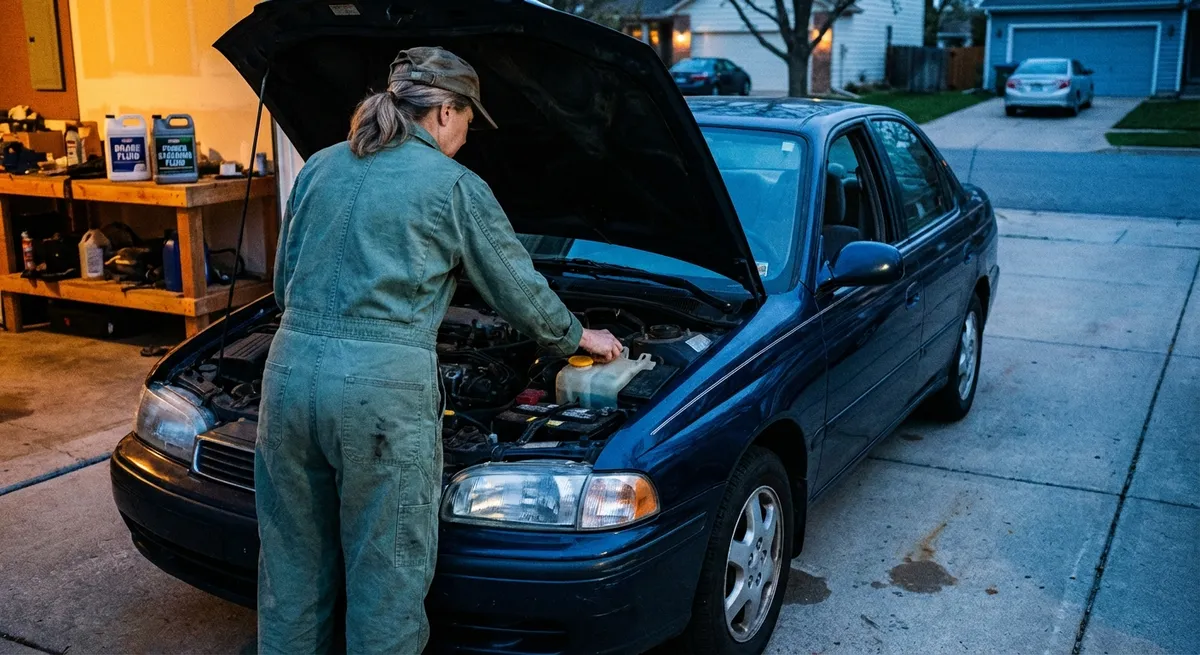
This guide walks through five often-overlooked fluid habits that make a real difference, especially if you actually enjoy driving and want your car to stay sharp, not just “running.”
Know Your Car’s Fluid Map (And Where To Check Each One)
Before you can maintain fluids, you need to actually know where everything lives under your hood and under the car.
Start with your owner’s manual. Most manuals have a section that shows the location of your engine oil dipstick, coolant reservoir, brake fluid reservoir, power steering fluid (if equipped), and windshield washer tank. Some also note whether your transmission has a dipstick or is “sealed” and requires a shop to inspect.
Spend 10–15 minutes with the hood open and the manual in hand. Label caps with a paint pen if it helps: “OIL,” “COOLANT,” “BRAKE,” etc. This is especially useful if multiple people drive or maintain the car. If your car is newer and has an underbody cover, note that some fluid checks (like differential or transfer case fluid on AWD/4×4 vehicles) may require lifting the vehicle and removing panels—work best handled by a shop if you’re not comfortable.
The goal is simple: you shouldn’t be guessing about what’s under the hood. When you know exactly where each fluid is and how to check its level, you’re more likely to catch problems early—long before they feel like problems behind the wheel.
Actionable point #1:
Create a quick “fluid map” for your specific car: take a photo under the hood, then annotate or print it out and label each fluid location. Keep it with your service records or in the glovebox.
Make Engine Oil Checks a Habit, Not a Reaction
Even if you follow the service interval for oil changes, you can’t assume the engine is always at a perfect level. Engines burn oil at different rates, especially as mileage climbs, and extended drain intervals on modern cars mean more time for a level to drift from “OK” to “dangerous.”
Check oil at least once a month, and before any long road trip. Do it on level ground with a warm engine that’s been turned off for a few minutes so the oil can drain back to the pan. Pull the dipstick, wipe it, reinsert fully, then pull again and look at both level and color. Slightly dark oil isn’t a problem on its own, but gritty or thick sludge-like oil is a warning sign.
If the level is low but still on the dipstick range, top off with the exact grade and specification listed in your owner’s manual. Don’t mix random “close enough” viscosity oils; modern engines are often designed for very specific formulations. If you regularly need more than about a quart between oil changes, ask a mechanic to investigate consumption issues, leaks, or PCV system problems.
Keeping oil within the proper range protects everything from timing chains and cam phasers to turbochargers. For enthusiasts who drive hard or track their cars, more frequent checks (and shorter intervals) pay off in reduced wear and more consistent performance.
Actionable point #2:
Set a recurring reminder on your phone or calendar to check engine oil monthly, and always keep one extra quart of the correct oil in your trunk or garage.
Treat Coolant as a Critical System, Not Just “Antifreeze”
Coolant doesn’t just stop your engine from freezing—it carries heat out of the engine, prevents overheating, and contains additives that protect internal passages from corrosion and scale. Those additives wear out over time, even if the coolant still “looks fine.”
Always check coolant at the reservoir, not by removing a hot radiator cap. Most reservoirs have “MIN” and “MAX” marks that you should check when the engine is cold. A small variation isn’t catastrophic, but if it’s repeatedly dropping below “MIN,” you may have a slow leak from a hose, water pump, radiator, or heater core.
Don’t top off with straight water unless you’re dealing with an emergency and plan a proper flush later. Use the correct type of coolant (different chemistries exist: OAT, HOAT, specific OEM blends) and mix ratio specified by your manufacturer. Mixing incompatible types can reduce corrosion protection and shorten the life of water pumps and radiators.
For performance-minded drivers, a healthy cooling system keeps engine temps stable under load, which keeps power consistent and reduces the risk of knock or premature component wear. If you see rust-colored coolant, sludge, or an oily sheen, stop driving and have the system inspected immediately—those are signs of internal contamination or more serious issues like head gasket failure.
Actionable point #3:
During each oil change, make a habit of visually checking the coolant reservoir level and hoses for seepage, crusty buildup, or cracks—and record the date and odometer if you ever add coolant.
Don’t Ignore “Lifetime” Fluids: Transmission and Differential
Many modern cars advertise “lifetime” transmission or differential fluids, but “lifetime” often means “the life of the warranty” or “the period before a typical owner trades the car,” not the life of the mechanical parts if you want to keep the vehicle long-term.
Automatic transmissions, dual-clutch gearboxes, CVTs, and differentials all rely on clean, properly formulated fluid to handle heat and load. Over time, that fluid picks up wear particles and breaks down under thermal stress, especially if you tow, drive in heavy traffic, or enjoy spirited driving.
Because many newer transmissions don’t have an external dipstick, you’ll be relying on service intervals and symptoms, not quick driveway checks. Shifts that feel harsher or slower, whining noises under load, or delayed engagement when shifting from Park to Drive are all warning signs. By then, though, you may already be late.
If you own an enthusiast-focused car, truck, or SUV, look up the “severe service” schedule in your manual or on the manufacturer’s service website and use that as your rule, not the “normal driving” schedule. Even if your manufacturer doesn’t specify a change, many independent experts recommend a fluid service in the 60,000–90,000 mile range for transmissions and differentials you plan to keep long-term.
Actionable point #4:
Check your owner’s manual (or official service site) for transmission and differential fluid intervals, then add those to your maintenance log with target mileage so they don’t get forgotten once you pass 60,000 miles.
Keep Brake Fluid and Power Steering Fluid Fresh for Confidence and Control
Brake fluid and power steering fluid rarely get attention until there’s a serious problem, but both directly impact how your car feels and how safely it stops or steers—especially under high load or emergency maneuvers.
Brake fluid is hygroscopic: it absorbs moisture from the air over time, which lowers its boiling point and can promote internal corrosion. That moisture also makes pedal feel spongier under hard braking. Most manufacturers recommend a brake fluid change around every 2–3 years, regardless of mileage. Enthusiasts who brake hard or track their cars may benefit from more frequent changes and higher-performance fluid rated to a higher boiling point (while still matching manufacturer specs for compatibility).
You can visually inspect brake fluid at the reservoir: it should be clear to light amber. Dark, murky, or very brown fluid is a sign it’s overdue. Never top off with random fluid; use the exact DOT rating (DOT 3, 4, or 5.1) specified by your car. DOT 5 (silicone-based) is usually not compatible with systems designed for DOT 3/4/5.1.
For vehicles with hydraulic power steering (as opposed to electric), power steering fluid also degrades over time, especially with repeated high-angle steering inputs (parking, autocross, tight back roads). Whining noises while turning, heavy steering, or visible foaming in the reservoir are all signs of trouble. Some cars use unique OEM-specific steering fluids, so always confirm the correct type before topping off or flushing.
Fresh fluid in these systems keeps pedal feel consistent, steering effort predictable, and the relationship between your inputs and the car’s response tight and confidence-inspiring.
Actionable point #5:
Add a two-year reminder to your maintenance plan for a brake fluid change, and ask your mechanic to inspect (and if needed, flush) power steering fluid during your next major service.
Conclusion
Fluids are the quiet, invisible foundation of how your car feels and how long it lasts. They don’t grab attention like new wheels or a tune, but they protect the mechanical parts that make those upgrades worthwhile.
By mapping your car’s fluids, checking oil and coolant regularly, planning real service for “lifetime” transmission and differential fluids, and keeping brake and steering fluids fresh, you’re doing more than basic maintenance—you’re preserving the sharpness, reliability, and character of the car you enjoy driving.
Work these five habits into your regular routine, and you’ll notice the difference not just at the shop, but every time you’re behind the wheel.
Sources
- [U.S. Department of Energy – Maintaining Your Vehicle](https://www.energy.gov/energysaver/maintaining-your-vehicle) - Explains how regular maintenance (including fluids) improves efficiency and longevity
- [NHTSA – Vehicle Maintenance Checklist](https://www.nhtsa.gov/sites/nhtsa.gov/files/2022-03/veh_maint_chklist_032022-v3-tag.pdf) - Federal safety-focused checklist including brake and fluid-related items
- [AAA – The Truth About Engine Oil and Engine Oil Changes](https://newsroom.aaa.com/2020/06/truth-about-engine-oil-and-engine-oil-changes/) - Discusses modern oil change intervals and why checks still matter
- [Ford Motor Company – Scheduled Maintenance Guide](https://www.ford.com/support/how-tos/owner-resources/schedule-maintenance/service-schedules/) - Example of manufacturer guidance on fluid service intervals
- [University of California, Davis – Coolant and Antifreeze Facts](https://safetyservices.ucdavis.edu/units/occupational-health/iatp/coolant-antifreeze-facts) - Covers coolant composition, hazards, and why proper handling and changes are important