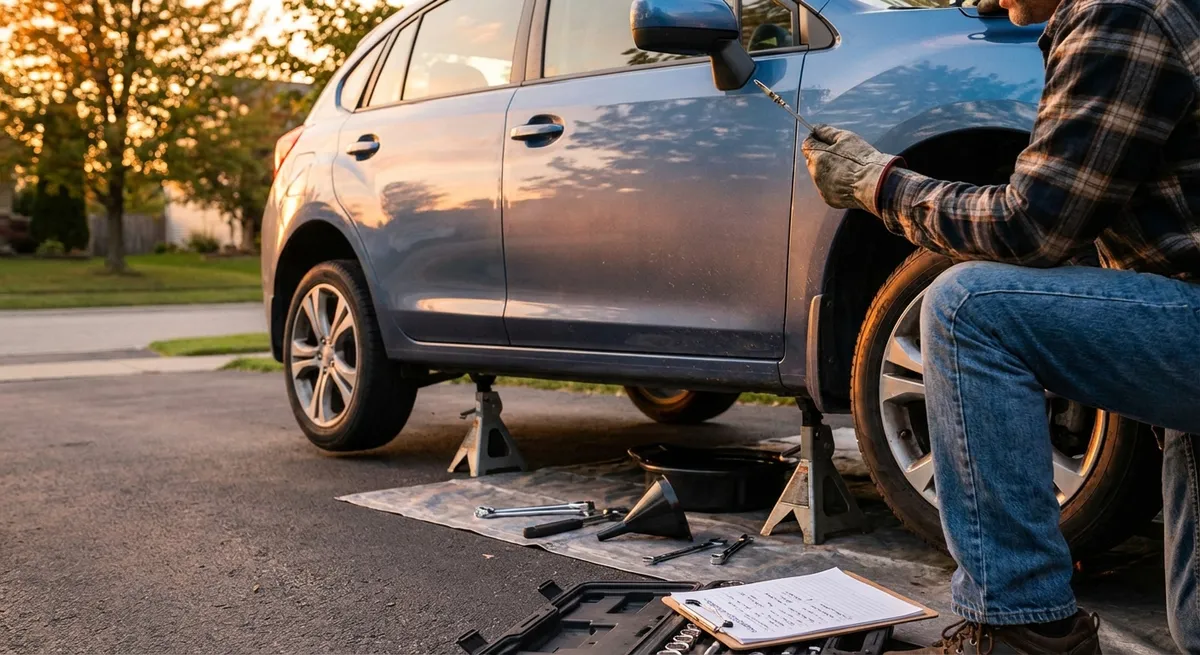
This isn’t a mechanic’s fantasy checklist. These are realistic, real-world actions you can fit into a busy week and still see a difference in how your car drives, feels, and ages.
Build a Quick Visual Walk-Around into Your Routine
A 60-second walk-around once or twice a week can catch issues long before they’re expensive—or dangerous.
Look at your car the way a tech doing an inspection would:
- Tires: Check for uneven wear, bulges, exposed cords, or anything stuck in the tread. Uneven wear can point to alignment or suspension problems. Also look at tread depth—if it’s close to the wear bars molded into the grooves, it’s time to plan a replacement.
- Leaks under the car: After your car has been parked for a while, glance at the ground. Dark, oily spots can be oil or transmission fluid; green, orange, or pink puddles may be coolant; clear water under the passenger side is usually just A/C condensation (normal).
- Lights: In the evening or in a garage, turn on headlights, high beams, brake lights, reverse lights, and turn signals. Use reflections in glass or a nearby wall, or have someone help. Being “that car” with one working headlight is both unsafe and a ticket magnet.
- Glass and mirrors: Chips in the windshield can often be repaired cheaply—if you catch them before they spread crack lines across the glass.
- Exhaust smell and sound: If you notice a new, sharp exhaust note or smell fumes inside the cabin, that’s an urgent safety issue (carbon monoxide risk) and needs a shop visit immediately.
This tiny habit acts like an early-warning radar. You’re not diagnosing; you’re just noticing changes before they turn into breakdowns.
Respect Warm-Up and Cool-Down: How You Drive Matters More Than You Think
Modern cars don’t need to idle forever, but how you treat them in the first and last few minutes of a drive has a direct impact on wear—especially on engines and transmissions.
On cold starts:
- Start the car, wait about 15–30 seconds for oil pressure to stabilize and idle to settle.
- Drive off gently—avoid high RPM, full-throttle launches, or sustained high-speed driving until the engine is at normal operating temperature.
- Cold oil is thicker and doesn’t flow as well; aggressive driving before warm-up accelerates wear on bearings, piston rings, and even automatic transmissions.
Before shutting down:
- After a highway run or heavy load (mountain driving, towing, or spirited backroad run), give the car a “cool-down mile” of easy driving before you park.
- For turbocharged cars, this is especially valuable; gentle driving allows oil to circulate and temperatures to drop, which helps prevent oil coking in the turbo’s bearings.
These tiny adjustments don’t show up on a dashboard, but over 100,000+ miles, they’re the difference between a motor that feels loose and tired and one that still pulls clean and strong.
Treat Tires and Alignment as Core Maintenance, Not Optional Extras
For most drivers, tires are the biggest overlooked maintenance item, even though they affect safety, performance, and cost more than almost any other “wear” component over a car’s life.
Key habits that actually move the needle:
- Check pressure monthly and before long trips. Use a quality gauge, and set pressures to the spec on the driver’s doorjamb sticker, not what’s printed on the tire sidewall. Underinflation increases flex, heat, wear, and fuel consumption; overinflation ruins ride and reduces grip.
- Rotate tires on schedule. Most manufacturers recommend rotating every 5,000–8,000 miles, often paired with oil changes. Rotation equalizes wear so you get the full life from a set instead of replacing two at a time.
- Pay attention to the steering wheel. If the car pulls to one side, the steering wheel isn’t centered on a straight road, or you feel new vibrations at speed, it’s time to have alignment and balance checked.
- Respect the age of the tire, not just the tread. Rubber hardens and cracks with time. Many safety organizations suggest being cautious with tires older than 6–10 years even if there’s tread left—UV, temperature swings, and storage all degrade the structure.
For enthusiasts, good tires with correct pressures and a proper alignment are the single most noticeable “upgrade” to how any car feels—more than many bolt-on mods.
Make Engine Air and Cabin Filters Part of Your Normal Schedule
Filters are cheap, easy to overlook, and quietly influential. Two in particular deserve a permanent spot on your maintenance radar: the engine air filter and the cabin air filter.
Engine air filter:
- Purpose: It keeps dirt, dust, and debris from entering the engine’s air intake.
- Why it matters: A severely clogged filter can hurt performance and fuel economy, and in dusty environments, a worn or damaged filter can let abrasive particles into the engine.
- Practical rule: Inspect at least once a year or every 12,000–15,000 miles, more often if you drive on dirt roads, in construction zones, or through dusty climates. Replace when it looks dirty or per your owner’s manual.
- Enthusiast angle: Consistent airflow helps ensure the ECU doesn’t need to constantly compensate for restrictions, keeping throttle response predictable and power delivery smooth.
Cabin air filter:
- Purpose: Filters the air entering your cabin through the HVAC system, catching dust, pollen, and often odors.
- Why it matters: A clogged cabin filter reduces airflow, makes the fan work harder, can contribute to foggy windows, and lets musty smells linger. For allergy sufferers, it’s a game-changer.
- Practical rule: Typically replaced every 12,000–20,000 miles, or annually. If your fan seems weak or you smell funk when switching on A/C or heat, check it sooner.
Both filters are often DIY-friendly on most cars with basic tools, and swapping them out can easily be a 10–20 minute job that pays off every time you start the car.
Create a Simple, Written Maintenance Log (Your Future Self Will Thank You)
Whether your car is a humble commuter or your cherished weekend toy, tracking what you’ve done—and when—turns guesswork into data.
You don’t need special software. A notes app, spreadsheet, or small notebook in the glovebox works fine. For every maintenance event, include:
- Date and mileage
- What was done (oil change, brake pads, coolant flush, battery replacement, etc.)
- What parts/fluids were used (brand, viscosity, specifications if relevant—e.g., 0W-20 synthetic meeting manufacturer specs)
- Where it was done (shop name or “DIY”)
- Any observations (e.g., “front pads at 3 mm; recommend replace next visit,” “small oil seep near valve cover,” “battery tested borderline, monitor.”)
Why this matters:
- Prevents over- or under-servicing. No more wondering “Did I change this last year or the year before?” You’ll know.
- Helps diagnose problems. If you track when a new noise or symptom appeared relative to a repair, it’s easier to connect the dots.
- Boosts resale value. A clean, well-documented maintenance history is one of the most powerful signals to a buyer—or dealer—that a car has been cared for.
- Supports warranty and recall work. If a component fails early, records showing proper maintenance can help with goodwill repairs or warranty decisions.
Enthusiasts already know: the best “mod” for reliability is documentation. It turns your car’s history from a mystery into a clear story.
Conclusion
Keeping a car healthy isn’t about memorizing every line of the service manual—it’s about creating a handful of habits that quietly stack the odds in your favor. A quick weekly walk-around, mindful warm-up and cool-down, intentional tire and alignment care, smart filter changes, and a simple maintenance log are all low-effort steps that pay back in reliability, safety, and driving enjoyment.
Your car doesn’t need perfection; it needs consistency. Start with one or two of these habits this week, build from there, and you’ll feel the difference every time you turn the key.
Sources
- [National Highway Traffic Safety Administration (NHTSA) – Vehicle Maintenance](https://www.nhtsa.gov/road-safety/vehicle-maintenance) – Federal guidance on basic maintenance practices that improve road safety
- [Car Care Council – Car Care Resources](https://www.carcare.org/car-care-resource/car-care-guide/) – Consumer-focused explanations of maintenance items like filters, fluids, and inspections
- [U.S. Department of Energy – Fuel Economy: Keeping Your Car in Shape](https://www.fueleconomy.gov/feg/maintain.jsp) – Details on how proper tire pressure, filters, and tune-ups affect efficiency and performance
- [Bridgestone Tire – Tire Maintenance Tips](https://www.bridgestonetire.com/learn/tire-care-maintenance/) – Practical guidance on tread wear, rotation, inflation, and alignment considerations
- [AAA – Vehicle Maintenance Checklist](https://exchange.aaa.com/automotive/automotive-maintenance/vehicle-maintenance-checklist/) – Overview of key systems and service intervals for long-term vehicle reliability