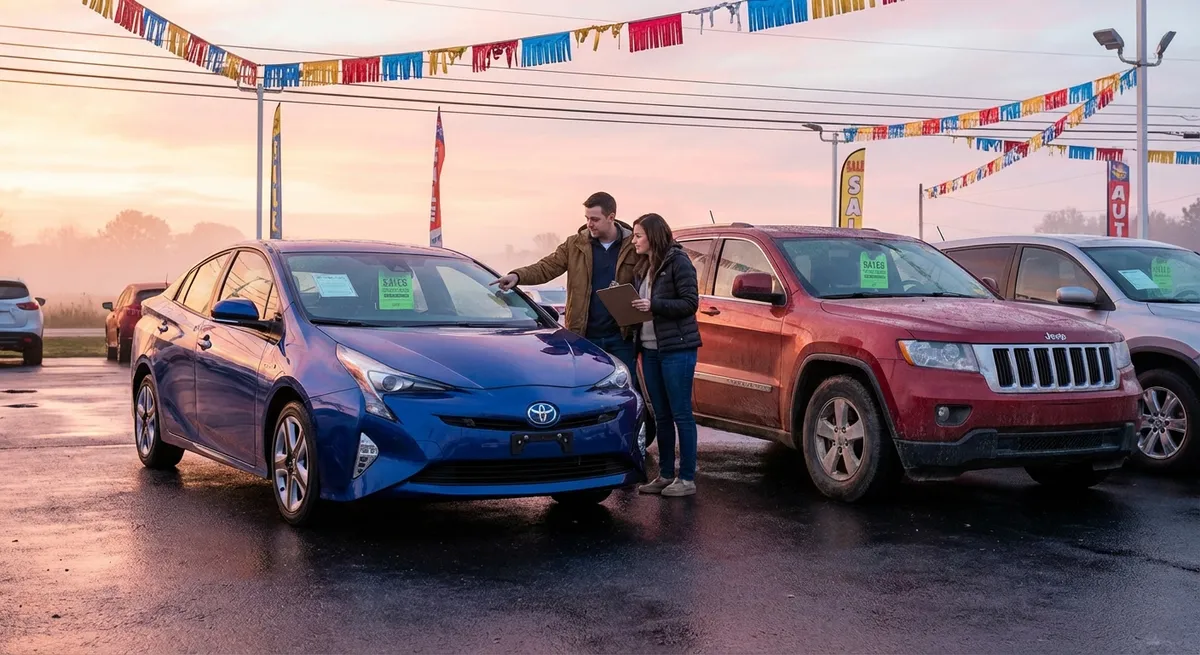
This guide focuses on practical, real‑world buying moves you can actually use, with five actionable points you can apply to almost any purchase.
Read the Market, Not Just the Window Sticker
Before you fall in love with a specific car, you need a realistic read on the market you’re walking into. The same model can feel “expensive” or “fair” depending on broader trends you may not see at first glance.
Start by tracking price ranges for your target vehicle over a few weeks on multiple platforms—franchise dealers, independent dealers, and private sellers. Look for patterns in mileage, trim, and equipment versus price. This will give you a working “band” of what’s normal, along with outliers that are suspiciously cheap or unreasonably high.
Use this research to separate emotional wants from value realities. For example, that rare color or wheel package might carry a higher asking price but almost no added resale value later. On the flip side, a less flashy spec with key functional options (advanced safety package, adaptive cruise, all‑weather package) often holds value better and is easier to sell or trade.
Pay attention to local versus regional pricing. In high‑demand metro areas, lightly used vehicles can be priced close to new; expanding your search radius 100–200 miles can give you leverage and fallback options. If you discover that your local dealer is consistently on the high side, you can either use cheaper out‑of‑area listings as negotiation pressure or simply be ready to travel for a better‑structured deal.
Market awareness doesn’t just help you negotiate—it tells you when not to. If inventory is genuinely tight and comparable examples are all near the same number, your best move might be to focus less on squeezing the last few hundred dollars and more on getting the right car with favorable long‑term costs (warranty coverage, interest rate, and condition).
Use Timing to Tilt the Numbers in Your Favor
Car pricing doesn’t live in a vacuum—dealers are chasing monthly, quarterly, and annual targets, and manufacturers are constantly adjusting incentives to move the metal they care about most right now. You can’t control that, but you can align your timing with it.
Month‑end and quarter‑end can still be useful, but they’re not magic. Some stores hit their quotas early and stop dealing aggressively; others are behind target and become very flexible in the last few days. This is where pre‑shopping is critical: if you’ve already narrowed your options and contacted multiple dealers, you can quickly pivot when one suddenly has motivation to move a specific car near the end of a cycle.
Seasonality also matters. Convertibles and performance cars tend to be more negotiable as cold weather sets in, especially in snow‑belt regions. All‑wheel‑drive crossovers and trucks may be firmer in late fall but softer as winter turns to spring and demand stabilizes. If your current car is still usable, consider planning your purchase a season “ahead” of what you want, not during peak emotional demand.
Model changeovers are another opportunity. When a refreshed or redesigned model is arriving, outgoing versions can see extra factory cash, subsidized financing, or dealer‑specific discounts—especially if consumer interest instantly shifts to the new body style. For an enthusiast, this can be a sweet spot: you get a mechanically proven platform, often with heavy discounts, as long as you’re okay with it being the “older” design on paper.
If you’re eyeing an EV or plug‑in hybrid, keep an eye on federal and state incentive timing. Some credits have income caps, MSRP limits, or phase‑out schedules. Structuring your buying window to lock in a specific incentive can be more valuable than haggling on a few hundred dollars of dealer discount.
Separate the Parts of the Deal (So You Don’t Lose the Plot)
One of the easiest ways to overpay is to talk about everything at once: price, trade‑in, payments, add‑ons, and financing blended into one confusing conversation. Dealers often present “monthly payment” as the main focus, which hides markup and extras inside a number that sounds manageable.
Start by isolating the purchase price of the car before taxes and fees. Treat it like a separate negotiation from your trade‑in and financing. You want to know exactly what you’re paying for the vehicle itself compared to your market research. A clean quote will show vehicle price, destination, dealer fees, and any installed accessories line by line. Ask for this breakdown in writing or via email.
Once you have a clear sale price, move on to your trade‑in as a separate transaction. Have a good idea of its value by checking multiple appraisal tools and, ideally, getting at least one real‑world offer (for example, from an online car‑buying service). If the dealer’s trade offer is weak, you can either push them up using your external offers or be prepared to sell your car independently. Running both paths in parallel keeps you from getting boxed in.
Only after you’re satisfied with the price and trade should you talk about how you’ll pay—cash, financing, or leasing. This layering protects you from a common trap: accepting a strong trade number or attractive payment while quietly giving back the savings via inflated sale price, extended terms, or unnecessary add‑ons rolled into the loan.
By breaking the deal into parts, you keep your mental bandwidth focused. You’re less likely to say yes to “it all looks good” when you haven’t actually evaluated each piece on its own merits.
Make Financing Work for You, Not the Dealer
Financing is where many solid deals quietly turn into expensive ones. Even a small bump in interest rate or an extra year of term can add thousands in cost, usually hidden behind a comfortable monthly payment.
Start with your own pre‑approval before you shop in person. Credit unions and community banks often offer lower, more transparent rates than dealer‑arranged financing. Having a pre‑approved offer in hand gives you a benchmark; if the dealer wants your financing business, they’ll need to match or beat it. This turns their finance office from a mystery box into a competitive bidder.
Be wary of stretching the loan term just to hit a lower monthly number. A 72‑ or 84‑month loan might feel affordable, but you’ll pay more interest over time, and you may end up “upside down” (owing more than the car is worth) for years. Aim for the shortest term you can reasonably manage while leaving room in your budget for insurance, maintenance, fuel, and unexpected repairs.
Manufacturer‑subsidized rates (like 0% or very low APR offers) can be attractive, but do the math. Sometimes the low rate comes at the cost of fewer rebates or discounts. Compare the total cost of: (a) low APR with minimal rebates and (b) larger rebates with a higher but still competitive rate from your bank or credit union. The better deal is the one with the lower total cost over the life of the loan, not just the flashier headline.
In the finance office, scrutinize every line. Products like extended warranties, tire and wheel coverage, paint protection, and gap insurance can be useful in specific cases, but they’re high‑margin items with heavily variable pricing. If you want one of these, research independent options beforehand and be ready to say no if the dealer’s price is high or the coverage is vague. You should never feel rushed into signing for extras you don’t fully understand.
Inspect and Verify Before You Commit
Whether the car is new or used, never assume that “on paper” equals “in reality.” A careful inspection and verification process helps you avoid inheriting someone else’s problems—or paying full price for a car that isn’t as represented.
For used vehicles, a pre‑purchase inspection (PPI) by a reputable independent mechanic is non‑negotiable, especially on performance or luxury cars where repair costs can be steep. A good PPI checks for hidden accident damage, worn suspension components, leaks, pending maintenance items (like timing belts or brake jobs), and electronic faults that may not trigger obvious warning lights yet. The cost of a PPI is small compared to the leverage it gives you—or the money it can save you from a bad buy.
Request and review service history wherever possible. Manufacturer service records, dealer invoices, or even well‑organized independent shop receipts help you see if maintenance has been consistent and done on time. Gaps don’t automatically mean the car is bad, but they should prompt closer inspection. For turbocharged, direct‑injection, or high‑revving engines, proof of regular oil changes with the correct specification is especially important.
For new cars, don’t skip the inspection just because the odometer is near zero. Walk around the car in good lighting and check paint consistency, panel gaps, wheels, glass, and interior surfaces for damage or defects. Confirm that all promised accessories and options are actually present—floor mats, spare tire or repair kit, charging cable for EVs, second key, and any specific packages you ordered. Test all electronics, from driver‑assist systems to infotainment and climate controls.
Finally, take the test drive seriously. Don’t let it be a quick loop around the block at low speed. Listen for noises, feel for vibrations, test braking performance, and experience highway speeds if possible. For enthusiasts, make sure the car behaves the way you expect under real‑world acceleration, cornering, and braking, not just casual commuting. If something feels off, pause the deal and investigate before signing, not after.
Conclusion
A strong car purchase isn’t just about negotiating a number—it’s the result of understanding the market, timing your move, structuring the deal in parts, owning your financing, and verifying the actual vehicle in front of you. When you approach buying this way, you shift from reacting to sales tactics to executing your own plan.
For enthusiasts and everyday drivers alike, the goal is the same: a car that fits your life, at a price and structure that still feels good years later. With a bit of preparation and discipline around these five points, you’ll walk into any showroom or private sale with clear benchmarks, real leverage, and far fewer surprises.
Sources
- U.S. Bureau of Labor Statistics – Consumer Price Index: Motor Vehicles - Provides historical pricing and inflation context for new vehicle costs
- Consumer Reports – How to Buy a New Car - Practical overview of pricing, incentives, and deal structure
- FTC – Buying a Used Car - U.S. Federal Trade Commission guidance on inspections, contracts, and red flags in used‑car purchases
- National Highway Traffic Safety Administration (NHTSA) – Vehicle Safety Recalls - Official database to check VINs for open safety recalls before buying
- National Automobile Dealers Association (NADA) – Understanding Vehicle Financing - Explains dealership financing, loan terms, and consumer considerations