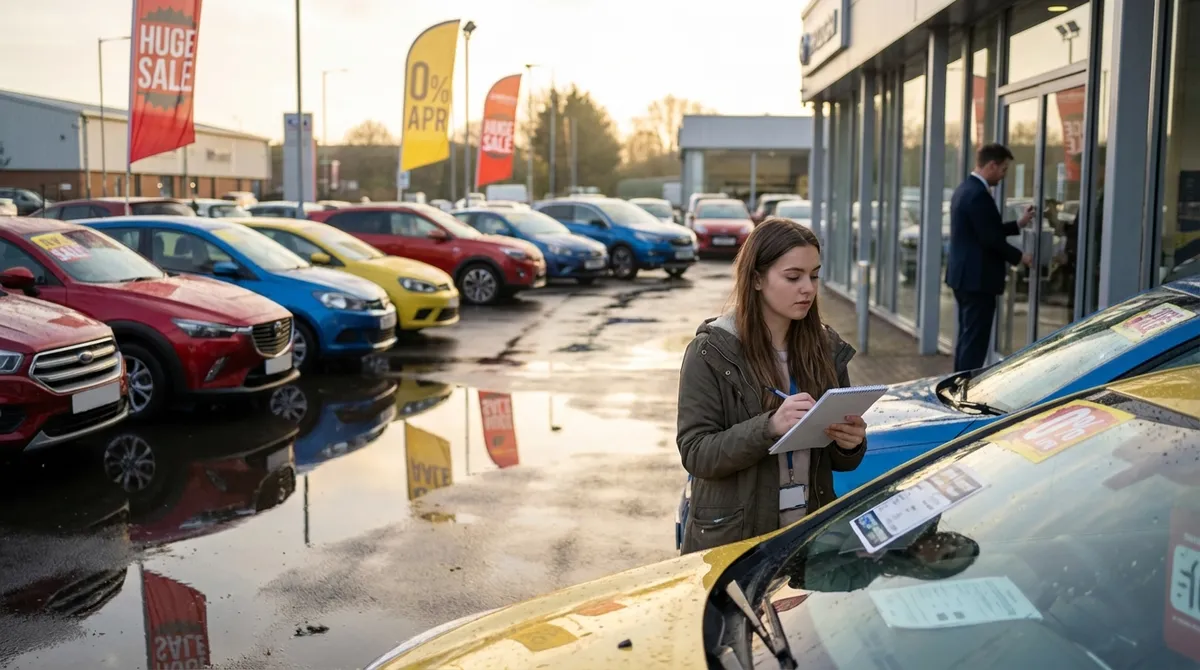
This guide focuses on the practical side of how and when to buy, not just what to buy. These five actionable moves are designed for real-world car buyers who want solid value without turning the process into a second job.
Understand the Market Before You Step Onto a Lot
Walking into a dealership “just to look” without a clear price anchor is how buyers end up thousands above what they could have paid.
Start with big-picture pricing, then narrow down:
- Use vehicle valuation tools to get a realistic price range for the specific year, model, mileage, and trim you’re considering. Don’t just check one site—look at a few to see the spread.
- Compare local listings, not just national averages. A car that’s common in one region may be scarce and more expensive in another.
- Look at supply indicators: if many similar cars sit on local lots for weeks, you have more leverage. Fewer listings, especially for a hot model, shift power to the seller.
- Pay attention to incentives and rebates listed on manufacturer websites and automotive news outlets. These directly affect how much room there is to negotiate.
- Use this data to form a walk-away price: the number where you’re comfortable leaving, even if the salesperson counters. That number keeps emotion from driving your decision.
Once you have a baseline, you’re no longer guessing; you’re comparing the dealership’s numbers to an informed reference, not to your feelings in the moment.
Time Your Purchase Around Real-World Patterns, Not Myths
Some buying myths (like “always buy on a rainy day”) are mostly folklore, but a few timing patterns are supported by data and dealer behavior.
Consider these timing advantages:
- End of the month/quarter/year: Many sales teams work on targets and volume bonuses. When they’re behind on goals, they can be more flexible on price, especially on in-stock units.
- Model-change windows: When a new model year is announced or arrives, outgoing inventory often gets more aggressive discounts—even if the outgoing model is still essentially the same car.
- Holiday promotion periods: Major sales events (Memorial Day, Labor Day, year-end) can combine factory incentives with dealer discounts, especially on slower-moving trims.
- Off-peak demand seasons:
- Convertibles and sports cars may be less in demand during colder months.
- AWD crossovers and SUVs can sometimes be more negotiable at the end of winter than at the beginning.
- Mid-week vs. weekend: On slower weekdays, you’re more likely to get a salesperson’s time and attention, which can lead to more transparent discussions and less pressure.
Timing won’t turn a bad deal into a great one, but stacked with good prep, it can move you closer to the low end of the realistic price range.
Separate the Car Price From the Rest of the Deal
One of the most powerful tactics is also one of the simplest: unbundle the transaction.
Dealerships often blend multiple levers at once—price, trade-in, financing, and extras—so that you only see the monthly payment. That makes it hard to know where you’re winning or losing.
Instead:
- Negotiate the vehicle price first, based on your research, before talking trade-ins or financing. Stay focused on the out-the-door (OTD) price, which includes all taxes and fees.
- Once you have a clear written quote for the OTD price, then discuss your trade-in. Use trade valuation tools in advance so you know whether their offer is reasonable.
- Treat financing as its own product:
- Compare the dealer’s rate to pre-approved offers from your bank or credit union.
- A slightly lower car price with a higher interest rate can cost more over time than a slightly higher price with a better loan.
- Watch for add-ons (extended warranties, paint protection, gap coverage) quietly padded into the payment. Ask for a full line-item breakdown and decline anything you don’t clearly understand or need.
By separating each piece, you make it harder for a seller to offset a “discount” on one line with hidden costs on another.
Use Pre-Approval and Online Options as Real Leverage
Modern car buying doesn’t have to start at a showroom. Done right, you can handle most of the heavy lifting from your laptop or phone.
Put these tools to work:
- Get pre-approved for a loan from a bank or credit union before visiting the dealer. This gives you:
- A clear budget ceiling
- A benchmark interest rate
- The ability to say “I’m already financed” if the dealer’s offers are worse
- Use online price quotes from multiple dealerships on the same or similar vehicles. Ask for OTD quotes in writing and compare them side by side.
- If you’re flexible on color or minor features, tell dealers you’re willing to look at multiple stock numbers, not just one car. This widens your options and your leverage.
- For used cars, request the VIN and run your own checks (vehicle history report, recall status) before you negotiate. A clean or problematic history can justify your target price.
- In some markets, online-first platforms or dealer home-delivery programs can simplify the process. Even if you prefer buying in person, their pricing can serve as a competitive reference.
When a dealership knows you have real alternatives—financing and vehicles—there’s more incentive for them to bring their best offer forward.
Protect Yourself With a Structured Inspection and Test Strategy
Enthusiasts often care about engines, handling, and options—but value is destroyed quickly if you miss mechanical or ownership red flags.
Before you decide a deal is “good” based on price alone:
- For used vehicles, line up a pre-purchase inspection (PPI) with an independent mechanic you choose. Many shops offer flat-rate inspections and can spot upcoming maintenance or repair time bombs.
- Review maintenance records whenever possible. Regular oil changes, fluid services, and major interval work (like timing belts) suggest the previous owner cared about longevity.
- Check for open recalls using the VIN on official recall sites. Recall work is typically free, but unresolved issues can hint at neglected care.
- During the test drive:
- Pay attention to transmission behavior (shifts, delays, jerks)
- Listen for suspension noises over bumps
- Test brakes for noise, vibration, and straight-line stopping
- Check all tech features (infotainment, cameras, sensors) for glitches
- After driving, inspect tires for uneven wear (could signal alignment or suspension issues) and look for signs of leaks under the car.
A slightly more expensive car that’s mechanically solid is often a smarter buy than a “bargain” that needs thousands in near-term repairs.
Conclusion
Buying a car you feel good about years later isn’t about outsmarting salespeople; it’s about stacking a few practical advantages in your favor.
Understand real-world pricing before you shop, time your purchase when inventory and incentives work for you, unbundle the deal so you can see where money is really moving, use online tools and pre-approval to create genuine leverage, and protect yourself with thorough inspections and purposeful test drives.
Taken together, these moves don’t just save money—they help you end up with a car that fits your life, your budget, and your expectations on the road.
Sources
- [U.S. Bureau of Labor Statistics – Consumer Price Index: New and Used Vehicles](https://www.bls.gov/cpi/factsheets/new-vehicles-and-used-cars-and-trucks.htm) - Provides data on pricing trends for new and used vehicles, helpful for understanding market conditions
- [Kelley Blue Book – Car Values](https://www.kbb.com/car-values/) - Industry-standard tool for estimating vehicle values and checking fair prices in your area
- [Consumer Reports – Car Buying & Pricing](https://www.consumerreports.org/cars/buying-a-car/) - Independent guidance on pricing, negotiating, and evaluating vehicles
- [Edmunds – How to Buy a New Car](https://www.edmunds.com/car-buying/how-to-buy-a-new-car.html) - Detailed breakdown of the modern buying process, including online quotes and negotiation tips
- [National Highway Traffic Safety Administration (NHTSA) – Recall Lookup by VIN](https://www.nhtsa.gov/recalls) - Official database for checking safety recalls on specific vehicles