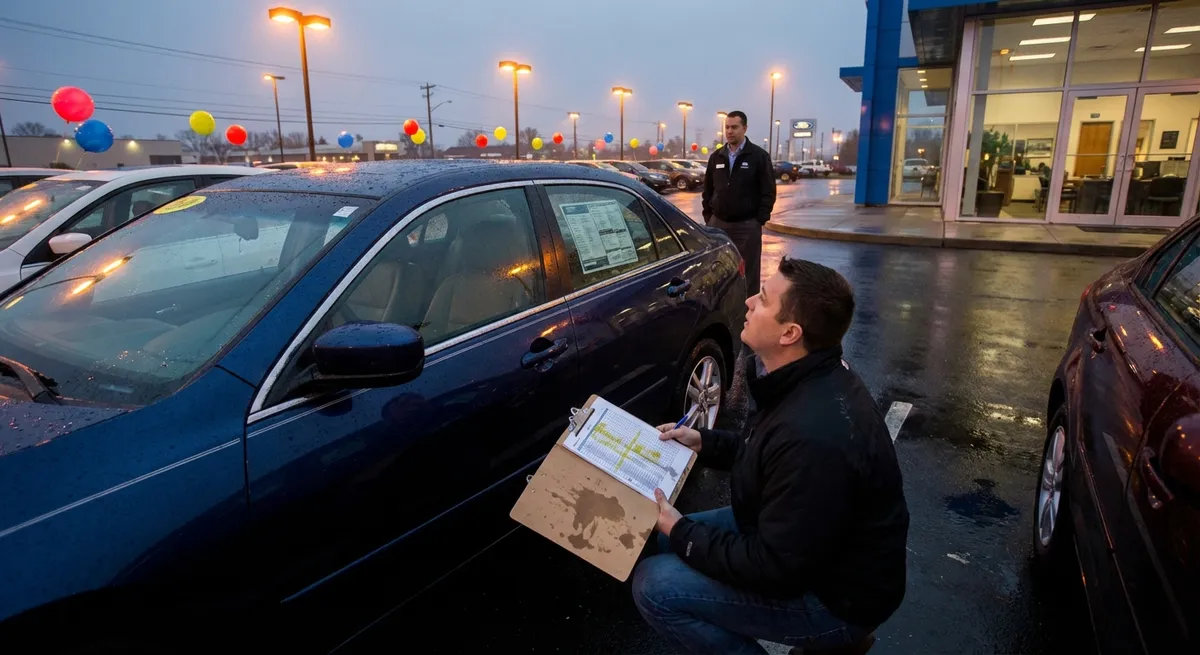
This guide breaks down five practical, real-world tactics that move you from “hope this is a good deal” to “I know exactly what I’m paying for and why.”
Separate the Car Price From the Monthly Payment
Salespeople love to ask, “What monthly payment are you looking for?” It sounds helpful, but it’s designed to keep you focused on one number instead of the actual cost of the car.
Here’s how to protect yourself:
- Refuse to negotiate on monthly payment. Tell them you’re only discussing the out-the-door (OTD) price: vehicle price + taxes + fees + mandatory add-ons.
- Ask for a written breakdown. Before you talk financing, get the OTD price on paper or via email. If they won’t provide a clean breakdown, that’s a signal to walk.
- Know how payment can be manipulated. Dealers can stretch the loan term (e.g., from 60 to 84 months) to make a payment look affordable while you pay thousands more in interest.
- Use your own calculator. Plug the sale price, term, and APR into an online auto loan calculator to verify what the payment should be. If their numbers don’t match, ask why.
- Treat financing as a separate negotiation. First agree on OTD price, then shop the loan. This keeps each piece of the deal transparent and easier to compare.
When you make dealers talk in OTD numbers instead of “What do you want your payment to be?”, it becomes much harder for hidden fees and inflated add-ons to sneak into the deal.
Test the Car for Your Actual Life, Not the Showroom
A 10-minute loop around the dealership tells you almost nothing about how the car will feel in six months. You want the test drive to mimic your real driving as closely as possible.
Make your test drive work for you by:
- Driving the way you actually drive. If you commute in heavy traffic, drive it in traffic. If you take highway trips, get it on the highway and test lane changes, passing, and road noise.
- Testing visibility and comfort. Adjust the seat, mirrors, and steering wheel as you would daily. Check blind spots, rear visibility, and how easy it is to see the instrument cluster and infotainment.
- Evaluating ride + noise, not just power. Notice cabin noise at 40–70 mph, how the suspension handles rough surfaces, and whether you feel fatigue after 20–30 minutes. That’s what you’ll live with.
- Trying real-life loading. If you can, bring your car seats, stroller, luggage, golf clubs, or tools. Open the trunk, fold the rear seats, and confirm it actually fits.
- Paying attention to controls. Test the backup camera, climate controls, driver-assist systems, and infotainment while parked. Ask yourself: “Can I operate this without digging in menus while driving?”
A car that feels exciting for 5 minutes in the showroom can become annoying if the seats pinch your shoulders, the infotainment lags, or the cabin booms on the highway. Buy for the way you live, not the way the car looks on a rotating platform.
Use Total Cost of Ownership, Not Just Purchase Price
Two cars with similar prices can cost thousands of dollars apart over five years. Fuel, insurance, depreciation, and maintenance matter just as much as the sticker on the window.
To compare total cost realistically:
- Check reliability data and common issues. A cheaper car that’s known for big repair bills at 80,000 miles is rarely a bargain. Look at reliability ratings and real-owner reporting.
- Estimate real-world fuel costs. EPA ratings are useful starting points, but read road tests and owner reports for more realistic consumption. Multiply by your annual mileage to see the difference.
- Ask your insurer for quotes before you buy. Some vehicles—especially performance models, certain trims, or cars with expensive crash sensors—carry significantly higher premiums.
- Consider parts and maintenance costs. Certain brands or engines are known for pricey parts or labor-intensive jobs (for example, timing belts vs. chains, turbo vs. non-turbo).
- Think about resale value. Strong resale brands and popular trims (mid-level, not base) often save you money when you sell or trade in, even if they cost slightly more up front.
When you frame the decision as “What will this cost me to own for five years?” instead of “Can I swing the payment?”, your list of smart choices changes quickly—and usually for the better.
Control the Trade-In Conversation to Avoid Losing Value
Your trade-in can quietly erase a lot of the “discount” you think you negotiated. Dealers handle both sides of the transaction, and they’re not required to tell you where they made up margins.
Here’s how to avoid that trap:
- Get independent offers first. Visit at least one or two online or local used-car buyers (CarMax, Carvana, or similar services) for written offers. These give you a realistic baseline.
- Keep trade-in separate from the purchase price. Negotiate the OTD price of the new car first. Only after that is set do you introduce your trade-in.
- Know your trade’s condition cold. Look up your car’s value in multiple guides and be honest about condition. Bring maintenance records and note any recent major work (tires, brakes, battery).
- Be ready to walk away with two transactions. If the dealer lowballs your trade relative to your baseline offers, tell them you’ll sell it elsewhere and just buy the car. That alone often improves their offer.
- Watch for “over-allowance” tricks. Sometimes a dealer will show an inflated trade-in value but quietly raise the sale price or add fees. This is another reason the OTD price (before trade) matters.
Think of your trade-in as its own asset, not Monopoly money. Treating it separately can preserve hundreds or thousands of dollars that often vanish in a bundled deal.
Turn Financing and Add-Ons Into a Yes/No Checklist, Not a Sales Pitch
The financing office (F&I) is where a clean deal can bloat quickly. Extended warranties, gap insurance, paint protection, tire packages, and “security” systems are all profit centers—and often presented under time pressure.
Regain control with a simple checklist:
- Shop financing before you step onto the lot. Get pre-approved through your bank or credit union. This gives you a benchmark APR and shows the dealer you have options.
- Compare APR + total interest, not just rate. A slightly lower APR with a much longer term can still cost you more. Ask for the total interest paid over the life of the loan at different terms.
- *Decide in advance which protections you’d ever consider. For example: gap insurance may make sense if you’re putting very little down or leasing; a warranty might matter if the car has certain high-cost components.
- Ask for actual coverage details, not just sales language. For warranties, ask: deductible amount, what’s excluded, labor rate caps, and whether you can use independent shops. For gap insurance, confirm payout limits and exclusions.
- Resist “this price is only valid today” pressure. Many add-ons can be purchased later (sometimes cheaper) through third parties, your insurer, or your lender. Urgency often signals a high-margin product.
The F&I office is designed to turn “maybe” into “yes” by default. Walking in with a pre-approval and a short list of what you’ll accept flips that script in your favor.
Conclusion
Smart car buying isn’t about memorizing every trick dealers use—it’s about controlling the few levers that matter most: the total price, the way the car fits your life, the long-term ownership cost, the value of your trade, and the structure of your financing.
When you:
- Focus on out-the-door price, not payment
- Test the car in your real-world conditions
- Compare total cost of ownership, not just sticker
- Treat your trade-in as a separate negotiation
- Turn financing and add-ons into a yes/no checklist*
…you replace guesswork and pressure with clarity and leverage. That’s how you walk out not just with a new car, but with a deal that still feels smart years down the road.
Sources
- [Consumer Financial Protection Bureau – Understand vehicle financing](https://www.consumerfinance.gov/consumer-tools/auto-loans/) - Explains key concepts in auto financing, dealer tactics, and how to compare loan offers
- [Federal Trade Commission – Buying a new car](https://consumer.ftc.gov/articles/buying-new-car) - Covers negotiation strategies, add-ons, financing, and understanding pricing
- [Edmunds – True Cost to Own](https://www.edmunds.com/tco.html) - Provides total cost of ownership estimates, including depreciation, insurance, maintenance, and fuel
- [Insurance Institute for Highway Safety (IIHS) – Vehicle ratings](https://www.iihs.org/ratings) - Offers safety ratings and test results that can influence insurance costs and long-term ownership decisions
- [Kelley Blue Book – Car values and pricing](https://www.kbb.com/) - Helps estimate trade-in values, private-party prices, and fair purchase prices for new and used cars