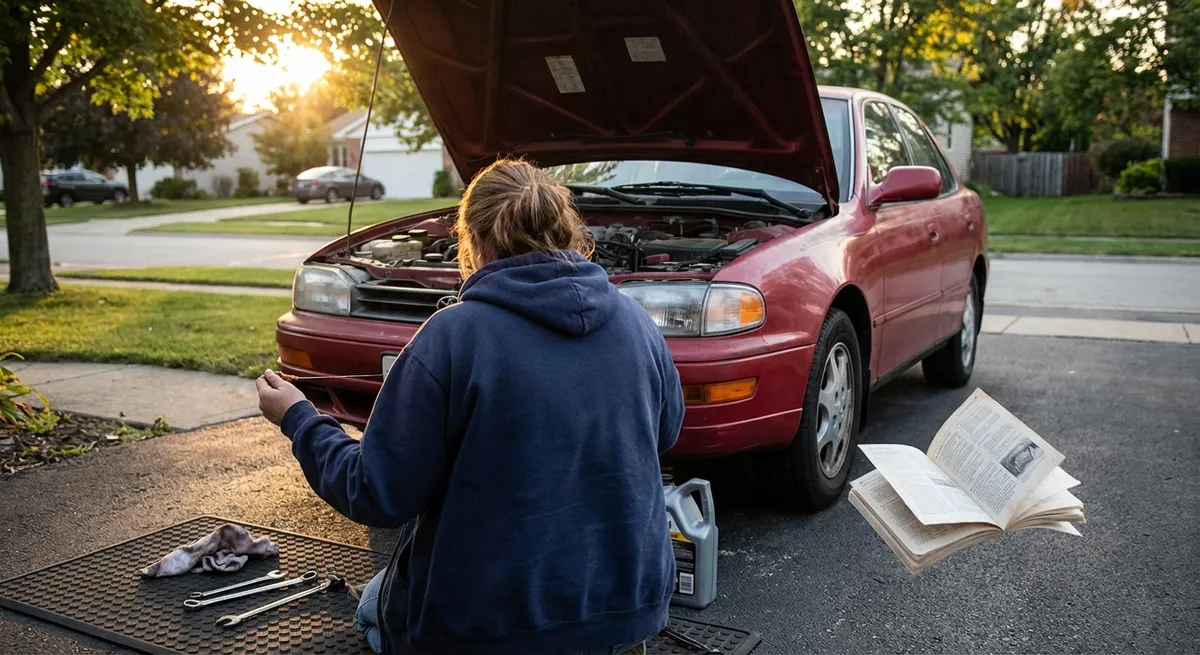
Fluids First: The Health Check Most Drivers Skip
Automotive fluids are your car’s lifeblood. When they break down, everything downstream gets more expensive.
Engine oil is the obvious one, but five other fluids deserve regular attention: coolant, brake fluid, transmission fluid, power steering fluid (if equipped), and windshield washer fluid. Modern synthetic oils can last longer, but that only helps if the level stays correct and the right grade is used. Low or dirty oil accelerates engine wear, especially on cold starts.
Coolant does more than prevent overheating; it also protects internal passages from corrosion and mineral buildup. Old coolant can become acidic over time, damaging aluminum components and radiator cores. Brake fluid absorbs moisture naturally; as its boiling point drops, brake performance can degrade under hard use, and internal corrosion in lines and calipers can start silently.
Actionable point #1: Once a month, on a cold engine, inspect all accessible fluids:
- Check engine oil with the dipstick for level and color (amber to dark brown is normal; gritty, sludgy, or milky is not).
- Inspect coolant level in the overflow reservoir and confirm it matches the recommended type in your owner’s manual.
- Look at brake fluid in the reservoir; it should be clear to light amber, not dark brown.
- Review your manual for transmission service intervals; don’t “lifetime fluid” your way into a transmission rebuild.
If you’re unsure how to access or identify a fluid, have a technician show you once — that five-minute lesson pays off for the life of the car.
Tires and Alignment: Where Safety, Performance, and Efficiency Meet
Your tires are the only contact your car has with the road, yet they’re often treated as an afterthought. Underinflated or worn tires increase stopping distances, reduce fuel economy, and can cause unpredictable handling in emergency maneuvers.
Tire pressure shifts with temperature changes, slow leaks, and normal seepage through the rubber. Even cars with tire pressure monitoring systems (TPMS) don’t always warn you until pressure is significantly low. Uneven wear patterns — more wear on one edge, cupping, or feathering — often signal alignment or suspension issues that will progress if ignored.
Actionable point #2: Build a quick tire routine into your month:
- Use a quality digital tire pressure gauge, not just the gas-station air pump.
- Set pressures to the value on the driver’s door jamb sticker — not the max PSI stamped on the tire.
- Visually inspect tread for embedded nails, outer-edge wear (often alignment-related), or cord showing.
- Rotate tires approximately every 5,000–7,500 miles, or as your manual suggests.
If your steering wheel isn’t centered, the car drifts on a flat road, or you see uneven wear, schedule an alignment. Correcting this early is far cheaper than replacing a prematurely worn set of tires and suspension components.
Batteries, Belts, and Hoses: The Common Stranding Trio
When cars die suddenly, these three are usually involved: battery, belt, or hose. They’re relatively inexpensive to maintain but brutal to ignore.
Batteries degrade slowly with time, heat, and short-trip driving. Many fail with little warning beyond slightly slower cranking or dimmer lights at startup. Once a modern battery drops below a certain threshold, electronics can misbehave and control modules may log errors.
Drive belts power critical systems such as the alternator, power steering pump, water pump (on many engines), and A/C compressor. A broken belt can mean immediate overheating or loss of charging. Hoses carry coolant and vacuum; small cracks or bulges become burst hoses and roadside steam.
Actionable point #3: Proactively inspect and age-out these wear items:
- Test your battery annually after year three (or sooner in very hot or very cold climates). Many auto parts stores do this free.
- Check battery terminals for corrosion; clean and protect them to avoid poor connections.
- Inspect serpentine belts for cracks, glazing (shiny surfaces), or missing chunks; replace if questionable, not just when they snap.
- Look over coolant hoses for bulges, soft spots, cracks, or dampness around clamps.
Replacing a marginal belt or aged battery on your schedule is always cheaper — in time and money — than dealing with a tow and emergency repair.
Braking Systems: Quiet Changes That Affect Stopping Distance
Brake systems typically get attention only when they squeal, pulse, or feel soft — but by then, wear has already progressed, and rotors may need replacement along with pads. Heat cycles, moisture in brake fluid, and worn components all change how your car stops long before you hear a sound.
Many newer cars have pad-wear sensors, but not all. Even with sensors, they usually alert at the last safe portion of pad life, not early enough to plan leisurely around it. Warped rotors can show up first as a vibration under braking, especially at highway speeds.
Actionable point #4: Treat braking as a system, not just pads:
- At least twice a year, have a visual inspection of pad thickness and rotor condition.
- Ask your shop to measure rotor thickness against the minimum spec, not just “looks okay.”
- Consider a brake fluid flush every few years, especially if you drive in hilly areas, tow, or brake hard frequently.
- Pay attention to subtle changes: a longer pedal travel, the car pulling slightly to one side when braking, or a pulsing sensation through the pedal.
Early attention to small changes can prevent caliper sticking, rotor damage, and uneven pad wear — all more expensive than routine service.
Driving Patterns and Service Intervals: Match Maintenance to How You Actually Drive
The service schedule in your owner’s manual typically has two tracks: “normal” and “severe” use. Many drivers assume they fall under “normal,” but short trips, heavy traffic, extreme temperatures, and frequent towing all push your car into severe-service territory.
Repeated short drives don’t allow oil to reach full operating temperature long enough to burn off condensation and fuel dilution. Stop-and-go commuting is harder on brakes, transmissions, and cooling systems than steady highway cruising. Even if your annual mileage is low, time-based intervals (like brake fluid and coolant age) still matter because fluids and rubber degrade chemically.
Actionable point #5: Customize your maintenance plan to your reality:
- Be honest about your driving: lots of city miles, short trips, or extreme climates call for shorter intervals.
- Use your car’s maintenance reminder system as a baseline, not the ultimate authority; cross-check with the manual.
- Keep a simple log (app or notebook) of dates, mileage, and services performed. This helps spot patterns early.
- If you modify your car (performance tune, bigger wheels, towing packages), adjust service intervals to suit the added stress.
A realistic maintenance schedule, tailored to your use, prevents the “I don’t drive much, so I don’t need service” trap — which often leads straight to age-related failures.
Conclusion
Preventive maintenance isn’t about doing everything; it’s about doing the right things early enough that they stay cheap and predictable. By focusing on fluid health, tire and alignment care, the battery/belt/hose trio, the full braking system, and a maintenance plan that matches how you actually drive, you eliminate most of the surprise failures that strand people on the side of the road.
The payoff isn’t just fewer breakdowns. It’s a car that feels tight, responds predictably, and holds its value better — and a driver who knows what’s happening under the hood long before the warning lights come on.
Sources
- [National Highway Traffic Safety Administration (NHTSA) – Tire Safety](https://www.nhtsa.gov/equipment/tires) - Covers tire pressure, tread, and maintenance recommendations with safety data
- [U.S. Department of Energy – Fuel Economy: Keeping Your Car in Shape](https://www.fueleconomy.gov/feg/maintain.jsp) - Explains how maintenance like tire pressure and tune-ups affect fuel economy
- [AAA – Car Battery Testing and Replacement](https://exchange.aaa.com/automotive/automotive-testing/car-battery-buying-guide/) - Detailed guidance on battery life, testing, and replacement considerations
- [Bridgestone – Brake Service Basics](https://www.bridgestonetire.com/learn/maintenance/brake-service/) - Overview of brake components, wear signs, and why timely service matters
- [Pennsylvania Department of Transportation – Vehicle Preventive Maintenance](https://www.penndot.pa.gov/TravelInPA/Safety/Pages/Vehicle-Preventive-Maintenance.aspx) - Government-backed checklist for routine inspections and maintenance practices