Clarify What You Really Need the Car to Do (Not Just What You Want)
Before you browse a single listing, get specific about how the car will actually be used. This isn’t about dream garages; it’s about daily life.
Think in terms of jobs the car needs to handle: commuting distance, cargo (strollers, tools, sports gear), passengers (kids, car seats, coworkers), and climate (snow, heat, mountains). Someone with a 60-mile daily commute has different priorities than someone who mostly does short city trips and one big road trip a year.
Write down your must-haves, nice-to-haves, and deal-breakers. Must-haves might include advanced safety features (automatic emergency braking, blind spot monitoring), good fuel economy, or enough towing for a small trailer. Nice-to-haves might be leather seats or a panoramic roof. Deal-breakers could include poor crash-test ratings, no Android Auto/Apple CarPlay, or a cramped back seat.
This simple list will keep you grounded when a salesperson tries to upsell you or a flashy car online steals your attention. Your goal: buy the car that fits your real life, not your five-minute impulse.
Actionable Point #1:
Create a 3-column list (Must-Have / Nice-to-Have / Deal-Breaker) before you start shopping, and bring it with you (or keep it on your phone) when you visit dealers or inspect private-sale cars. If a car fails a must-have or hits a deal-breaker, you walk away—no exceptions.
Look Beyond the Sticker: Estimate Total Cost of Ownership
Two cars can have similar prices on the window but very different long-term costs. If you only focus on purchase price, you risk “saving” money upfront and overpaying for years in fuel, maintenance, and depreciation.
Start by checking gas mileage (MPG or MPGe for EVs) and compare how that matches your driving pattern. City-heavy drivers should pay extra attention to city MPG; highway commuters to highway MPG. For EVs and plug-in hybrids, factor in electricity rates, home charging setup, and any public charging fees.
Next, review insurance costs. Some models, especially performance-oriented trims or high-theft vehicles, can be significantly more expensive to insure. Many insurers have online quote tools—run sample quotes with your actual information for two or three models you’re considering.
Finally, think about maintenance and repairs. Some brands offer longer warranties or free scheduled maintenance for a set time. Others have well-known higher costs for parts and labor. Reliability ratings from credible sources and owner forums can give you a sense of what to expect after the warranty expires.
Actionable Point #2:
Pick 2–3 candidate models and compare them using a total cost of ownership calculator (many auto sites and insurers offer these). Include fuel/energy, insurance, and an estimate of maintenance. If a model is significantly more expensive per year to run, bump it down your list—even if the purchase price looks attractive.
Put Reliability and Safety at the Center of Your Shortlist
For an out-of-warranty replacement, long-term reliability isn’t a luxury—it’s the main event. A car that spends time in the shop can erase any savings you made at purchase, not to mention the stress and inconvenience.
Check independent reliability rankings from organizations that test and survey large groups of owners. Look for multi-year trends for a model, not just a single model year. Some models improve significantly after a redesign; others get worse. Pay close attention to problem areas like transmissions, turbochargers, infotainment systems, and hybrid batteries—they’re often expensive to fix.
Safety is just as important. Review crash test ratings, not just generic “safe or not” labels. Ratings from multiple testing bodies (where available) help you understand how the car performs in different types of impacts. Also check which active safety features are standard versus optional; some lower trims might lack features you assume are included.
If you’re buying used, search specifically for known issues and recalls. Look up the VIN for any open recalls before you commit. For older vehicles, verify that major recalls have already been completed.
Actionable Point #3:
Before you schedule a test drive, check each model’s reliability and safety using at least two independent sources (reliability surveys and crash test data). If a car has consistently poor reliability or mediocre crash test scores, remove it from your list regardless of how appealing the price or styling may be.
Test Drives with a Plan: Simulate Your Real Daily Use
A quick 10-minute loop around the block doesn’t tell you much about how a car will live with you. Treat the test drive as a structured evaluation, not just a formality.
Recreate your normal driving conditions as closely as the dealer or seller will allow—city traffic, highway speeds, hills if you have them. Pay attention to seat comfort, visibility, road noise, and how easy it is to use the controls without taking your eyes off the road. Try parking in tight spots, merging onto a busy road, and making U-turns.
If you regularly use child seats, bring one and test how easy it is to install, load, and unload. If you haul gear, bring a couple of bulky items (within reason) and see how they fit in the trunk or cargo area. Check rear-seat headroom and legroom with real people if possible, not just brochure numbers.
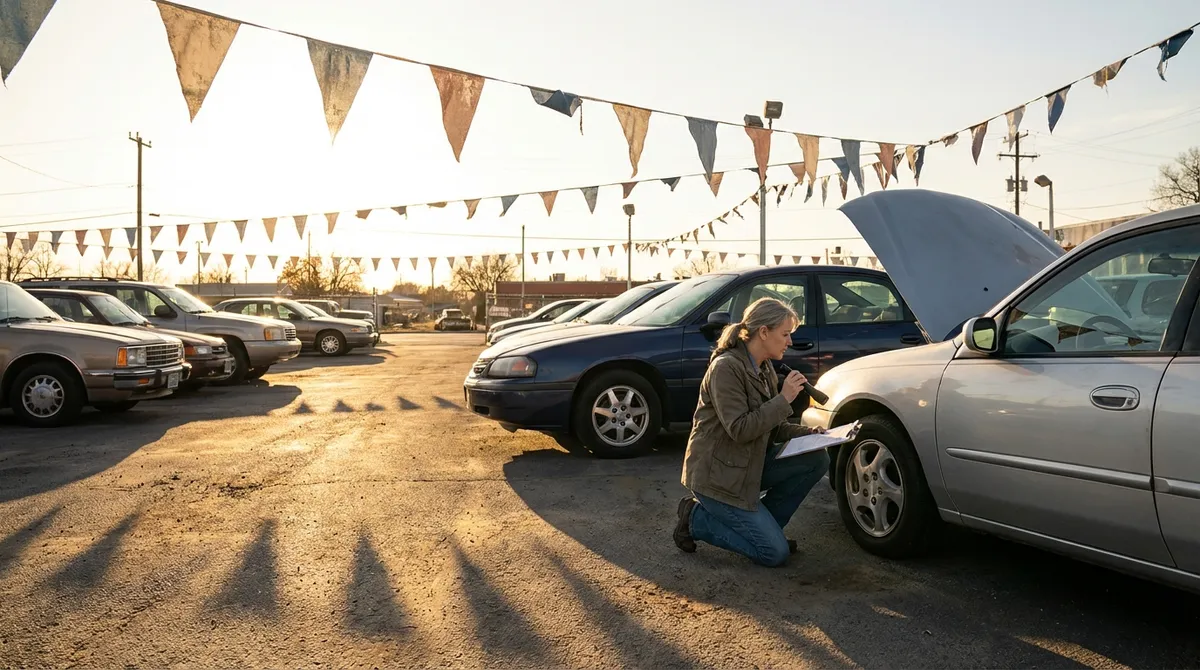
For used cars, listen for unusual noises (knocks, rattles, whining), check that all electronics work, and verify features like climate control in both hot and cold settings if possible. After the drive, pop the hood and walk around the vehicle looking for leaks, uneven tire wear, or mismatched paint panels.
Actionable Point #4:
Create a short test-drive checklist on your phone: comfort, visibility, noise, acceleration, braking, parking, tech usability, and cargo/child seat fit. During the drive, rate each from 1–5. If a car scores poorly on comfort or visibility, don’t assume you’ll “get used to it”—move on to a better fit.
Protect Yourself on Used Deals: Inspection and Paper Trail
If you’re moving into a used car to save money, the savings only matter if the car is structurally and mechanically sound. A clean interior and shiny tires don’t guarantee anything under the surface.
Always run a vehicle history report using the VIN. While not perfect, it can help you spot major red flags like salvage titles, previous total losses, odometer discrepancies, or repeated accidents. Compare reported mileage and service entries with what the seller claims.
Next, insist on a pre-purchase inspection (PPI) by an independent, trusted mechanic—not the seller’s shop. A thorough inspection can uncover hidden issues with suspension, brakes, leaks, older tires, and evidence of flood or collision damage. Expect to pay for the inspection yourself; it’s cheap insurance compared to an unexpected transmission failure.
Review the service records if available. Regular oil changes, brake services, and documented repairs show that the previous owner actually maintained the vehicle, not just drove it until something broke. Be wary of heavily modified vehicles if you’re prioritizing reliability; aftermarket performance parts can signal hard driving and future headaches.
Actionable Point #5:
Make your offer contingent on a satisfactory pre-purchase inspection from a shop you choose. If the seller refuses, treat that as a major warning sign and be prepared to walk away—no matter how good the price looks.
Conclusion
Shopping for your next car—especially when you’re replacing an aging, out-of-warranty vehicle—is about smart planning, not guesswork. Start by defining what the car must do for your real life, then balance purchase price with long-term ownership costs. Put reliability and safety at the center of your search, use structured test drives to filter out poor fits, and treat used purchases like an investment that warrants serious inspection.
Approach the process methodically, and you’ll end up with a car that doesn’t just look good for a month—it quietly does its job for years without constant surprises. That’s the real win.
Sources
- [Insurance Institute for Highway Safety (IIHS) – Vehicle Ratings](https://www.iihs.org/ratings) - Crash test ratings and safety evaluations for new and used vehicles
- [NHTSA – Vehicle Safety Ratings](https://www.nhtsa.gov/ratings) - U.S. government safety ratings and recall lookup by VIN
- [Consumer Reports – Car Reliability & Owner Satisfaction](https://www.consumerreports.org/cars-car-reliability-owner-satisfaction/) - Independent reliability data and owner survey results
- [U.S. Department of Energy – Fuel Economy Guide](https://www.fueleconomy.gov/feg/findacar.shtml) - Official fuel economy and energy use information for gasoline, hybrid, and electric vehicles
- [Federal Trade Commission – Buying a Used Car](https://consumer.ftc.gov/articles/buying-used-car) - Practical guidance on inspections, vehicle history, and avoiding used-car pitfalls