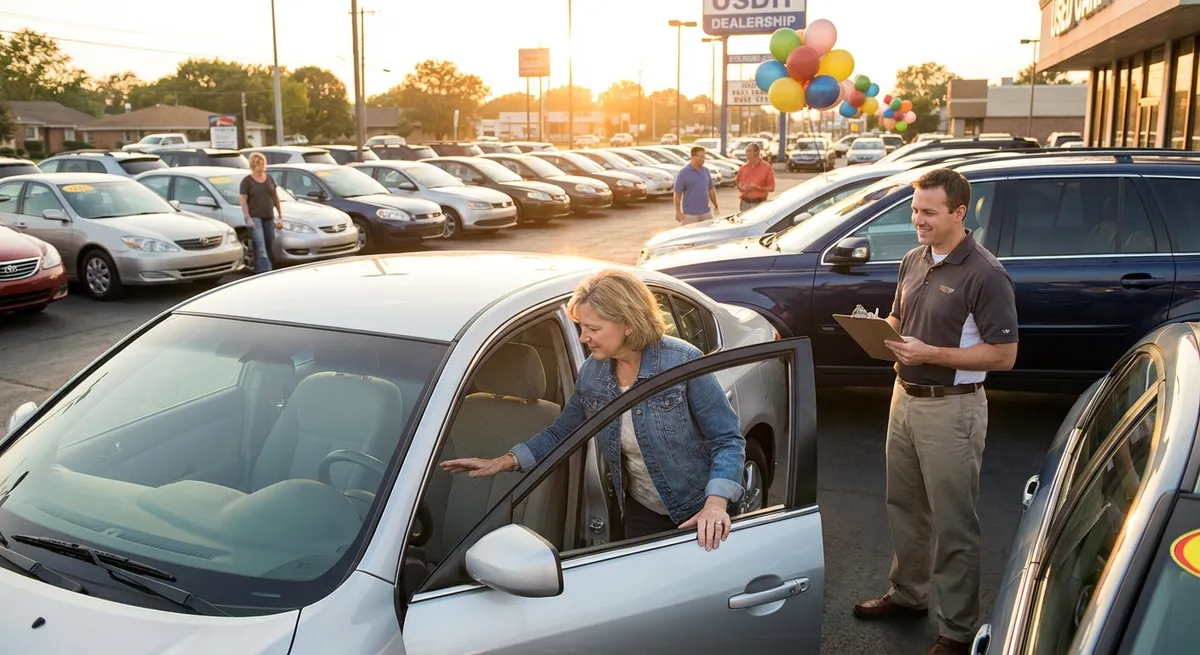
This guide focuses on five practical, real-world moves you can use before, during, and after you sit down to sign anything.
Start With Your Real Life, Not the Lot
Before you open a single listing, map the car to your lifestyle instead of the other way around. Most people start with “sedan vs. SUV” or “new vs. used” and skip the questions that matter day to day.
Ask yourself:
- How many people do you regularly carry, and how tall are they? If you’ve got teens or adults in the back seat, test legroom and headroom, not just seat count.
- What’s your actual cargo? Strollers, bicycles, music gear, home project supplies—bring a tape measure, or better yet, bring the actual gear to your test drive.
- How do you drive most of the time—short city hops or long highway miles? City drivers may value smaller footprints and better visibility; highway drivers should favor comfort, noise levels, and driver-assist features.
- How often do you deal with bad weather or rough roads? That may justify all-wheel drive, better tires, and specific safety tech more than a sunroof or larger wheels.
- Where will the car live—street parking, tight garage, shared driveway? Measure your spaces so the car you love actually fits your world.
Write your must-haves and nice-to-haves in advance. Use this list like a checklist during test drives and while comparing models. It keeps you grounded when a salesperson steers you toward what’s on the lot instead of what fits your life.
Compare Total Cost of Ownership, Not Just the Monthly Payment
Two cars with the same monthly payment can cost radically different amounts over time. Focusing only on what it costs this month is how people accidentally buy more car than they can comfortably afford.
To get a clearer picture:
- Look beyond MSRP: add destination fees, dealer fees, taxes, and registration. That’s the actual “out-the-door” cost.
- Estimate insurance before you commit. Call your insurer or get online quotes with the specific car year, make, and model. Some models, trims, or engines quietly add hundreds per year.
- Factor in fuel or energy costs. A more efficient engine or a hybrid/EV may cost more upfront but save significantly if you drive high mileage. Check real-world MPG (not just the window sticker) and, for EVs, local electricity rates and charging access.
- Consider maintenance and repair costs. Some brands and models have cheaper parts and simpler service; others demand premium fluids, specialized tools, or dealer-only service.
- Plan for depreciation if you think you’ll sell or trade within 3–7 years. Popular, reliable models typically hold value better and lower your effective cost of ownership.
Use online calculators that plug in purchase price, fuel, insurance, and maintenance estimates across several models. When you compare that 5-year or 7-year cost, you’ll often find that the “cheaper” car on day one isn’t the cheapest to live with.
Inspect and Test Like You’re Keeping the Car 10 Years
Most test drives are too short and too polite. You’re not auditioning as a “good customer”; you’re investigating whether this car will still feel right when the new-car smell fades.
Make your test drive count:
- Sit in every seat. Check comfort, visibility, and headroom for driver and passengers.
- Test the driving position. Adjust the seat and wheel, then drive enough to see if your back, neck, or knees complain.
- Drive in mixed conditions if possible: surface streets, highway, and some rougher pavement. Listen for wind and road noise.
- Try common maneuvers: quick lane changes, tight parking, three-point turns, and parallel parking. Does the size and steering feel natural for you?
- Check tech while parked: how intuitive is the infotainment, climate control, and driver-assist setup? Physical buttons vs. touch-only controls can make a big difference in everyday use.
- Inspect the trunk and cargo area with the seats folded and upright. Is the loading height comfortable? Do liftover and hatch opening angles work for you?
Pre-purchase inspection is non-negotiable for used cars. Pay a trusted independent mechanic (not associated with the seller) to check the engine, transmission, tires, brakes, suspension, and underbody for rust or damage. The small upfront fee can save you from surprise repairs that dwarf the inspection cost.
Use Vehicle History, Recalls, and Reliability Data to Your Advantage
For used cars especially, you’re buying a story—how the car has been treated, serviced, and driven—not just a VIN and a paint color.
Here’s how to make that story work in your favor:
- Pull a vehicle history report using the VIN from reputable services. Look for accident records, title issues, odometer rollbacks, and frequent ownership changes.
- Ask for service records. A thick folder of oil changes, brake jobs, and scheduled maintenance signals a responsible owner. Gaps in maintenance around major mileage marks are red flags.
- Check for recalls and service campaigns on official manufacturer or government sites. Confirm that recall work was completed; use this as leverage or ask the seller to resolve open recalls before purchase.
- Research model-year-specific issues. Some model years are known for transmission problems, excessive oil consumption, or electronics failures. Focus on patterns from multiple sources, not single horror stories.
- If you’re buying older or higher-mileage vehicles, prioritize models with strong long-term reliability records. A well-kept, proven platform is often safer than a newer but unproven design.
Bring notes or printouts of common issues when you go to inspect or test the car. You’ll know exactly what to look and listen for—and if the seller is unfamiliar with obvious problems, that’s a sign to proceed carefully or walk away.
Control the Pace of the Deal From Start to Finish
Even if you’re not a negotiator by nature, you can still control the pace and structure of the deal so it serves your interests, not the dealership’s.
Practical ways to keep leverage:
- Separate the conversations. Keep the price negotiation, trade-in valuation, and financing discussion independent. This prevents shifting numbers from hiding the real cost.
- Come pre-approved for financing from your bank or credit union. This gives you a benchmark and bargaining power if the dealer offers to beat your rate.
- Talk out-the-door price, not “How much can you pay monthly?” A low monthly payment can hide a long loan term or extra add-ons.
- Be ready to pause. If you feel rushed, step away—get a coffee, go home, or sleep on it. A deal that “expires today” is usually more about pressure than value.
- Read every line before you sign. Look closely for add-ons (extended warranties, paint protection, gap coverage, anti-theft etching, nitrogen tires) that you didn’t explicitly ask for. Decline what you don’t need.
- Bring a second set of eyes if you can—a friend or family member who’s calm under pressure and willing to ask blunt questions.
The most powerful tool you have is the willingness to walk away. When you’re clear on what you want and what you’re willing to pay, “no, thanks” is often what leads to a better offer—or a better car elsewhere.
Conclusion
Buying the right car is less about spotting a one-time bargain and more about matching a machine to your real life, your budget, and your long-term plans. When you start with your daily needs, evaluate total ownership costs, test thoroughly, use data to confirm the car’s story, and control the pace of the deal, you’re not just hunting for a low price—you’re choosing a car you’ll actually be glad to live with.
Use these five moves as your framework, and every listing, lot visit, and test drive becomes easier to judge: does this car truly fit my life, or just my impulse in the moment?
Sources
- [U.S. Department of Energy – Fuel Economy Guide](https://www.fueleconomy.gov/feg/findacar.shtml) - Official fuel economy data and cost estimates for comparing different vehicles
- [National Highway Traffic Safety Administration (NHTSA) – Recalls](https://www.nhtsa.gov/recalls) - Search for safety recalls and investigate open issues on specific VINs
- [Consumer Reports – Car Reliability & Owner Satisfaction](https://www.consumerreports.org/cars/) - Long-term reliability, owner satisfaction, and road-test data across many models
- [Edmunds – True Cost to Own](https://www.edmunds.com/tco.html) - Detailed breakdown of ownership costs including depreciation, insurance, fuel, and maintenance
- [Insurance Information Institute – Auto Insurance Basics](https://www.iii.org/article/auto-insurance-basics) - Explains how vehicle choice, driving profile, and coverage affect insurance costs