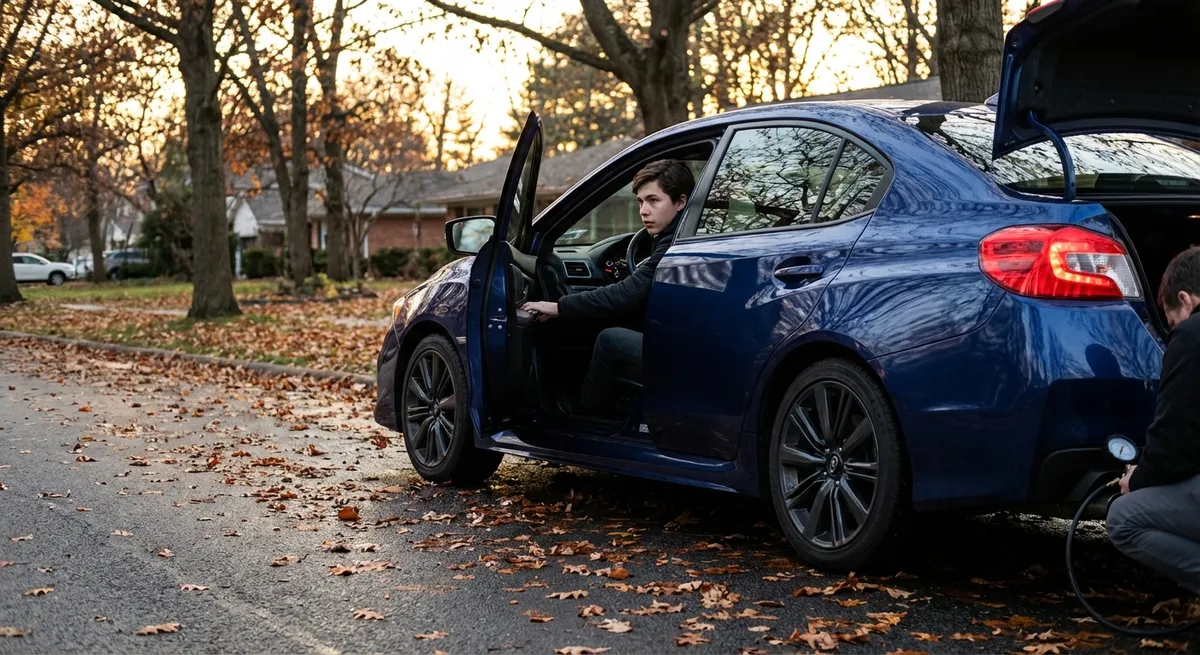
Treat the First Walk-Around as a Silent Damage Report
Before you even start the engine, your first “test drive” happens on foot.
Move slowly around the car with the mindset of an inspector, not a buyer in love. Compare panel gaps on both sides of the car; mismatched gaps or doors that don’t close cleanly can hint at past collision repairs. View the car from different angles in natural light—subtle color mismatches between panels may indicate repainting.
Check the windshield and glass for chips, cracks, and excessive pitting that could worsen over time. Look inside the wheel wells and along the lower edges of doors and rocker panels for rust or fresh undercoating that might be hiding it. Inspect the tires for uneven wear: heavy wear on one edge can signal alignment, suspension, or steering issues that may cost you later.
If you’re looking at a used car, quickly peek under the car from the front and rear; damp or oily areas around the engine, transmission, or differential can point to leaks. This quiet, methodical walk-around often reveals more than a loud sales pitch ever will.
Make the Cabin Fit Your Daily Life, Not Just Your Wish List
Once inside, focus less on the new-car smell and more on how the cabin will work for you over thousands of miles.
Start with your driving position. Adjust the seat, wheel, and mirrors to match how you would actually drive on a commute or road trip. Can you see the instrument cluster clearly without hunching forward? Is there enough thigh support? If you can’t get comfortable in five minutes of tweaking, it probably won’t improve in year three of ownership.
Simulate your real use cases: if you use child seats, bring one and test how easily it installs, how accessible the anchors are, and whether rear doors open wide enough. If you routinely carry gear, fold the rear seats down and check the load floor height, opening width, and whether you can realistically lift your items in and out. Try out the infotainment system as you would when driving—can you adjust climate, navigation, and audio without diving through confusing menus?
Finally, pay attention to small but telling details: Are there enough USB ports where passengers actually sit? Is there a proper place for your phone where it won’t fly into the passenger footwell during a hard stop? A cockpit that fits your routines is worth more than a spec sheet filled with features you’ll rarely touch.
Use the Test Drive to Stress the Drivetrain—Smoothly, Not Harshly
A well-planned test route will tell you far more than a quick loop around the block.
Ask in advance if you can take a varied route that includes city streets, a stretch of highway, and a rougher road if possible. On startup, listen to the engine from outside and inside the car; rattles, long cranking, or rough idle are bad signs. As you accelerate gently from a stop, notice if the transmission shifts smoothly or hesitates and “flares” in rpm between gears.
On a clear, safe stretch, try a brisk (not reckless) acceleration to highway speed. For automatics, you’re watching for smooth kickdown and consistent shifts; for manuals, you’re feeling for a clear clutch engagement point and no grinding while changing gears. At steady cruise, check for vibrations through the wheel, seat, or floor—these can spring from tires, wheels, driveshafts, or engine mounts.
On an open section of road, lightly weave within your lane and take a few long, gentle curves. The steering should feel consistent, not vague in the center and then suddenly heavy. When braking from moderate speed, apply firm, steady pressure; the car should track straight with no pulsing through the pedal. You’re not trying to abuse the vehicle—you’re trying to simulate years of use in twenty minutes.
Let Technology Prove Itself in Real Time, Not Just in the Brochure
Modern cars are packed with driver aids and connectivity features, but not all systems are created equal. The test drive is the time to see how they behave in typical traffic.
If the car has adaptive cruise control, try it briefly on a suitable road and watch how smoothly it maintains distance and reacts to cut-ins. Lane-keeping assistance should gently nudge you back if you drift, not ping-pong you between lines. Pay attention to how easy it is to enable, disable, and adjust these systems—if you need three menus and two submenus, you’re likely to ignore them later.
Connect your own phone via Bluetooth and, if available, Apple CarPlay or Android Auto. Confirm that calls sound clear on both ends, apps load without lag, and you can operate navigation and music with minimal distraction. Try voice commands: can you reliably set a destination or call a contact without repeating yourself?
Also evaluate the backup camera and any parking sensors or 360-degree systems in a real parking scenario. Visual clarity, guiding lines that move with the steering, and accurate distance alerts make everyday maneuvering far safer and less stressful. If the tech feels clunky or intrusive in a short test, it won’t magically improve after purchase.
Turn Post-Drive Impressions into a Cost and Risk Checklist
When you park and shut the car off, don’t rush to the numbers. Capture what you just learned while it’s fresh.
Sit quietly in the car for a moment and jot quick notes: seat comfort, noise level, visibility, control layout, and any odd sounds or behaviors. Compare these notes to your daily driving reality—long highway stretches, stop-and-go traffic, rough rural roads—and ask whether this car will reduce or add to your usual fatigue.
Then translate your observations into potential costs. Uneven tire wear, brake pulsation, or suspension clunks suggest near-term maintenance. A cramped back seat could mean future frustration if your family grows. An overcomplicated infotainment system may lead to distraction and, in a worst case, safety risk. If you’re considering a used vehicle, plug the VIN into a reputable vehicle history service and cross-check what you saw with reported accidents, open recalls, or prior title issues.
Finally, resist on-the-spot pressure. Take your notes home, compare them against other candidates, and look up long-term reliability and ownership costs from independent sources. A car that felt “fine” in the moment may look worse—or much better—once you put your impressions next to real-world data on fuel economy, repair frequency, and depreciation.
Conclusion
A thoughtful test drive is your best defense against buying a car that doesn’t match your life or your budget. By slowing down your walk-around, making the cabin prove it fits your routines, putting the drivetrain and tech through realistic scenarios, and turning impressions into a practical cost checklist, you dramatically sharpen your buying decision. The goal isn’t to find a perfect car—it’s to find the one whose compromises you understand, accept, and can afford over the years you’ll actually live with it.
Sources
- [U.S. Federal Trade Commission – Buying a Used Car](https://consumer.ftc.gov/articles/buying-used-car) - Official guidance on inspections, test drives, and contracts for used vehicles
- [Consumer Reports – Test-Driving Tips for Buying a New Car](https://www.consumerreports.org/cars/buying-a-car/how-to-test-drive-a-new-car-a4940107794/) - Practical checklist for evaluating vehicles during a test drive
- [Edmunds – How to Test-Drive a Car](https://www.edmunds.com/car-buying/how-to-test-drive-a-car.html) - Detailed breakdown of what to look, listen, and feel for on a test route
- [NHTSA – Vehicle Safety and Recalls](https://www.nhtsa.gov/recalls) - Official database to check VINs for safety recalls and defect investigations
- [IIHS – Vehicle Ratings](https://www.iihs.org/ratings) - Independent crash test and safety ratings to complement your on-road impressions