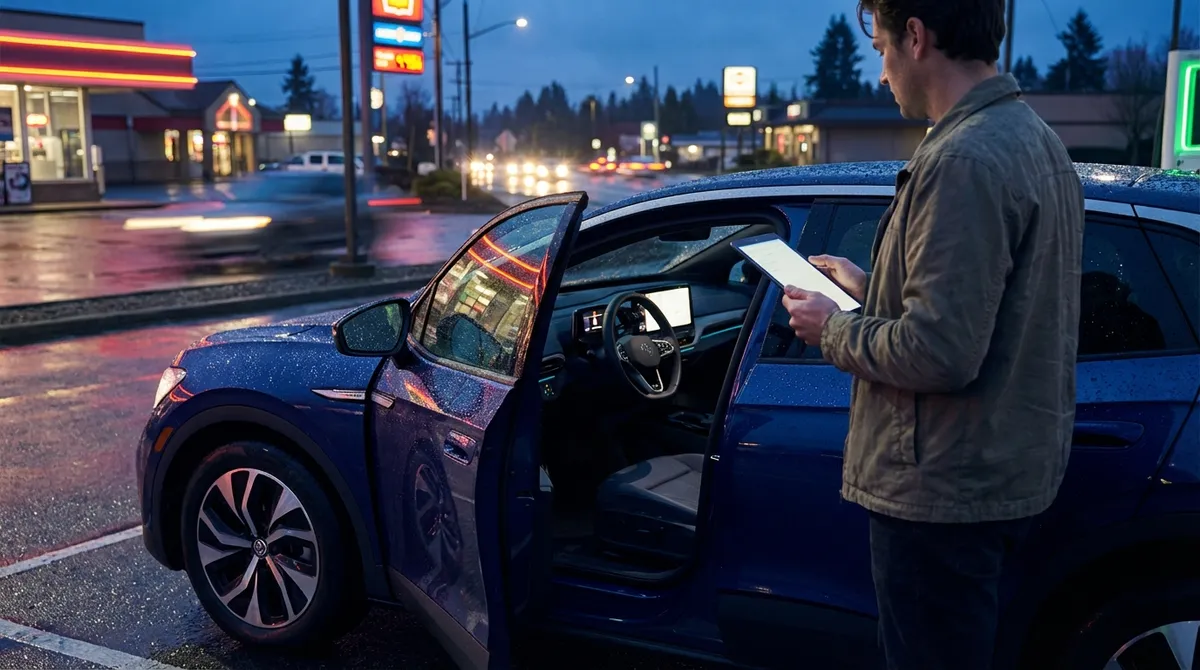
This guide breaks down practical, review-focused checkpoints that help you cut through the noise, understand what actually affects ownership, and make smarter decisions before you schedule a test drive.
Focus on Range in Your Real Conditions, Not Just the Headline Number
Most EV reviews lean on the EPA range figure or a manufacturer claim, but the real story is how that range holds up in your daily life.
Pay close attention to how reviewers test range: highway-only, mixed driving, city-heavy, or stop-and-go commuting. EVs can perform very differently in each scenario, and some models shine in urban driving but drop quickly at high speeds. Look for mentions of temperature, terrain, and driving style, since cold weather, hills, and frequent fast acceleration can easily trim 20–30% off the quoted range.
Reviews that include consumption data (like kWh per 100 miles or miles per kWh) on specific routes are especially valuable because they let you estimate your own results. Cross-check that with your commute length, typical weekend drives, and how often you’d be comfortable charging. If multiple reviewers mention the same pattern—such as faster-than-expected range drop at 75 mph—that’s usually a reliable signal.
Actionable point #1: When reading EV reviews, write down three numbers: EPA range, the reviewer’s observed range, and their average highway speed. Use that trio to decide if the car realistically fits your weekly driving without constant “range anxiety.”
Look Beyond 0–60: Evaluate Power, Braking, and Stability Together
Many car reviews hype 0–60 mph times, especially for EVs with instant torque. That’s fun trivia, but it doesn’t tell you whether the car feels controlled, predictable, or confidence-inspiring on real roads.
As you read, note how the reviewer describes throttle response in everyday driving. Do they mention jolty acceleration from a stop, or difficulty modulating power in traffic? Also pay close attention to comments about brake feel—some EVs blend regenerative and friction braking, which can feel inconsistent if not well-tuned. If multiple reviews criticize “grabby brakes” or an awkward transition at low speeds, expect a learning curve in stop-and-go traffic.
Stability and steering feedback matter just as much. Look for mentions of body roll in corners, how the car feels during quick lane changes, and whether the steering feels numb, over-boosted, or communicative. Reviewers who describe a car as “floaty,” “unsettled over bumps,” or “twitchy at highway speeds” are pointing at traits that can become tiring—or even unnerving—on long drives.
Actionable point #2: When comparing reviews, make a quick three-column note: throttle feel, brake feel, and high-speed stability. Favor cars that are consistently described as “linear,” “predictable,” and “composed” rather than just “fast.”
Read Charging Coverage Like a Daily-Use Report, Not a Tech Demo
Charging performance is often shown in perfect conditions—warm battery, high-power DC fast charger, and an empty-to-80% test that doesn’t reflect typical ownership. To translate reviews into reality, you need to know how an EV behaves in non-ideal situations.
Start with the charging curve, not just the “10–80% in X minutes” claim. Reviewers who include graphs or detailed notes about how quickly power tapers as the battery fills are especially helpful. A car that charges very quickly from 10–40% but slows dramatically after that might be great for short top-ups, but less ideal for longer trips where you prefer a single, more substantial stop.
Also, look for commentary on charger compatibility and network reliability. Some reviews will mention issues with non-Tesla fast-charging networks, location availability, or peak-period congestion. If a reviewer struggles to find a working charger on a major highway, that’s a real-world sign of what you might face on road trips.
Actionable point #3: When reading about charging, focus on: (1) how long it takes to go from 20–80%, (2) what speed it holds in the middle of the charge (not the initial peak), and (3) whether reviewers report consistent experiences across different stations and weather. Use those details to map out how a typical 300–400-mile road trip would actually play out.
Use Interior and Tech Reviews to Predict Daily Ease, Not Just Wow Factor
Interior and tech impressions in reviews often focus on “premium feel,” design flair, or screen size. For ownership, you’ll want to interpret those comments in terms of distraction, learning curve, and long-term usability.
Take note of how reviewers interact with core controls: climate, drive modes, and commonly used features like defrost, audio volume, and driver assist toggles. If the review mentions burying simple functions deep in menus, laggy responses, or confusing layouts, that friction will show up every day you own the car.
Screen glare, fingerprint-prone surfaces, and overly sensitive touch controls can be more important than the size of the display. Reviewers who drive the car in both day and night conditions may mention reflections, overly bright screens at night, or difficult-to-read fonts. All of these matter more than a showroom demo or static photos.
Also watch for comments on smartphone integration—whether Apple CarPlay and Android Auto are wired or wireless, how stable the connection is, and how well the native navigation compares to phone-based apps. If several reviewers keep abandoning the built-in system for Google Maps or Waze, assume you’ll probably do the same.
Actionable point #4: As you read reviews, list three daily tasks—like adjusting temperature, changing playlists, or turning on seat heaters—and note how many taps, button presses, or menus they require in each car you’re considering. Favor vehicles that let you do these with physical controls or simple, quick on-screen actions.
Treat Real-World Ownership Feedback as the Tie-Breaker
Professional car reviews are great for first impressions, but ownership patterns emerge over time. When you’re close to deciding between two EVs, real-world owner feedback can highlight issues that short-term testers might miss.
Search for long-term tests from automotive outlets and pay attention to recurring problems: software glitches, unexpected range loss over months, build-quality issues, or charging-port reliability. Notes like “frequent over-the-air updates fixed early quirks” or “persistent warning lights that required multiple dealer visits” are strong signals of how mature the car’s software and support ecosystem really are.
Owner forums, Reddit threads, and user reviews can add context—just filter out obvious one-off rants or fanboy praise. Look for patterns: repeated complaints about wind noise at a certain speed, squeaks and rattles after a year, or battery health after 20,000–40,000 miles. These themes are much more informative than any single glowing or scathing review.
Actionable point #5: Before finalizing your choice, pick the EV you’re most interested in and search for “long-term review,” “year in review,” and “[model] battery degradation.” If you see the same 2–3 issues mentioned across multiple sources, factor those into your decision—or use them as negotiation leverage for warranty coverage or service plan add-ons.
Conclusion
Modern EV reviews are packed with data, but not all of it has equal value when you’re deciding what to drive every day. By focusing on how reviewers measure real-world range, describe power and braking behavior, explain charging performance, assess interior usability, and report long-term ownership patterns, you can turn scattered impressions into a clear, practical picture.
Instead of chasing the quickest 0–60 time or the biggest screen, use these review-reading strategies to judge how an EV will actually fit your life—on cold mornings, crowded highways, and long weekends away. The right car isn’t just impressive on paper; it’s predictable, comfortable, and easy to live with every single day.
Sources
- U.S. Department of Energy – Fueleconomy.gov EV Information - Explains EV range ratings, efficiency metrics, and how conditions affect real-world performance
- EPA – Electric Vehicle Fuel Economy and Range - Details how the EPA tests and labels EV range and efficiency, useful for interpreting review figures
- Consumer Reports – Electric Vehicles Guide - Provides long-term testing insights, owner satisfaction data, and reliability trends for EVs
- Edmunds EV Road Tests and Reviews - Offers standardized EV road tests with charging curves, range results, and usability notes
- IIHS – Vehicle Safety Ratings - Helps cross-check any safety claims in reviews with crash test results and active safety evaluations