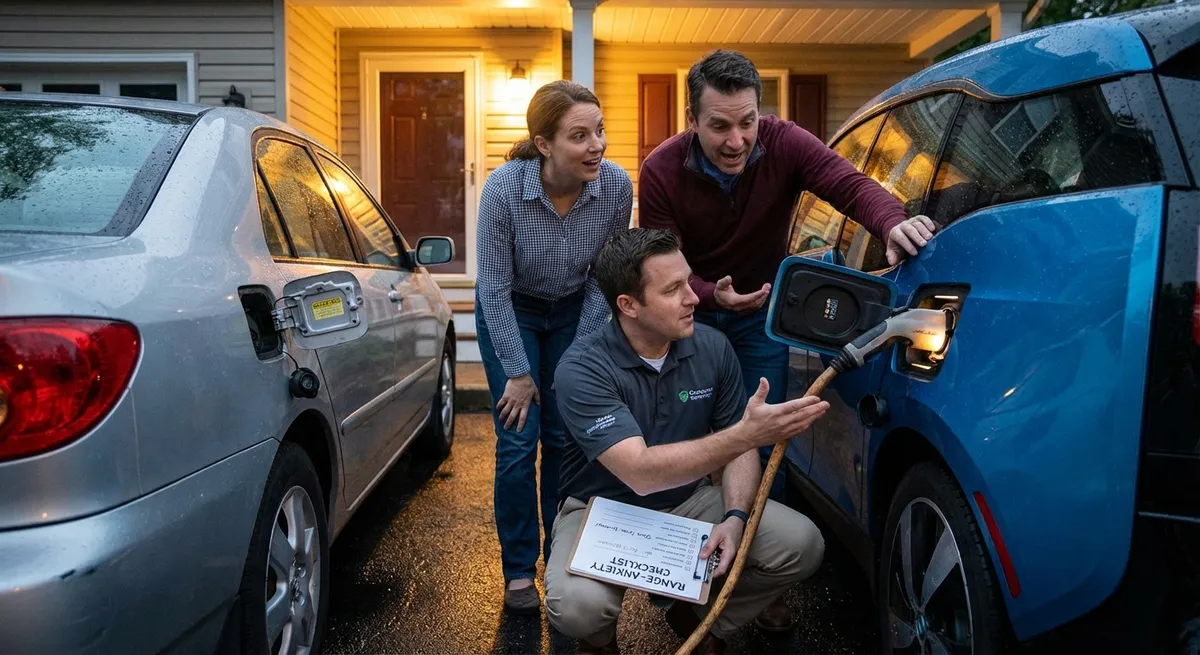
Understand Range the Way You Understand MPG (But Smarter)
On paper, EV range looks simple: a number in miles. In reality, it behaves more like “best-case MPG” than a guaranteed distance.
Start by mapping your real driving, not your imagined worst-case scenario. Use a maps app or your phone’s location history to see your average daily miles for the last month. For most people, it’s under 40–50 miles, which even modest EVs crush without effort.
Then, add these range reality checks:
- Weather penalty: Cold climates can knock real-world range down by 20–40%, especially in winter with cabin heat on high.
- Highway vs. city: EVs often get better “mileage” in city driving due to regenerative braking, and worse at steady high highway speeds.
- Battery buffer: Plan around using 20–80% of the battery for daily use to preserve long-term health and avoid range anxiety.
- Future habits: If you foresee a new job with a longer commute or frequent weekend trips, size your range with that in mind.
The key question isn’t “What’s the max range?” but “What’s the worst day I actually drive, and how does this car handle that with a comfortable buffer?” If your “worst normal day” is 120 miles, something rated for 220–260 miles is a safer, less-stress starting point than chasing the cheapest short-range model.
Match Charging Options to Your Living Situation Before You Buy
The smartest EV shoppers figure out their charging game before signing paperwork. Where you park each night matters more than where you drive.
If you own a home with a driveway or garage:
- Check your electrical panel first. A modern 200-amp panel makes Level 2 (240V) charging easy; older homes may need upgrades.
- Plan for a Level 2 charger. A 7–11 kW home charger typically adds 20–40 miles of range per hour, enough to refill overnight even from low.
- Get quotes before buying. Call a local electrician, send photos of your panel and parking spot, and get a real installation estimate—costs vary widely.
If you rent or live in an apartment:
- Ask about existing EV parking. Some buildings already have shared chargers or dedicated EV spots you can rent.
- Study nearby public chargers. Use apps like PlugShare or the networks’ own apps (e.g., ChargePoint, EVgo, Electrify America) to map real options near home and work.
- Look at charging downtime. Is there a charger you can plug into while you’re at the gym, grocery shopping, or at the office? Those “park anyway” hours are your quiet advantage.
If your charging access is limited or unreliable, prioritize EVs with:
- Larger battery packs (for less frequent charging)
- Faster DC fast-charging speeds (to make public charging stops shorter)
- Strong compatibility with major networks (including adapter options if needed)
Having a solid charging plan turns EV ownership from “range anxiety” into “plug in, wake up full, repeat.”
Compare Total Cost of Ownership, Not Just the Sticker Price
EVs often cost more upfront than comparable gas cars, but focusing only on the purchase price hides their biggest advantage: running costs.
Break it down into a simple yearly comparison:
- Fuel vs. electricity:
- Estimate your annual miles (for many drivers, around 12,000–15,000).
- Compare your current MPG and local gas prices against EV efficiency (kWh/100 miles) and your home electricity rate.
- In many regions, charging at home is like paying the equivalent of $1–$1.50 per gallon.
- Maintenance:
- EVs don’t need oil changes, timing belts, or exhaust work.
- Brake wear is often lower due to regenerative braking.
- Budget instead for tire wear (EV torque can be hard on tires) and routine inspections.
- Incentives and tax credits:
- Federal, state, and sometimes local incentives can significantly reduce the final cost.
- Some utilities offer EV rebates or discounted off-peak charging rates.
- Insurance and depreciation:
- Get real insurance quotes before buying; some EVs cost more to insure due to repair costs or performance.
- Check used values for that model 3–5 years back to get a feel for how it holds value.
When you add fuel, maintenance, and incentives over 3–5 years, many EVs end up cheaper to own than a similarly equipped gas vehicle—especially if you drive more than average or pay high fuel prices.
Test-Drive With an EV-Specific Checklist
A quick loop around the block doesn’t reveal what living with an EV is like. Use your test drive to simulate your actual use, not just see how fast it feels.
During the drive, pay special attention to:
- Regen braking settings: Try multiple levels (if available). Can you comfortably drive with “one-pedal” style, or do you prefer lighter regen?
- Charging information on the display: Is it easy to see charging speed, remaining time, and state of charge? Does the navigation integrate charging stops automatically for long trips?
- Cabin comfort vs. efficiency: Run the climate control like you would on a hot or cold day. Watch how estimated range changes—this is your real-world preview.
- Noise and ride at highway speeds: Some EVs are quiet and composed, others expose road and wind noise once the engine’s gone.
- Controls and tech learning curve: Are key features buried in touchscreens, or are there physical buttons for climate and core driving functions?
After the drive, ask the salesperson specific questions:
- Typical real-world range owners report in your climate
- Included charging cable types and maximum charge rates
- Any software-based feature subscriptions (heated seats, advanced driver assistance systems, etc.) you may need to budget for
A focused EV test drive is less about drama (0–60 times) and more about whether this car feels intuitive and low-stress for your daily routines.
Choose an EV That Fits Your Charging Speed, Not Just Your Lifestyle
Two EVs can have similar range but very different charging experiences. When you rely on fast charging for road trips—or even regular top-ups—charging speed matters almost as much as battery size.
Look at these specs carefully:
- Maximum DC fast-charge rate (kW):
- A car rated at 150 kW or 200+ kW will generally charge significantly faster than one capped at 50–75 kW—if you can access stations that deliver that rate.
- Charging curve, not just peak:
- Some EVs briefly hit a high peak then taper down quickly; others maintain a strong rate for more of the session. Independent tests and owner forums are useful here.
- AC charging capability (onboard charger):
- If you plan to use Level 2 charging often (home or workplace), a stronger onboard charger (e.g., 11 kW vs. 7 kW) shortens charge times on compatible circuits.
Then, match the car to how you’ll actually charge:
- Mostly home charging, few long trips?
- Peak DC speed is less critical; prioritize comfort, price, and range.
- Frequent road trips or apartment living with public charging?
- Fast, consistent DC charging and wide network compatibility become major decision points.
Make “How fast does this car refill miles where I actually charge?” part of your buying criteria, not an afterthought. A car that recharges confidently in the places you live, work, and travel will always feel bigger-range than one with a larger battery but slower, frustrating charging.
Conclusion
Switching to an EV doesn’t have to be a leap into the unknown. When you understand how range really behaves, confirm your charging options upfront, run the numbers on total cost of ownership, test-drive with EV-specific questions, and match the car’s charging performance to your real life, you turn uncertainty into a clear plan.
The right electric car won’t just get you from A to B—it will quietly recharge while you sleep, cut your fuel and maintenance bills, and deliver a smoother, more responsive drive every day. Do the homework once, and you’ll feel the payoff every mile after.
Sources
- U.S. Department of Energy – FuelEconomy.gov: Electric Vehicle Basics - Explains EV efficiency, charging levels, and range fundamentals
- U.S. Department of Energy – Office of Energy Efficiency & Renewable Energy: Charging at Home - Details practical home charging considerations and equipment
- U.S. Department of Energy – Alternative Fuels Data Center: Benefits and Considerations of Electricity as a Vehicle Fuel - Breaks down cost, maintenance, and environmental aspects of EV ownership
- Internal Revenue Service – Clean Vehicle Credits - Official information on U.S. federal tax credits and eligibility for EV buyers
- Consumer Reports – Electric Cars 101: The Answers to All Your EV Questions - Independent testing and real-world insight into range, charging, and ownership costs