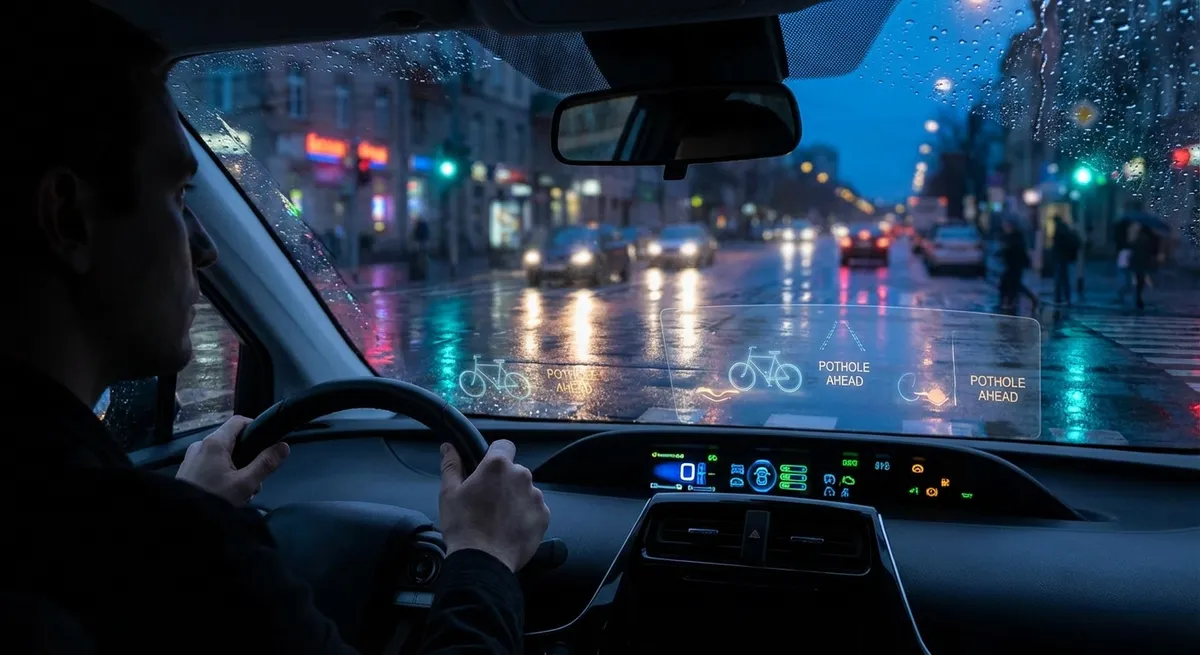
This isn’t about turning you into a mechanic or a data scientist. It’s about using the tech your car already has in simple, practical ways.
Understanding the “Invisible” Network in Your Car
Most vehicles built in the past decade contain a network of sensors sharing information through onboard computers. Even if your car isn’t loaded with options, it likely includes:
- Wheel-speed sensors (for ABS and stability control)
- Tire pressure sensors (TPMS)
- Temperature sensors (engine, outside air, sometimes cabin zones)
- Oxygen and airflow sensors (for fuel/air mix)
- Steering angle and yaw sensors (for stability and lane-keeping)
- Cameras or radar (for adaptive cruise, collision warnings, or lane assist)
This sensor network feeds both the dashboard you see and the systems working in the background, like traction control and automatic emergency braking.
For owners, the key is to stop thinking of warnings and displays as “annoying lights” and start seeing them as real-time feedback. Used correctly, these sensors can help you:
- Improve fuel economy
- Extend tire and brake life
- Catch small issues before they become expensive repairs
- Drive more smoothly and confidently in bad weather
Below are five practical ways to turn this invisible data into everyday advantages.
Actionable Point 1: Use Tire Pressure Data to Tune Ride, Range, and Safety
If your car has TPMS, it’s giving you more than just a “low tire” warning—especially if it shows individual pressures for each wheel.
Practical ways to use it:
- Treat the placard as your baseline. The correct pressures are listed on a sticker inside the driver’s door jamb (not on the tire sidewall). Use this as your reference, not guesswork.
- Check pressures cold, then monitor warming. On a stable day, check pressures before driving. Then watch how they change after 15–20 minutes on the highway. A tire that heats up much more or less than the others might be under-inflated, over-inflated, or dragging due to an alignment or brake issue.
- Watch for slow drifters, not just warnings. If one tire consistently runs 2–4 psi lower than the rest but doesn’t trigger a warning, you may have a tiny leak, a bead issue, or a damaged valve. Addressing it early prevents abnormal wear and unexpected flats.
- Adjust seasonally. Air contracts in the cold and expands in the heat. A 10°F change can shift pressure by about 1 psi. Use your TPMS readings at the first major seasonal change (fall/spring) as a prompt to reset pressures.
- For EVs and hybrids, use it to protect range. Slight under-inflation adds rolling resistance, which hits electric range and fuel economy quickly. Keeping tires at spec or 1–2 psi above (within manufacturer guidance) can yield noticeable range gains over time.
This is low-effort, high-reward tech: a few seconds glancing at tire pressures once a week can improve safety, comfort, and cost.
Actionable Point 2: Turn Engine and Temperature Readouts Into a Real Early-Warning System
Modern cars often hide detailed temperature gauges behind simple icons, but there’s still more information available than many drivers use.
Here’s how to make engine and temperature monitoring useful:
- Know your “normal” before there’s a problem. On a typical commute, notice where the engine temperature gauge stabilizes and how long it takes to get there. That mental baseline lets you spot changes months or years later.
- Don’t ignore the thermostat behavior. If your car suddenly takes much longer to warm up or never reaches normal operating temperature, that can affect fuel economy, cabin heat, and emissions—and it often points to a failing thermostat.
- Pay attention to ambient temperature plus cooling fan noise. If the outside temp is low but your cooling fans are running constantly at high speed after short drives, that’s a hint that the system is working harder than it should—possibly due to a partially clogged radiator, low coolant, or failing sensor.
- Use your infotainment data if available. Some vehicles let you view oil temperature, transmission temperature, or even coolant temp through hidden or “performance” menus. For towing, mountain driving, or track days, these are extremely valuable numbers to watch.
- Respect any “reduced power” or “limp mode” activation. When systems detect abnormal temperatures or sensor readings, the car may limit power to protect itself. Treat this as a strong warning, not an inconvenience. Continuing to push the car hard in this state risks major damage.
Learning your car’s normal temperature behavior takes a few days. The payoff is catching issues like low coolant, clogged radiators, or failing sensors well before they strand you.
Actionable Point 3: Make Driver-Assistance Sensors Work for You, Not Against You
Systems like adaptive cruise control, lane-keeping assist, blind-spot monitoring, and automatic emergency braking rely on cameras, radar, or ultrasonic sensors. Many drivers either over-trust them or turn them off entirely. There’s a smarter middle ground.
How to use these systems practically:
- Start by learning each system’s limits. Check the owner’s manual or the automaker’s website for specifics on speed ranges, weather limits, and conditions that may cause false alerts (sharp curves, snow-covered lines, direct sun).
- Use adaptive cruise to smooth your driving. On highways, adaptive cruise can reduce hard braking and sudden accelerations by maintaining consistent gaps. This can improve comfort and, in many cases, fuel economy.
- Treat lane centering as a coach, not a pilot. Lane-keeping and lane-centering are best used as nudges to improve your own lane discipline. If you feel frequent corrections, that’s feedback about your steering consistency—not an invitation to let go.
- Keep sensor surfaces clean. Camera lenses near the windshield, radar units in the grille, and parking sensors in the bumper all need clear surfaces. Dirt, ice, or bumper stickers can degrade performance or trigger warnings. A quick wipe when you fuel up or charge the car can restore reliability.
- Log repeated false alarms or dropouts. If your car regularly disables lane assist or forward collision warnings in normal weather, that may indicate misaligned sensors, a camera calibration issue, or a software update need. Mention specific patterns to your service advisor; it helps them diagnose faster.
Think of driver-assistance tech as a second set of eyes and a steady right foot—not a replacement for yours. The more you understand its behavior, the more confidently you can use it.
Actionable Point 4: Use Live Fuel and Energy Data to Refine Your Driving Style
Most modern cars show real-time and average fuel economy; EVs show energy consumption in miles/kWh or similar units. Instead of treating these as trivia, you can use them to train better driving habits.
Practical ways to use this data:
- Reset trip data intentionally. At the start of a work week or a long trip, reset a trip computer so you can see how your driving over that period affects fuel use. Compare different routes or techniques.
- Watch how small inputs change the live readout. On a flat road, experiment: gently accelerate, then accelerate more aggressively. You’ll see instant fuel economy plummet with hard throttle, then recover. That’s direct feedback on how you’re using fuel.
- Use coasting and anticipation. Lift off the accelerator earlier when approaching slow traffic or lights and watch how the instant consumption improves. In EVs and hybrids, you’ll often see regeneration indicators showing energy being put back into the battery.
- Compare eco modes with normal modes over identical stretches. Run the same 10–20 mile highway segment in eco and normal modes on different days, under similar conditions. If eco mode significantly reduces fatigue (softer throttle, smoother shifts) and saves fuel, keep it on for routine commutes.
- For EVs, learn your “real” range from live data. Use energy consumption over a few full charges to understand how speed, temperature, and HVAC use affect your actual range versus the dashboard estimate. Planning with your own numbers builds confidence and avoids range anxiety.
Over a few weeks, these small experiments can add up to quieter, smoother drives and noticeable savings at the pump or charger.
Actionable Point 5: Turn Warning Lights and Codes Into Actionable Information
Warning lights and diagnostic codes are the most obvious outputs of your car’s sensor network. Many owners either ignore them too long or panic immediately. A more informed approach is to turn them into structured information you can act on logically.
Here’s how:
- Learn the difference between flashing and solid lights. For most vehicles, a flashing check engine light or severe brake/ABS warning means: stop safely as soon as possible. A solid light often indicates an issue that needs attention soon but may not demand an immediate roadside stop.
- Use a basic OBD-II scanner or Bluetooth dongle. Affordable code readers plug into your car’s diagnostic port and show stored trouble codes and live data. You don’t need to fix the problem yourself, but reading the code before visiting a shop gives you context and helps avoid miscommunication.
- Pair codes with recent behavior. If a code appears after fueling up, hitting a deep pothole, or driving through standing water, note that detail. For example, a loose gas cap can trigger an emissions (EVAP) code. That information can prevent unnecessary parts replacement.
- Take photos of the dashboard and scanner screen. Capture warning lights and codes with timestamps. If the problem is intermittent and disappears before your service appointment, this evidence is extremely valuable for technicians.
- Look for patterns across systems. If traction control, ABS, and stability control lights all appear together, that often points to a shared sensor (like a wheel-speed sensor) or wiring issue rather than three unrelated failures. Mentioning this pattern can focus diagnostics.
You don’t have to become a full DIY troubleshooter to benefit from this. Simply treating your car’s warnings as structured data—rather than random frustrations—can save time, money, and guesswork.
Conclusion
Today’s cars are packed with sensors, but most drivers only interact with a tiny fraction of the information those systems provide. By consciously using tire pressure data, temperature behavior, driver-assistance feedback, fuel and energy readouts, and diagnostic warnings, you turn hidden tech into practical advantages.
You don’t need new gadgets or expensive upgrades. You just need to start noticing the signals your car is already sending—and respond to them with small, consistent habits. Over time, that awareness can mean safer trips, lower operating costs, and a car that quietly serves you better every mile.
Sources
- [National Highway Traffic Safety Administration (NHTSA) – Tire Pressure Monitoring Systems](https://www.nhtsa.gov/equipment/tire-pressure-monitoring-systems) – Overview of TPMS function, safety impact, and regulatory background
- [U.S. Department of Energy – Fuel Economy Guide](https://www.fueleconomy.gov/feg/driveHabits.jsp) – Explains how driving habits and speed affect fuel consumption, with practical tips
- [AAA – Advanced Driver Assistance Systems (ADAS) Overview](https://newsroom.aaa.com/2018/05/aaa-finds-new-vehicle-safety-technology-reduces-crashes/) – Research on how driver-assistance tech reduces crashes and how drivers should use it
- [Carnegie Mellon University – Understanding OBD-II Codes](https://www.cmu.edu/vehicle-communications/obd-ii.html) – Educational overview of OBD-II diagnostics and trouble codes
- [U.S. Environmental Protection Agency (EPA) – Vehicle and Engine Emissions Diagnostics](https://www.epa.gov/vehicle-and-engine-certification/on-board-diagnostics-obd) – Technical background on onboard diagnostics and emissions-related sensors