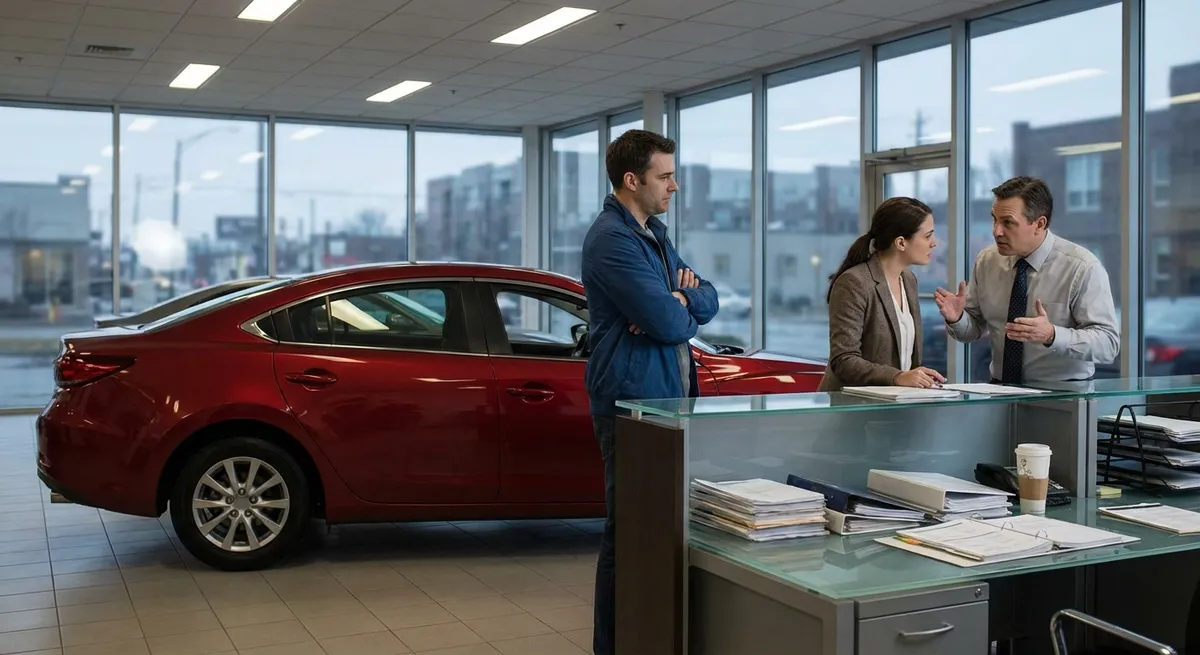
This guide focuses on what many buyers overlook: the environment of the deal. Not just the car, but the people, the paperwork, and the pressure in the room. These five practical checkpoints will help you slow things down, see the full picture, and walk away if anything feels off.
1. Treat the First Conversation Like a Test Drive for the Seller
Before you fall in love with the car, evaluate the person selling it.
Pay attention to how they answer questions, not just what they say. When you ask about accident history, maintenance, or number of previous owners, note whether they give direct, specific answers or vague, deflective ones. Someone who says, “I think it’s fine, never had any issues,” but can’t produce a single record is giving you information—just not the kind you want.
Ask for specifics: service intervals, where maintenance was done, and whether they have invoices or digital records. A reputable dealer or honest private seller usually doesn’t get defensive when you push for clarity; they expect it. If they rush to talk price but dodge questions about history, title status, or repairs, that’s a red flag.
For private sellers, verify that the name on the title or registration matches the person you’re talking to. At a dealer, check that the business name on signage, website, and paperwork are consistent. If you feel like you’re working harder than the seller to understand the car’s story, pause the process.
Actionable move: Go into calls or showroom visits with a short list of non-negotiable questions printed or on your phone and insist on straight answers before you discuss price.
2. Read the Paper Trail Before You Read the Price Tag
Enthusiasts often laser-focus on mileage, trim, and options—but the paperwork tells you whether owning that car will be a headache.
For dealers, ask to see a buyer’s guide/window sticker (in many countries this is required for used vehicles) that shows whether the car is sold “as is” or with a warranty, and what is covered. Read it line by line. An appealing price can mask a car that’s being offloaded as-is with no protection.
For any used car, request:
- A vehicle history report from a reputable provider (Carfax, AutoCheck, or similar in your region).
- Any service records or maintenance logs, ideally with dates and odometer readings.
- Documentation for major repairs like timing belt replacements, transmission work, or airbag recalls.
If documentation is “lost” or “not available,” treat that as missing information, not a small inconvenience. Missing records don’t automatically kill the deal, but they should reduce what you’re willing to pay and increase what you inspect.
Check the VIN on the car (dash, door jamb, engine bay) against every document you’re given. Any mismatch is a full stop until you understand why.
Actionable move: Don’t commit to any deposit or financing discussion until you’ve seen a history report and confirmed the VIN across the car and documents.
3. Watch How the Price Changes When You Show You’re Not in a Hurry
One of your biggest advantages as a buyer: being willing to walk away.
When you show you’re not desperate, you get to observe how the seller behaves when the deal isn’t guaranteed. Tell them clearly: “I’m looking at a few options and not buying today without checking everything.” Then see what happens.
Healthy behaviors from a seller:
- They stay calm and stick to facts about the car.
- They’re willing to let you think it over or sleep on it.
- They can explain their pricing logic (market value, reconditioning cost, demand).
Unhealthy behaviors:
- Suddenly offering a “today only” price with no real justification.
- Claiming “someone else is about to buy it” when the car’s been listed for weeks.
- Pushing add-ons or extras as “mandatory” (alignment packages, paint protection, nitrogen fill, etc.) that appear out of nowhere.
Pressure tactics usually mean you’re closer to their best number than they want to admit—or they know there are issues with the car. A seller who believes in the car doesn’t need to panic when you hesitate.
Actionable move: Build in a 24-hour cooling-off period for yourself before you start shopping. Tell every seller up front that you don’t commit on the spot. That single boundary often filters out the worst actors.
4. Break Down the Out-the-Door Price—Line by Line
The “good deal” you saw in the listing can dissolve at the paperwork desk.
Your focus should be the out-the-door (OTD) price: what you actually pay after all taxes, fees, and add-ons. Ask for an itemized breakdown before you sign or agree to any financing. A good dealer will print or email this without hesitation.
Look specifically for:
- Document fees / admin fees – These vary by region; some are reasonable, some are pure profit. Compare with typical rates in your area.
- Dealer-installed accessories – Window etching, floor mats, paint sealant, wheel locks. Decide which are truly valuable to you.
- Unrequested services – “Protection packages,” “appearance packages,” or “GPS tracking” that were never discussed.
- Financing-related products – Extended warranties, GAP insurance, tire and wheel protection. These can be useful but are negotiable and often overpriced at the dealership.
If you’re paying cash or using your own financing, nothing in the paperwork should change if you decide not to use the dealer’s financing. If it does, ask why—and be ready to walk.
Actionable move: Ask this exact question: “Can you give me the full out-the-door price with every fee, in writing? I don’t want any surprises at signing.” Don’t move forward with test drives or credit checks until you have it.
5. Let a Third Party Be the “Bad Cop” for You
Even experienced enthusiasts miss things when emotions get involved. A neutral second opinion can save you thousands—or save you from a car you shouldn’t buy at all.
For used cars, arrange a pre-purchase inspection (PPI) from an independent, trusted shop that has no connection to the seller. This should include:
- A test drive and visual inspection on a lift.
- Checks for leaks, uneven tire wear, suspension issues, and prior bodywork.
- A scan of onboard diagnostics for stored or pending fault codes.
- An honest assessment of upcoming maintenance costs.
A seller who refuses or heavily resists a third-party inspection is telling you everything you need to know. For new cars, a PPI is less common, but you can still bring a knowledgeable friend or mechanic-minded contact to evaluate panel gaps, paint quality, and build consistency.
Think of the PPI as insurance. Spending a small amount up front can reveal hidden frame damage, imminent major repairs, or flood history that no casual walkaround would show.
Actionable move: Make the PPI part of your buying script: “If everything checks out at my independent inspection, I’m ready to move forward.” You position yourself as serious—but on your terms.
Conclusion
Choosing the right car is only half the battle. The environment in which you buy—the people, paperwork, pressure, and process—can turn a solid car into a bad deal or a fair car into a smart purchase.
By testing the seller’s transparency, demanding a real paper trail, resisting urgency, dissecting the out-the-door price, and bringing in a neutral expert, you shift the advantage back to you. You’re no longer just reacting to what’s in front of you—you’re actively managing the deal.
The car world rewards patience, curiosity, and the willingness to walk away. Use these five checkpoints as your personal playbook, and you’ll be far better positioned to drive home with a car—and a contract—you actually feel good about.
Sources
- [Federal Trade Commission – Buying a Used Car](https://www.consumer.ftc.gov/articles/buying-used-car) – Explains the FTC Used Car Rule, buyer’s guides, and key protections for used-car shoppers
- [Consumer Reports – How to Buy a Used Car](https://www.consumerreports.org/cars/buying-a-car/how-to-buy-a-used-car-a1306945148/) – Practical advice on inspections, vehicle history reports, and negotiating
- [U.S. Bureau of Consumer Financial Protection – Auto Loans](https://www.consumerfinance.gov/consumer-tools/auto-loans/) – Guidance on financing, add-ons, and understanding the full cost of an auto purchase
- [Carfax – What Is a Vehicle History Report?](https://www.carfax.com/vehicle-history-reports/) – Details on what history reports show and how they help you spot potential issues
- [National Highway Traffic Safety Administration – VIN Decoder & Recalls](https://www.nhtsa.gov/recalls) – Official tool for checking VIN information and open safety recalls on vehicles