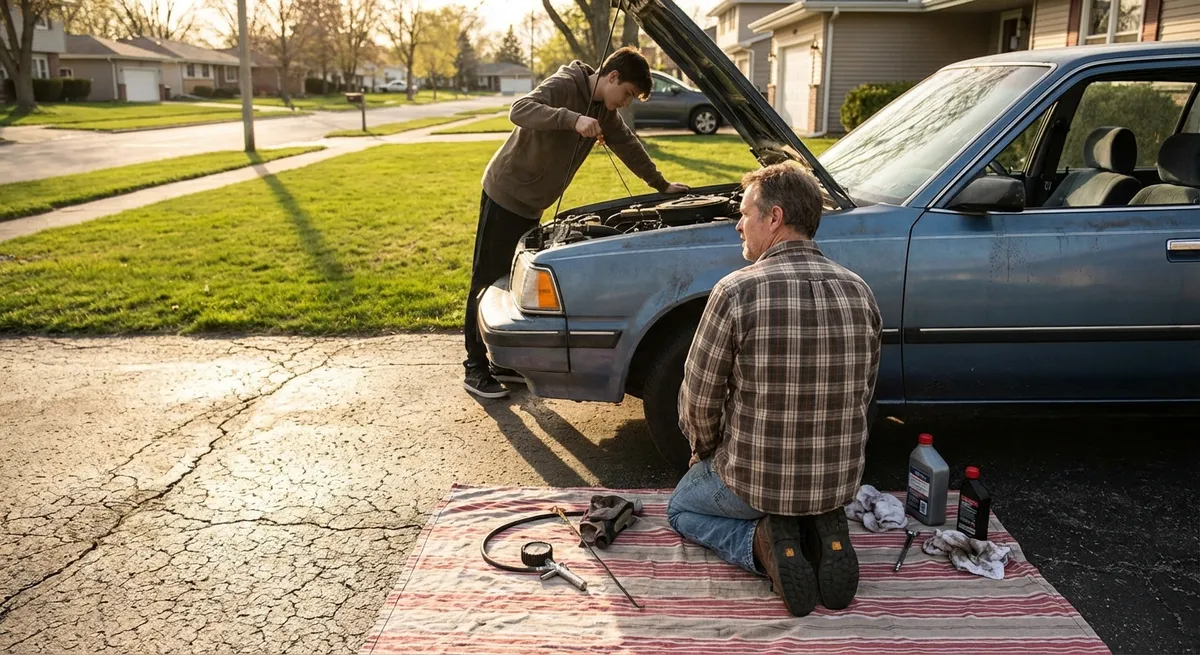
This guide walks through five practical maintenance actions you can fold into your monthly or weekend routine. They’re aimed at owners who care about how their car feels on the road, not just whether it starts.
1. Treat Tire Care as a Performance Upgrade, Not a Chore
Tires are the only part of your car actually touching the road, yet they’re the most ignored “performance part” most owners have. Good tire care doesn’t just prevent flats; it sharpens steering, shortens stopping distances, and improves fuel economy.
Once a month, check tire pressure when the tires are cold (parked for a few hours, out of the sun). Use the pressure listed on the driver’s door jamb, not the number on the tire sidewall. Even a 3–5 psi drop can dull steering response and force the engine to work harder. While you’re there, inspect the tread with a simple tread-depth gauge or a coin: look for uneven wear on inner or outer edges, which can signal bad alignment or worn suspension components. Run your hand lightly across the tread—feathered or cupped patterns often mean a suspension or balance issue that’s starting to show up in your ride quality. Don’t forget the spare if you have one; a flat spare is useless during a roadside emergency. For enthusiasts, this is also a good time to note how the car feels before and after correcting pressures; over time you’ll link specific pressure changes to feel at the wheel.
2. Make Fluid Checks a Fast, Repeatable Routine
Fluids are your car’s lifeblood: engine oil, coolant, brake fluid, transmission fluid (if serviceable), and power steering fluid (if not electric). A quick, repeatable check can catch slow leaks or overheating risks before they become roadside breakdowns.
Start with the engine off and cool. Pull the oil dipstick, wipe, reinsert, and check level between the low and full marks; note whether it looks clean amber or dark and gritty. Dark isn’t always bad if you’re near the end of an oil interval, but gritty or metallic flecks are not a good sign. Inspect coolant level at the expansion tank markings, never by opening a hot radiator cap. Low coolant can lead to overheating, warped heads, and expensive repairs. Look at brake fluid level and color—dark brown or nearly black fluid often means it’s overdue for a flush, which can affect pedal feel and braking performance. If you have a serviceable transmission dipstick, check it according to the manual’s procedure (often with the engine running and warmed up); burnt smell or very dark fluid is a red flag. The key is building a baseline in your head: once you know what “normal” looks like for your car, you can spot changes quickly.
3. Keep the Battery and Electrical System from Quietly Failing You
Modern cars depend heavily on stable voltage. Weak batteries and corroded terminals don’t just make starting harder; they can cause weird intermittent issues with sensors, infotainment, and driver-assistance systems.
Once every month or two, pop the hood and visually inspect the battery. Look for white or blue-green powder around the terminals—that’s corrosion, and it increases resistance, especially under high load (like starting in cold weather). You can clean mild corrosion yourself with a baking soda–water mix and a dedicated battery brush, making sure the ignition is off and you wear eye protection. Gently wiggle the battery cables; they should be snug with no movement at the posts. If you drive mostly short trips or let the car sit for days, consider periodically using a smart trickle charger to keep the battery fully topped off. For enthusiasts with OBD-II scanners or multimeters, a quick voltage measurement (resting and with engine running) can tell you a lot about battery health and alternator output. Document the date stamped on the battery case; once you’re past the 4–5 year mark in many climates, preemptive replacement is often cheaper than a tow.
4. Protect Your Airflow: Engine and Cabin Filters Matter More Than You Think
Air filters directly affect how efficiently your engine burns fuel and how clean the air is inside your car. Dirty filters don’t usually cause dramatic failures, but they steal power and comfort slowly over time.
Check your engine air filter at least twice a year, more often if you drive in dusty or sandy environments. Access is usually simple: unclamp or unscrew the airbox lid and lift the filter out. Hold it up to a strong light; if you can barely see light through the media or it’s clearly packed with dirt, leaves, or bugs, it’s time to replace. A clean filter allows consistent airflow, helping the engine respond more cleanly to throttle inputs. The cabin air filter is often behind the glovebox or under the cowl at the base of the windshield. A clogged cabin filter can make your HVAC system noisy and weak, fog windows more easily, and trap moisture and odor inside the ducts. For drivers who care about focus and comfort on longer trips, fresh cabin filtration with a quality filter (e.g., activated carbon) can reduce fatigue caused by pollutants and pollen.
5. Listen, Look, and Feel: Use Your Senses to Catch Problems Early
You drive your car more than anyone else; that makes you the best early-warning system. Instead of tuning everything out with music or podcasts, occasionally drive a familiar route with the stereo off and your senses tuned to the car itself.
Pay attention to new noises: a rhythmic thump that changes with speed (could be a tire or wheel), a metallic clunk over bumps (often suspension bushings, mounts, or end links), or a squeal during braking (brake wear indicators or glazing). Feel for changes in steering weight or straight-line tracking—if you have to constantly correct the wheel to keep the car straight, something in alignment, tires, or suspension may be off. Watch for subtle vibration in the seat or steering wheel at specific speeds, which can indicate wheel imbalance or tire issues. Also keep an eye on gauges and warning lights: a temperature gauge that runs slightly hotter than usual or a check engine light that appears briefly and disappears are both signals worth scanning with an OBD-II reader or having a shop investigate. The earlier you connect a new sound or sensation to a specific condition (speed, cornering, braking, temperature), the easier and cheaper it usually is to fix.
Conclusion
Maintenance doesn’t have to mean big weekend projects, floor jacks, and specialty tools. A short, consistent ritual around tire checks, fluid inspection, electrical health, filters, and paying attention to how your car feels can dramatically extend its life and keep it driving the way enthusiasts prefer: tight, predictable, and responsive. Think of these habits as small investments that compound over time—preventing major failures, preserving performance, and making every drive feel just a little more dialed-in.
Sources
- [National Highway Traffic Safety Administration – Tire Maintenance](https://www.nhtsa.gov/equipment/tires) - Covers proper tire inflation, tread depth, and safety implications of poor tire care
- [U.S. Department of Energy – Keeping Your Car in Shape](https://www.fueleconomy.gov/feg/maintain.jsp) - Explains how maintenance like fluid checks and tire pressure affects fuel economy and performance
- [AAA – Car Battery Care and Maintenance](https://exchange.aaa.com/automotive/automotive-tips/battery/) - Details best practices for battery inspection, corrosion prevention, and replacement timing
- [Bridgestone – Air and Cabin Filter Basics](https://www.bridgestonetire.com/learn/maintenance/air-filter-vs-cabin-filter/) - Breaks down why engine and cabin filters matter, and when to replace them
- [University of California, Berkeley – Transportation Safety Tips](https://uhs.berkeley.edu/bewellatwork/transportation-safety) - Provides general vehicle safety and inspection advice relevant to monitoring vehicle condition