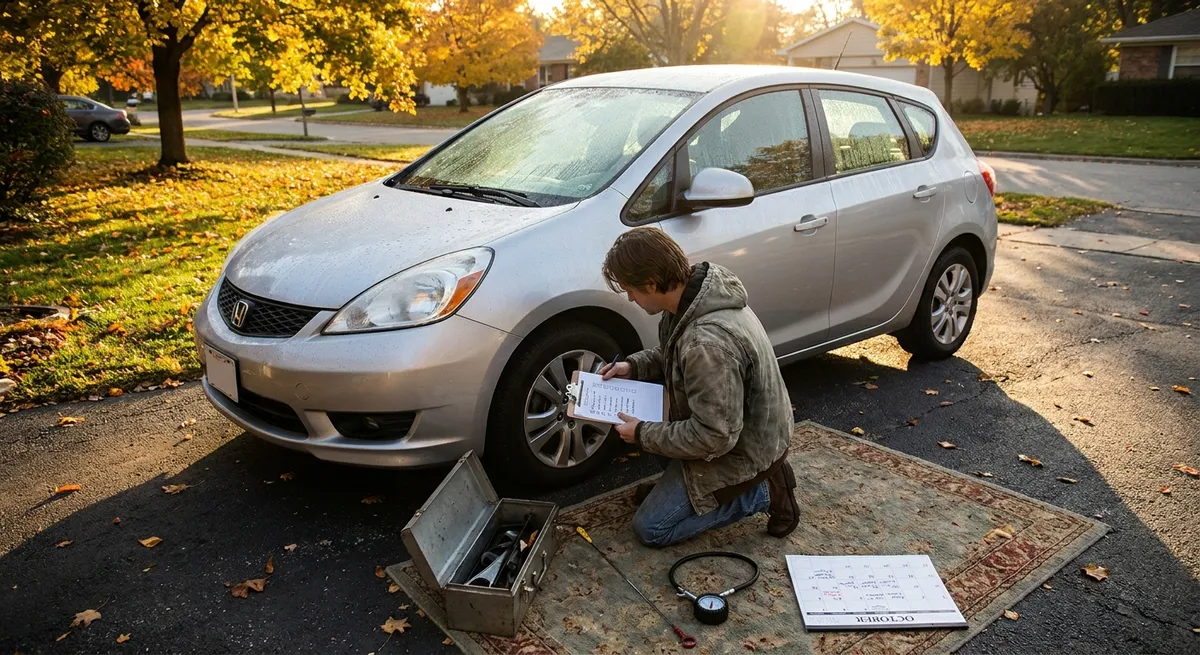
This guide focuses on practical habits and checkups you can actually keep up with—no dealership-level tools required. These five actions fit into real life, and together they create a system that keeps your car ready, not just running.
Build a Simple Monthly Walkaround Routine
A fast, repeatable visual check once a month is one of the highest-value habits you can build. It takes about 10 minutes and can catch problems long before they become failures.
Walk around the car and look for anything that seems off: fluid spots under where you park, misaligned body panels that might indicate something loosened, condensation inside light housings, or uneven tire shine (which can hint at abnormal wear). Check that all exterior lights work—headlights, brake lights, reverse lights, turn signals, and hazards. Many drivers go months with a burned-out bulb without knowing it.
Pop the hood and look at fluid levels you can safely access: engine oil dipstick, coolant reservoir, brake fluid reservoir, windshield washer fluid. You’re not looking to diagnose every problem; you’re simply looking for trends—fluid that’s dropping month over month, hoses that look cracked, or corrosion on battery terminals.
This consistent walkaround rhythm gives you a baseline. When something changes—new noise, new smell, new stain on the driveway—you’ll notice faster and can address it before it becomes a tow-truck situation.
Treat Fluids Like Components, Not Afterthoughts
Fluids are not just “consumables”; they’re active components that protect and enable major systems. Degraded fluid can silently damage critical parts long before a light appears on your dash.
Engine oil is obvious, but not the only one that matters. Brake fluid absorbs moisture over time, which can lower braking performance and corrode metal components. Coolant doesn’t just keep your engine from overheating—it also has corrosion inhibitors that lose effectiveness with age. Transmission and differential fluids ensure proper lubrication under high load and heat, especially important if you tow or drive aggressively.
Use your owner’s manual as the baseline for change intervals, but pay attention to “severe service” recommendations; city driving, short trips, extreme temperatures, and towing often push your car into that category without you realizing it. If your manual lists a range (e.g., every 30,000–60,000 miles), default to the shorter interval if you live in a hot climate, drive in stop-and-go traffic, or regularly carry heavy loads.
Keep a simple log—digital note or small notebook in the glove box—listing what fluid was changed, what type was used, and at what mileage. This makes future diagnosis easier and helps you avoid mixing incompatible fluids or letting intervals stretch too long.
Actionable point: Within the next week, check your owner’s manual for fluid change intervals and create a one-page “fluid schedule” you can reference and update.
Listen and Feel for Changes, Not Just Failures
Modern cars isolate you from a lot of feedback, which is great for comfort but bad for early detection. The key is not to obsess over every noise, but to notice changes in sound, vibration, and feel.
On a familiar route, drive with the radio and climate fan off for a few minutes. Pay attention to:
- Steering feel: Does the wheel feel looser, heavier, or slightly off-center? That can indicate alignment issues, tire problems, or suspension wear.
- Braking response: Is the pedal getting softer, travel increasing, or does the car pull slightly to one side under braking? That can point to brake fluid, pad, or caliper issues.
- Engine behavior: Hesitation on acceleration, uneven idle, or a new ticking or whine can spell ignition, fuel, or belt-driven component trouble.
- Vibration: A new vibration at certain speeds often traces back to tire balance, wheel issues, or drivetrain components.
Make a short note when you notice something new—what speed it happens at, what conditions, whether it’s getting worse. That information is invaluable if you bring the car to a shop, and it helps separate one-off quirks from patterns worth acting on.
Actionable point: Once per month, take a “quiet drive” and mentally rate your car’s steering, braking, and noise levels from 1–10 compared to how it felt when it was at its best. If anything drops more than a couple points, investigate or schedule an inspection.
Protect Your Tires: Your Only Contact Patch With the Road
Tires are where performance, safety, and efficiency all meet. You don’t need to be a tire expert, but you do need a system for keeping them in their optimal zone.
First, get a reliable digital tire pressure gauge and learn your car’s proper pressures from the door jamb label (not the sidewall). Set a reminder to check pressure at least once a month and before long trips, always when tires are “cold” (parked for several hours and not in direct sun). Even small deviations—3–5 psi low—can increase tire wear and fuel consumption and reduce braking performance.
Inspect tread visually. Look for uneven wear: more on the inside or outside edge, cupping (wavy pattern), or feathering (sharp edges in one direction). These patterns often indicate alignment or suspension issues. Use the built-in tread wear bars or a tread depth gauge; when you approach 4/32" (about 3 mm), especially in wet climates, start planning for replacement rather than waiting for the legal minimum.
Rotation matters more than most people realize. Rotating tires according to the schedule in your owner’s manual (often every 5,000–8,000 miles) equalizes wear and helps expose issues earlier, because the same corner of the vehicle won’t be masking a problem.
Actionable point: Buy a tire pressure gauge, check all four tires (and the spare, if equipped) this week, and set a recurring reminder in your calendar for monthly checks plus rotation at your next oil change interval.
Align Maintenance With Your Driving Style and Conditions
Factory schedules are built for an “average” driver under “normal” conditions—something that rarely exists in real life. To get the most out of your car, your maintenance plan should reflect how and where you actually drive.
If most of your trips are short (under 10–15 minutes), your engine often doesn’t reach full operating temperature, which can accelerate oil contamination and moisture buildup in the exhaust and crankcase. In that case, consider shorter oil change intervals and be vigilant about exhaust and emissions-related issues.
Hot climates and dusty environments stress cooling systems, air filters, and rubber components faster. You may want to inspect air filters more frequently and keep an eye on coolant condition and hose integrity. Cold climates and salted roads, on the other hand, make underbody rust prevention more important—periodic undercarriage rinses and inspections become a form of maintenance.
If you frequently tow, carry heavy loads, or drive spiritedly, transmission, differential, and brake maintenance all become more critical. Heat is the enemy in these systems; changing fluids on the early side of the recommended interval and upgrading to higher-performance brake pads or fluid (within manufacturer specs) can be cheap insurance.
Actionable point: Write down three words that summarize your driving reality (e.g., “short trips, city, hot” or “highway, cold, salted roads”) and use that as your lens when deciding whether to follow the minimum or more conservative end of maintenance intervals.
Conclusion
Maintenance doesn’t have to be complicated, but it does need to be intentional. A quick monthly walkaround, treating fluids as critical components, paying attention to changes in noise and feel, actively managing tire health, and tailoring maintenance to your real-world driving all work together as a practical rhythm—not a chore list.
You don’t need a lift, a full toolbox, or a mechanic’s background to keep your car ready. You just need a simple system, a few recurring reminders, and the willingness to act when something small changes instead of waiting for something big to break.
Sources
- NHTSA – Vehicle Maintenance and Safety – U.S. National Highway Traffic Safety Administration guidance on tire care and its impact on safety
- U.S. Department of Energy – Fuel Economy & Maintenance – Explains how proper maintenance affects efficiency, performance, and operating costs
- Car Care Council – Car Care Guide – Consumer-focused maintenance recommendations and service interval explanations
- AAA – Car Care & Maintenance Articles – Practical advice and explanations from a major automotive and roadside assistance organization
- Bridgestone – Tire Maintenance Tips – Detailed overview of tire pressure, tread wear, and rotation best practices