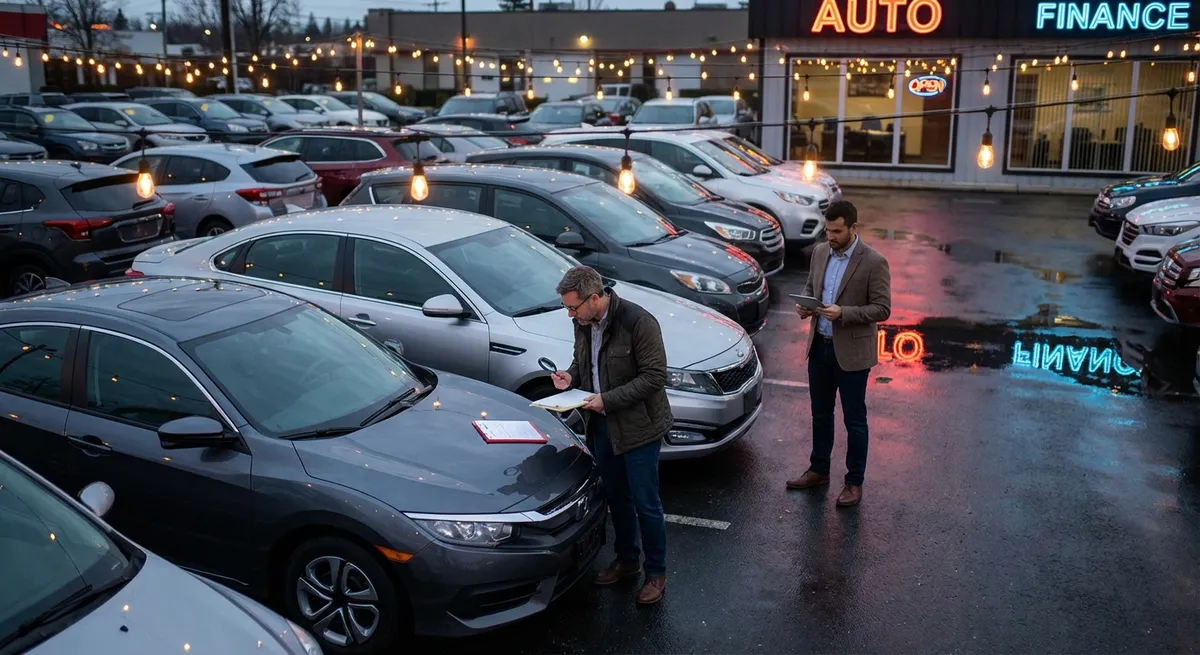
This guide focuses on five practical, actionable steps you can take before and during the buying process so you don’t end up with surprise costs, tech you’ll never use, or a payment that quietly squeezes your budget.
Lock In Your Real Budget (Not Just the Monthly Payment)
Most people walk into a dealership with a “target monthly payment” in mind. Dealers know this and can stretch loan terms or adjust numbers to hit that payment while quietly increasing the total cost. Flip the script by defining your budget in two layers:
- Total out-the-door (OTD) price.
This includes taxes, fees, and any add-ons. Decide the absolute maximum you’re willing to pay, not just the sticker price. Keep this number in writing for yourself.
- All-in monthly cost, not just the loan.
Build a simple monthly estimate:
- Loan or lease payment
- Insurance (get real quotes using VINs or at least model/trim + your ZIP)
- Fuel or charging costs (compare EPA fuel economy or kWh/100 miles to your current car)
- Routine maintenance and tires (performance or large wheels mean pricier replacements)
Actionable move:
Use a free auto loan calculator to check different term lengths (36 vs. 60 vs. 72 months) and interest rates. Decide:
- A maximum term you’re comfortable with (many people cap it at 60 months)
- The max OTD price that keeps your combined monthly car expenses under about 10–15% of your take-home pay
Walk into the dealership treating this OTD limit like a hard line. If the numbers don’t fit, you walk.
Get Preapproved Financing Before You Shop
Preapproval is one of the strongest tools you can bring to the dealership. It gives you:
- A clear interest rate and loan term you know you qualify for
- Serious leverage if the dealer tries to mark up interest
- A quick “reality check” on whether the car you want matches your financial profile
Dealers can sometimes beat your preapproved rate—but you want them competing with it, not setting the baseline.
Actionable move:
- Apply for preapproval with your current bank or credit union and at least one additional lender (online or local).
- Compare:
- APR
- Loan term
- Any hidden fees or prepayment penalties
- Bring printed or digital proof of your preapproval to the dealership.
At the negotiation table, keep the focus on price first, then financing. If the dealer offers a better rate, great—but use your preapproval as the safety net if they can’t.
Investigate the Car’s Real Costs and Weak Spots
Two cars with similar prices can have very different “living with it” costs. Before you commit, dig into the long-term picture rather than just the test drive feel.
For new cars, focus on:
- Reliability history for the brand and specific engine/transmission if it’s a carryover design
- Warranty coverage (powertrain, hybrid/EV battery, corrosion, roadside assistance)
- Expected depreciation – some models lose value faster than others
- Run a vehicle history report (Carfax, AutoCheck) whenever possible
- Check for open recalls using the VIN on NHTSA’s website
- Search common issues by model and year on owner forums and reliability sites
For used cars, go deeper:
Actionable move:
Make a short checklist for your candidate car (new or used):
- Known issues: timing chain, transmission, battery degradation on EVs, rust-prone areas
- Typical repair costs for major failures
- Reliability ratings from at least two independent sources
Take this with you to inspections and test drives to guide what you look and listen for instead of relying solely on “feels good to drive.”
Use the Test Drive to Simulate Your Actual Life
Most shoppers do a quick loop around the block and call it a day. That’s not enough. You want the test drive to answer: “Will this car work for me every day, in my real routine?”
Think in terms of specific use cases:
- Commute: How does it ride at highway speed? Is road and wind noise acceptable?
- Parking: Can you easily maneuver it into tight spots you deal with regularly?
- Family & cargo: Do car seats fit easily? Does the trunk handle strollers, golf bags, or tools?
- Visibility & tech: Are camera views clear? Do blind spots feel manageable? Are controls intuitive, or are you buried in touchscreen menus?
Actionable move:
Before your visit, write down 3–5 real-life scenarios you need the car to handle. During the test drive, intentionally:
- Merge onto a highway to test acceleration and confidence
- Hit at least one rough road or speed bump
- Test parking in a tight space if possible
- Pair your phone to the infotainment (if allowed) and check CarPlay/Android Auto responsiveness
If the dealer pushes for a very short or limited route, request a slightly longer drive that matches your daily use. If they refuse and you’re not comfortable, that’s a data point in itself.
Control the Conversation at the Dealership
Once you’re on the lot, the process is designed to steer you—not the other way around. You’ll see attempts to blend discussions about price, trade-in, financing, and extras into a confusing bundle. Separate them.
Actionable move: Handle the deal in this order:
- Price of the car (before trade, extras, or financing).
- Focus on the out-the-door price, not monthly payment.
- Use quotes from other dealers (even emailed ones) as leverage.
- Trade-in value (if applicable).
- Get instant online estimates (e.g., Kelley Blue Book, Edmunds) before you go.
- Get an offer from a standalone used-car buyer (like CarMax or Carvana) as a floor.
- If the offer is low, say you may sell it yourself and continue negotiating car price separately.
- Financing options.
- Present your preapproval and see if the dealer can beat the rate.
- Watch for extended terms (72–84 months) used to hide a high price.
- Add-ons and extras.
- Extended warranties, paint protection, VIN etching, nitrogen tires, etc. are profit centers.
- Only consider what you’d actually use, and compare third-party prices (for warranties, ceramic coatings, etc.) before saying yes.
Pause before signing; ask for a printed buyer’s order or detailed breakdown. Check line by line for:
If something’s off, calmly say: “This doesn’t match what we discussed. Let’s fix this, or I’ll need to walk and think it over.”
Conclusion
A smooth car purchase isn’t about finding the flashiest deal; it’s about making a series of controlled, informed decisions before and during your time at the dealership. When you:
- Define a realistic total cost and not just a monthly payment
- Walk in with preapproved financing
- Understand the car’s long-term costs and weak spots
- Use the test drive to mirror your real life
- And separate each part of the deal at the table
…you turn a process that usually favors the seller into one that works for you.
The result isn’t just a better car—it’s less financial strain, fewer surprises, and a purchase you still feel good about years down the road.
Sources
- [Consumer Financial Protection Bureau – Auto Loans](https://www.consumerfinance.gov/consumer-tools/auto-loans/) - Clear guidance on auto financing, dealer practices, and how to compare offers
- [Edmunds – How to Buy a New Car](https://www.edmunds.com/car-buying/how-to-buy-a-new-car-in-10-steps.html) - Practical step-by-step breakdown of the car-buying process, including pricing and negotiation
- [Kelley Blue Book – 10 Steps to Buying a Used Car](https://www.kbb.com/car-advice/articles/10-steps-to-buying-a-used-car/) - Detailed advice on inspecting, test-driving, and evaluating used vehicles
- [NHTSA – Vehicle Safety and Recall Information](https://www.nhtsa.gov/recalls) - Official U.S. government site for checking VIN-specific safety recalls and defect investigations
- [IIHS – Vehicle Ratings](https://www.iihs.org/ratings) - Crash test and safety ratings to factor safety performance into your purchase decision