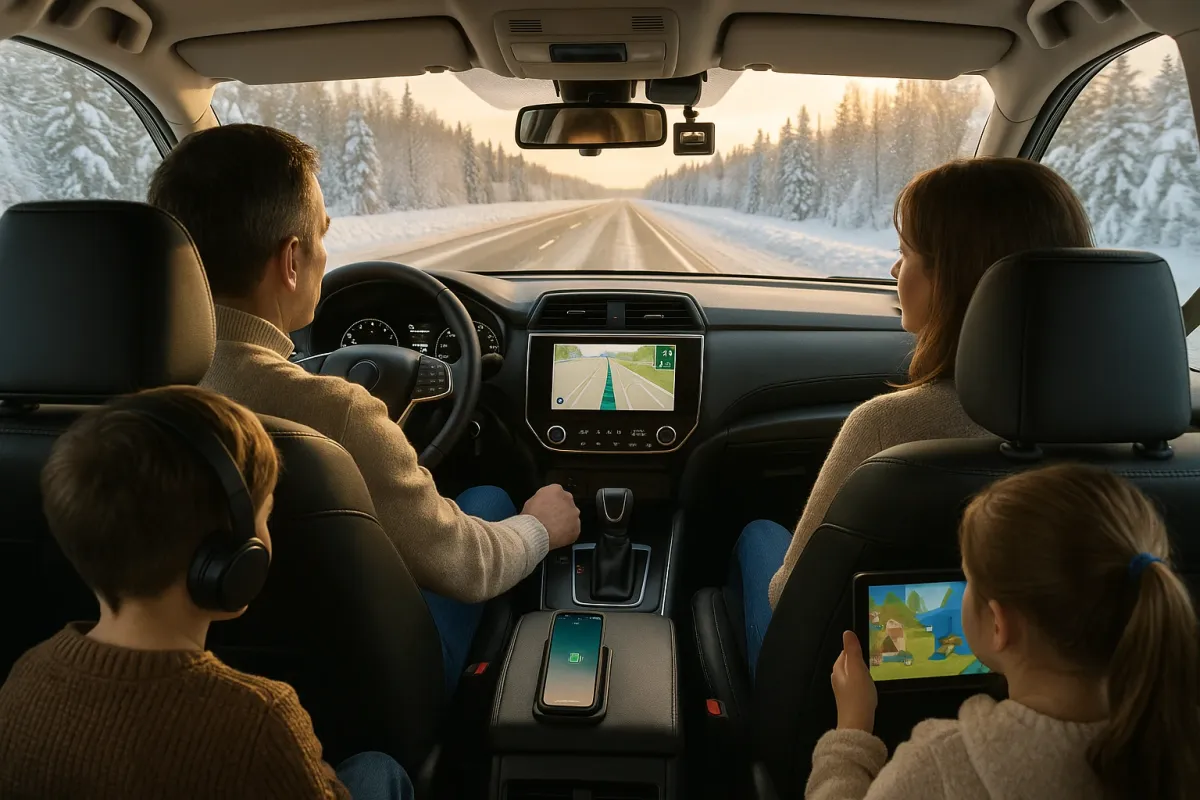
This year, viral packing hacks and travel gadget roundups are everywhere because people are trying to claw back some control from delays, traffic, and gridlock. The same mindset applies to your car. A few targeted, relatively affordable tech upgrades can make your road trip safer, calmer, and a lot less exhausting.
Below are five practical in‑car tech moves that give you real benefits right now—better navigation, safer charging, smarter organization, and less stress when things go wrong.
1. Replace Random “Travel Chargers” With a Proper High‑Output Setup
Those $10 gas‑station USB chargers are the power equivalent of airport food—overpriced and underperforming. With phones running navigation, music, and messaging all at once (and many cars still lacking modern USB‑C ports), underpowered charging is a fast path to dead batteries and frayed nerves.
Look for a reputable multi‑port car charger that supports at least one USB‑C Power Delivery (PD) port rated for 30W or higher, plus one or two USB‑A ports for passengers. Brands like Anker, Belkin, and Baseus consistently test well and publish real output specs. Avoid unbranded or ultra‑cheap chargers; they can overheat, interfere with your car’s electronics, or fail completely on long drives. If your vehicle has a 12V “cigarette lighter” socket only, a compact PD charger is the easiest modern upgrade you can make. Before a big trip, test your charger under real conditions—screen brightness up, maps running, Bluetooth on—and make sure your phone’s battery still climbs. If it doesn’t, upgrade before you hit heavy holiday traffic.
2. Turn Your Phone Into a Safer Dash Command Center
A lot of this year’s viral travel gadget lists push separate GPS units, tablet mounts, or “road trip entertainment screens.” For most drivers, a good phone mount plus smart app choices is far more practical—and safer. A solid, non‑wobbly mount positioned roughly at eye level near the instrument cluster lets you glance at navigation without taking your eyes far off the road. Look for dash or vent mounts from brands like iOttie, Scosche, or ESR that are rated to handle modern heavier phones and cases.
Then clean up your app setup before you leave. Download offline maps in Google Maps or Apple Maps in case you lose signal. Pre‑add your hotel, charging stops (for EVs), and key addresses as “favorites” so you’re not typing while driving. If your car supports Apple CarPlay or Android Auto, use it—it reduces distraction by giving you a simplified interface and better voice control. Turn off non‑essential notifications while driving, or use your phone’s “Focus/Driving” mode. The goal is to make your phone a clear, stable driving tool—not a glowing slot machine in your cupholder.
3. Add a Compact Power Inverter Instead of Lugging Every Gadget
Those “25 travel gadget” lists often assume you’ll bring separate power bricks, specialty chargers, and extra batteries for every device. A better car‑centric approach is a single, well‑chosen power inverter that lets you safely plug in standard household chargers during long drives or during a roadside delay.
Choose a pure sine wave inverter from a known brand (BESTEK, Energizer, etc.) in the 150W–300W range; that’s enough to run a laptop charger, camera battery charger, or small device without overly stressing your car’s electrical system. Avoid running hair dryers, kettles, or anything with a heating element off your 12V socket—they draw huge current and can blow fuses or melt cheap adapters. Mount or store the inverter where it has airflow and can’t be kicked by rear passengers. This setup lets you charge real work gear on the road, power a laptop for remote work from a rest stop, or keep kids’ devices topped off without a tangle of proprietary car chargers.
4. Use “Smart” Storage to Keep Tech Safe and Accessible
A lot of trending travel gadgets are just storage with extra branding—packing cubes, cable rolls, “tech pouches.” In a car, placement matters more than branding. Your goal: nothing heavy becomes a projectile in a hard brake, and you can reach what you need without digging while driving.
Use a dedicated, zippered tech pouch (any sturdy bag works) for cables, power banks, and small devices, and keep it under a seat or in the glove box—not loose on the dash. Pick 2–3 cable types you actually use (USB‑C to C, USB‑A to Lightning/USB‑C adapters) and label or color‑code them so passengers don’t yank the only cable compatible with your phone. For the front row, a slim organizer that hooks onto the passenger seatback or sits in the center console can hold your main charging cable, sunglasses, toll transponder, and parking cards. In SUVs and crossovers, use a simple trunk organizer with one section dedicated to “tech & emergency” gear: flashlights, a jump starter, tire inflator, and spare charging cables. The less you’re hunting for things in the dark at a snowy rest area, the better.
5. Build a Minimalist “Tech Emergency Kit” You’ll Actually Use
Today’s viral holiday travel content talks a lot about “being prepared,” but often veers into survivalist territory. For real‑world car travel, a small, focused tech emergency kit is both more realistic and more likely to be maintained. Start with a compact lithium jump starter from a reputable brand (NOCO, Clore, Antigravity). Modern units are small enough to fit in the glovebox and often include USB ports, giving you a backup phone power source if you’re stranded.
Add a quality LED flashlight with fresh batteries (or a rechargeable one with a USB‑C port), a basic tire pressure gauge, and a 12V portable tire inflator—especially if your car has a tire repair kit instead of a true spare. Store a printed list of key phone numbers (roadside assistance, insurer, family) in the glovebox in case your phone dies or gets damaged. If you drive an EV, add a backup RFID card or app access to your main charging network and keep a list of alternative chargers along your route. None of this is flashy, but when you’re stuck in a cold parking lot with a low battery or soft tire, this kit is worth more than any novelty travel gadget trending on social media.
Conclusion
As holiday travel chaos ramps up and “must‑have gadget” lists flood your feed, it’s easy to throw random tech into your cart and hope it makes the drive less painful. For car owners, the smarter move is to upgrade a few key areas: reliable charging, safer phone integration, flexible power, organized storage, and a lean emergency kit.
These five in‑car tech upgrades don’t just look clever in an Instagram story—they actually change how your drive feels when traffic stalls, weather turns, or your plans shift. Sort them out before you hit the road, and your car will be a calm, capable base of operations in the middle of the holiday storm.